
Fintech and investment platforms
AI in banking: where it pays off and what examiners expect
In banking software, an AI answer without a source is just an opinion with good grammar.
 Umair MajeedCo-founder and CEO, Datics AI8 min read
In brief
AI in banking pays off today in the slow, document-heavy work around decisions: reading onboarding and KYC files, answering servicing questions from policy, sorting fraud and AML alerts for analysts, drafting credit memos, and moving code and data. It pays off far less when a model makes the decision itself. The winning pattern is the same for all five: the AI drafts and cites its sources, a person approves, and every step lands in a record an examiner can read.
On this page
01Where AI pays off in banking software today
The best first uses share three traits. The input is messy text or documents, a skilled person already does the work by hand, and that person can check the output quickly against a source. Here is how the five strongest areas compare.
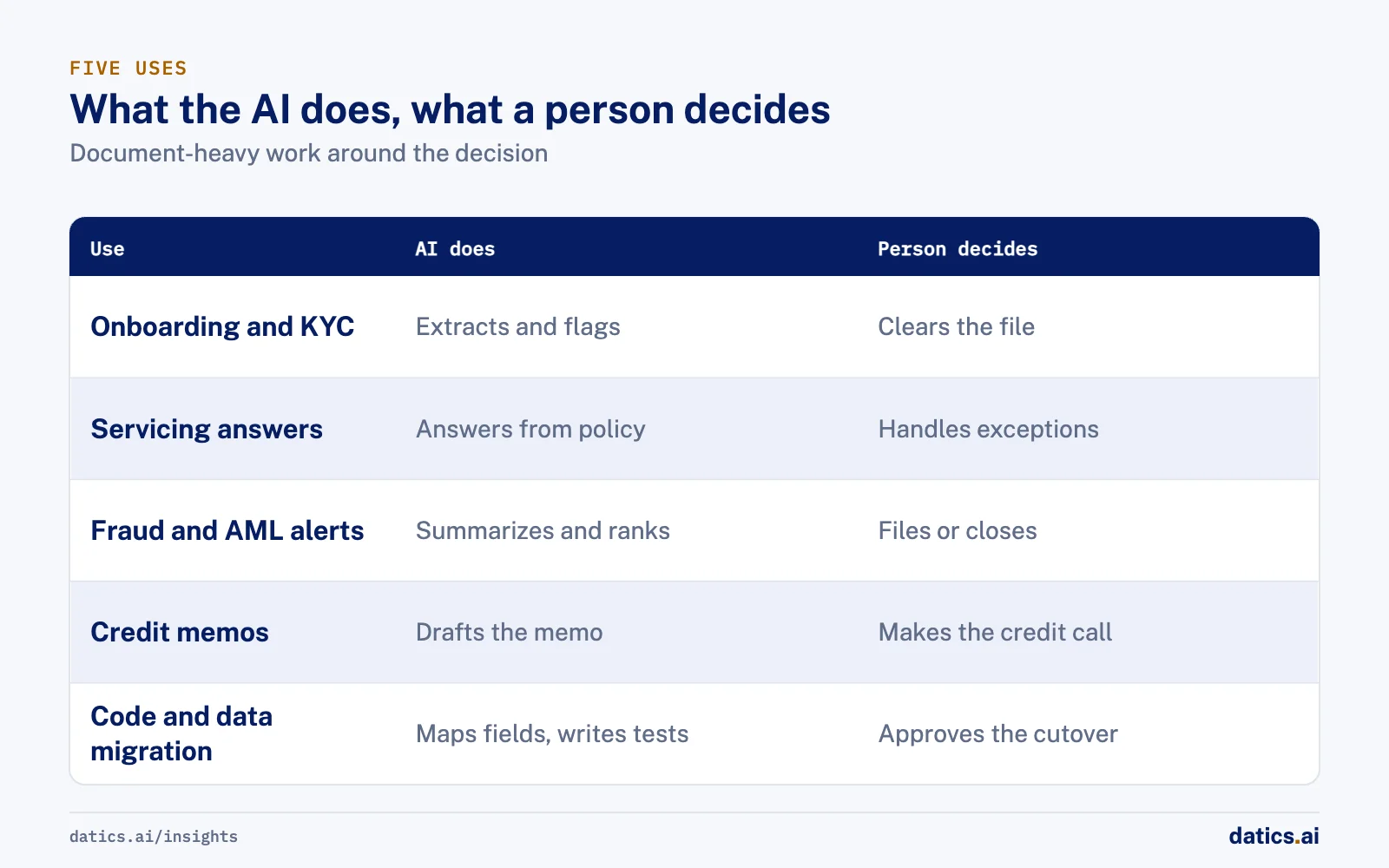
| Use | What the AI does | What a person still does | What to log |
|---|---|---|---|
| Document intake and KYC review | Reads IDs, statements and entity documents, fills fields, flags gaps | Confirms each field and clears the file | Source page for every field, reviewer, decision |
| Servicing and support answers | Answers from the policy, product terms and the account record | Handles exceptions and anything that changes the account | Question, cited policy passage, answer, handoff |
| Fraud and AML alert triage | Summarizes the alert, pulls related activity, suggests a priority | Decides to close, escalate or file | Evidence shown, analyst decision, reason |
| Credit memo and underwriting drafts | Drafts the memo from the file, spreadsheets and bureau data | Owns the credit decision and the reasons | Draft, edits, final memo, approver |
| Code and data migration | Maps old fields and logic to the new system, writes tests | Reviews mappings and signs off cutover | Mapping, test results, reconciliation |
Document intake is usually the fastest return. A loan file or a business onboarding packet can run to dozens of pages, and most of the effort is finding the right value and typing it in. A model that extracts each field and shows the page it came from turns that into a review task. Our guide to AI document extraction covers how to measure field accuracy before anyone relies on it.
Alert triage is the area where we would push hardest on scope. A model that writes a clear summary of an alert, with the transactions and prior cases beside it, saves analysts real time. A model that closes alerts on its own is a different system with a different risk profile, and most institutions are not ready to defend it.
Migration work is less visible but often the biggest prize. Banking software carries decades of rules in old code and old schemas. AI can read that code, propose field mappings and write the reconciliation tests, while engineers check each mapping before cutover.
02What regulators expect from AI in banking
No single U.S. rule covers AI in banking. What applies is a set of existing expectations, and several of them changed recently, so check the current text before you design to any of them.
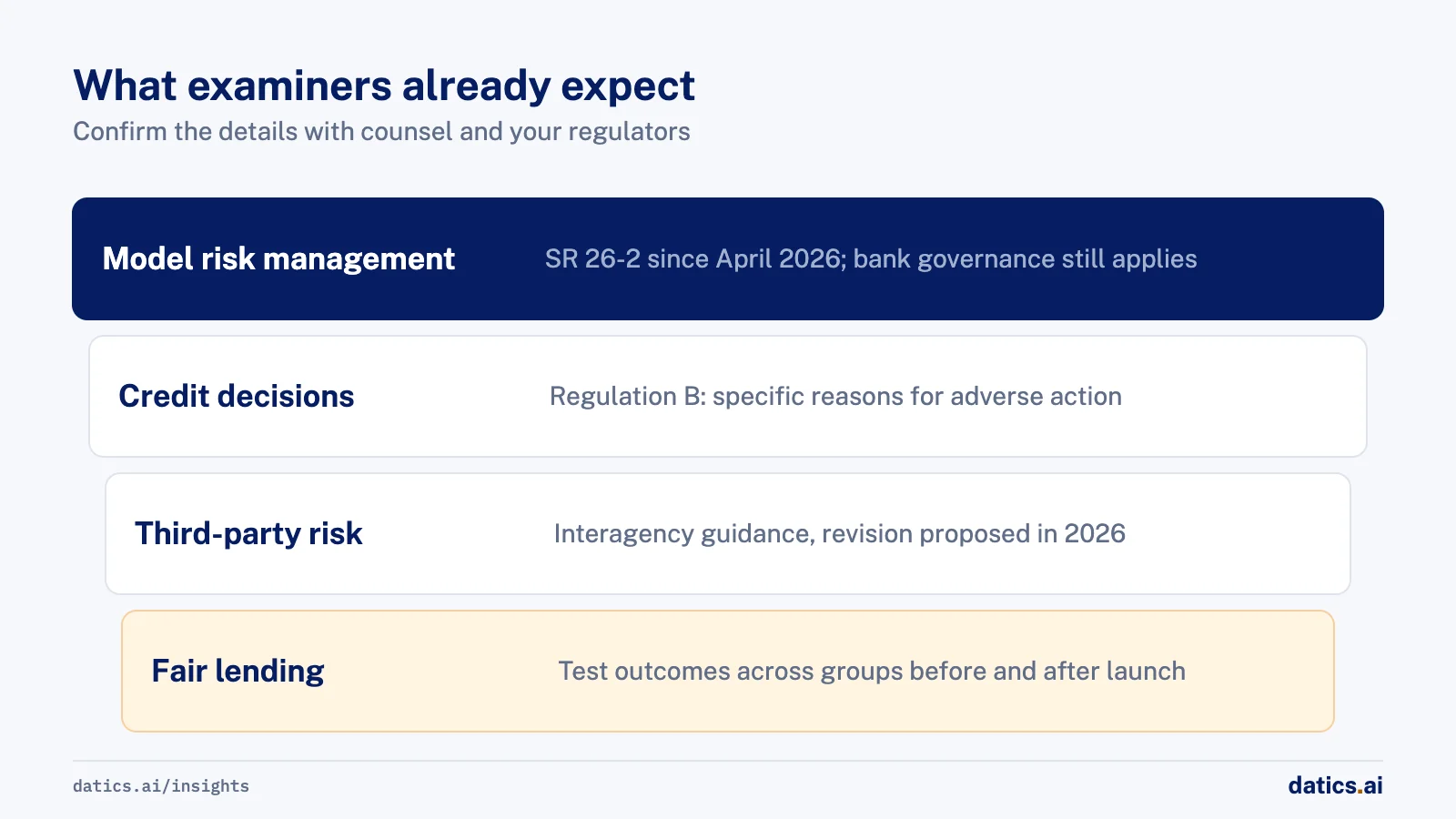
Model risk management. On April 17, 2026, the Federal Reserve, OCC and FDIC issued SR 26-2, revised guidance on model risk management. It supersedes SR 11-7 from 2011 and SR 21-8, the interagency statement on model risk for Bank Secrecy Act and anti-money laundering systems. The guidance says it is expected to be most relevant to banking organizations with over $30 billion in total assets, and that it does not set enforceable standards. Two details matter for builders. First, the guidance text states that generative AI and agentic AI models are not within its scope, while its principles apply to traditional models and to non-generative, non-agentic AI. It adds that a bank's own risk management and governance should guide the controls for anything outside its scope. Second, it says the principles of model risk management still apply to vendor models, and that sound practice includes ongoing monitoring and outcomes analysis to check that vendor models remain accurate and fit for purpose. If you sell a scoring or classification model to banks, expect your customers to ask for evidence that supports that work.
Credit decisions and adverse action notices. Under Regulation B, 12 CFR 1002.9, a creditor must give a statement of specific reasons for adverse action. The official commentary says statements that the applicant failed to achieve a qualifying score on the creditor's scoring system are insufficient. The CFPB had issued circulars applying this to complex algorithms, and those circulars appear on its withdrawn guidance list as withdrawn on May 12, 2025. The regulation itself still requires specific reasons. For product teams, the practical point is simple: if a model influences a credit decision, the software must be able to produce the principal reasons in plain terms, for each applicant.
Third-party risk. The 2023 interagency guidance on third-party relationships says the use of third parties does not diminish or remove a banking organization's responsibilities, and it walks through a life cycle of planning, due diligence, contract negotiation, ongoing monitoring and termination. In September 2026 the agencies and the NCUA proposed guidance to replace it, according to a Skadden summary of the proposal, with a more risk-based approach. Either way, if your product puts a model in front of a bank's customers or staff, you are part of your customer's vendor review, and so is your model provider.
Fair lending and broader risks. Treasury's December 2024 report on AI in financial services found that AI can amplify risks related to data privacy, bias and third-party providers, and recommended that firms review AI use cases for compliance with existing laws before deployment and reassess them periodically. For lending software, that means testing outcomes across groups before launch and again after every model change.
None of this is legal advice. Rules and guidance are moving, so product teams should confirm their reading with counsel and, through their bank customers, with the relevant regulators.
03Build it so an examiner can follow it
An examiner, an auditor or a bank's own model risk team will ask the same question in different words: show me how this answer was produced and who accepted it. Software that can answer that question in minutes is easier to buy and easier to keep. We build to six rules.
- 01
Every answer cites its source.
A servicing answer points to the policy passage. An extracted field points to the page and line. A memo paragraph points to the statement it summarizes. If the AI cannot find a source, it says so instead of guessing.
- 02
People approve decisions.
The AI suggests values, drafts and priorities. A named person applies, edits or rejects them, and the system stores which one. Our article on human-in-the-loop AI covers where to place those checkpoints so they do not slow the work.
- 03
The AI cannot reach what the user cannot reach.
Calls run under the signed-in user's permissions, through the product's APIs, never with open access to the database.
- 04
Everything is logged.
The input, the retrieved sources, the model and prompt version, the output, the reviewer and the final value. Our guide to building an AI audit trail lists the fields we keep.
- 05
Customer data stays where it belongs.
Choose model hosting that meets the bank's data terms, keep personal data out of prompts that do not need it, and document retention. More in our piece on AI data security.
- 06
The model and prompt are versioned.
A change to either is a release, with its own test results, so a bank can see what changed and when.
These rules also make the SR 26-2 scope question easier. Whether or not a bank classes your generative feature as a model, it will want the same evidence: what the system does, how it was tested, who checks it and how problems are caught.
04Evaluate on real cases before and after launch
Demos in banking are almost always built on clean examples. Real files are not clean: scanned statements, handwritten notes, policies that contradict each other, alerts with missing fields. The only test that predicts production is one run on the institution's own past cases, where the right answer is already known.
We start with a set of real cases per use, scored field by field or answer by answer, with the failure types written down: wrong value, missing source, answer from the wrong policy, a confident answer where the right response was to hand off. Then the same set runs after every model, prompt or data change. Outcomes analysis in SR 26-2 compares model outputs to real-world outcomes, and a standing test set of real cases is the plain software version of that idea. Our article on AI model evaluation covers how to build the set and how many cases each use needs.
05What we see in production
We have built this pattern for a live, regulated marketplace for private investment deals that runs on .NET and SQL Server. We delivered AI agents as services that reach the product only through APIs, never the database directly. A deal creation agent reads the issuer's uploaded decks, memos and financials and suggests values page by page, and every suggested value waits for the issuer to apply, edit or reject it. The AI version is stored next to the human version for comparison, a pre-publish gate requires a person to confirm, and the AI cannot publish or approve a deal or a KYC check. Compliance and legal interpretation stayed with the client.
On the investor side of the same kind of marketplace, five read-only agents recommend deals, check the issuer's summary against market analysis, answer questions only from the deal in view and a few named sources, and draft an expression of interest the investor edits before submitting. The AI never executes an investment, and the issuer accepts or rejects every expression of interest.
Not every change in financial software is AI, and the same discipline applies. When Coast Technology needed a new payment gateway and a new cloud account for its live invoicing and payments portal, we moved it while organizations kept invoicing. Card data stays in the gateway's hosted form and the backend receives only a token. We tested the gateway's limits on a demo account first, so the client learned before release that the hosted popup could not show its service fee.
If you build for banks or lenders and want a plan an examiner can follow, our fintech work starts with a two-week Planning Sprint for $5,000: a plan and a fixed quote, and the fee counts toward the build. If the AI is already built, our AI Scorecard tests it on 50 of your own cases over two weeks, also for $5,000.
Frequently asked questions
Does SR 11-7 still apply to AI in banking?
SR 11-7 was superseded on April 17, 2026 by SR 26-2, issued by the Federal Reserve, OCC and FDIC. SR 26-2 says generative and agentic AI models are outside its scope, while its principles apply to traditional models and other AI. Banks are still expected to govern those tools through their own risk management, so confirm with counsel how your customers will classify your feature.
Can a lender use an AI model to make credit decisions?
Regulation B requires a statement of specific reasons for adverse action, and a reference to failing a scoring system is not enough. Any model that influences a credit decision therefore needs to produce clear principal reasons for each applicant, and outcomes should be tested for fair lending. Many lenders use AI to draft memos and gather evidence while people make the decision.
Where should a banking software company start with AI?
Start with document intake or servicing answers grounded in policy. Both have clear sources, a skilled reviewer already in the workflow and results that can be scored on past cases. Leave fully automated decisions until the evaluation, audit trail and approval steps are proven.
How Datics helps
Building Fintech or investment software? See the AI modules we build for private markets, wealth, trading and market data platforms.
›References (7)
- Federal Reserve: SR 26-2, Revised Guidance on Model Risk Management (April 17, 2026)
- Federal Reserve, FDIC, OCC: Supervisory Guidance on Model Risk Management, SR 26-2 attachment
- CFPB: Regulation B, 12 CFR 1002.9, Notifications
- CFPB: Withdrawn guidance
- Federal Register: Interagency Guidance on Third-Party Relationships: Risk Management (June 9, 2023)
- Skadden: U.S. federal banking agencies propose revised third-party risk management guidance (September 2026)
- U.S. Treasury: Treasury releases report on the uses, opportunities and risks of AI in financial services (December 19, 2024)
Related work
Case studies from our projects on the same subject.
Regulated investment platform
Fintech · Private investment marketplace
Pitch decks become drafted deals, and issuers approve each field before publishing
Issuers retyped decks and financials into long deal forms. Now AI suggests each field, and the issuer applies, edits or rejects it.
Coast Technology
Other software · Multi tenant invoicing and payments portal
Organizations kept billing customers while we swapped the payment gateway and cloud account
A live invoicing portal had to change payment gateways and cloud accounts. We did both inside the running portal, and card data never reached the backend.
Related answers
Fintech and investment platforms
AI in fintech: what should it do, and what should it not?
AI in fintech should read documents, cite research and prepare deals and orders, while a person makes every regulated decision on money.
Umair MajeedReadFintech and investment platforms
AI in lending: where it pays off and where people decide
AI in lending pays off in document intake, completeness checks, credit memo drafts and servicing answers. Credit decisions and pricing stay with people.
Umair MajeedReadProperty management and field operations
AI for property management: where it pays off first
AI for property management pays off first in maintenance triage, turnover scheduling and tenant messages. Keep screening, payments and notices with people.
Umair MajeedReadYour customers already expect AI from your product.
Let us make it real inside the product you run today.