
Fintech and investment platforms
AI in lending: where it pays off and where people decide
In lending, let AI do the reading and the first draft, and let the lender own every yes, every no and every price.
 Umair MajeedCo-founder and CEO, Datics AI8 min read
In brief
AI in lending pays off first in the paperwork around a loan: reading borrower documents, pulling income and financial figures into fields, checking that an application is complete, drafting the credit memo and answering servicing questions from the loan's own terms. It should not decide alone on credit or pricing, because those decisions carry adverse action, fair lending and model risk duties. Every AI step should cite its source document, wait for a named person and leave a record.
On this page
01Where AI pays off in lending software
Origination, servicing, commercial and SBA lending and mortgage tech spend most of their human hours on the same things: collecting documents, retyping numbers, chasing what is missing and writing up the file. That work has clear inputs, clear outputs and a person who already checks it, so start there.
Here is how we rank the first candidates.
| Workflow | What the AI does | Who decides | Record to keep |
|---|---|---|---|
| Document intake and extraction | Sorts uploads (tax returns, bank statements, pay stubs, business financial statements) and pulls income, revenue, debts and dates into fields | Processor confirms each field | The value, the page it came from, who confirmed it |
| Application completeness | Compares the file against the checklist for that loan product, lists what is missing or out of date, drafts the request to the borrower | Processor sends the request | Checklist version, items flagged, message sent |
| Credit memo drafting | Drafts the borrower summary, financial narrative, collateral notes and open risks, each sentence tied to a document | Underwriter edits and signs | The draft, the final version and the differences |
| Servicing questions | Answers borrower or staff questions from the note, the payment history and the servicing policy | Staff, for anything the documents do not cover | Question, passages used, answer given |
| Collections outreach | Drafts messages inside templates and timing rules your compliance team owns | Collector reviews and sends | Draft, edits, sender, time sent |
Extraction is usually the first win. A processor who stops retyping a borrower's Schedule C or three years of business financials can spend that time on the file itself, and the platform gets cleaner data downstream. Our guide to AI document extraction covers how to measure field accuracy.
Completeness checks come next. A file often stalls on a missing signature, an expired statement or a schedule that does not tie to the return, not on the credit. Checking every upload against the product checklist, and drafting a plain request to the borrower, cuts that back and forth.
Credit memo drafting saves senior time. Underwriters still write the analysis and make the call, but they start from a draft with a citation on every claim.
Servicing answers and collections drafts work for the same reason: the answer already sits in the loan documents or the policy. Collections messages carry legal and reputational weight, so they stay drafts inside approved templates, and a person sends every one.
02Where AI must not decide alone: credit and pricing
Credit decisions and pricing are where a mistake becomes a legal problem, not a data problem. Regulation B, which implements the Equal Credit Opportunity Act, requires a creditor to notify an applicant of action taken within 30 days after receiving a completed application, and it says the statement of reasons for adverse action must be specific and indicate the principal reasons. The same section says that a statement that the decision was based on internal standards, or that the applicant failed to reach a qualifying score, is insufficient.
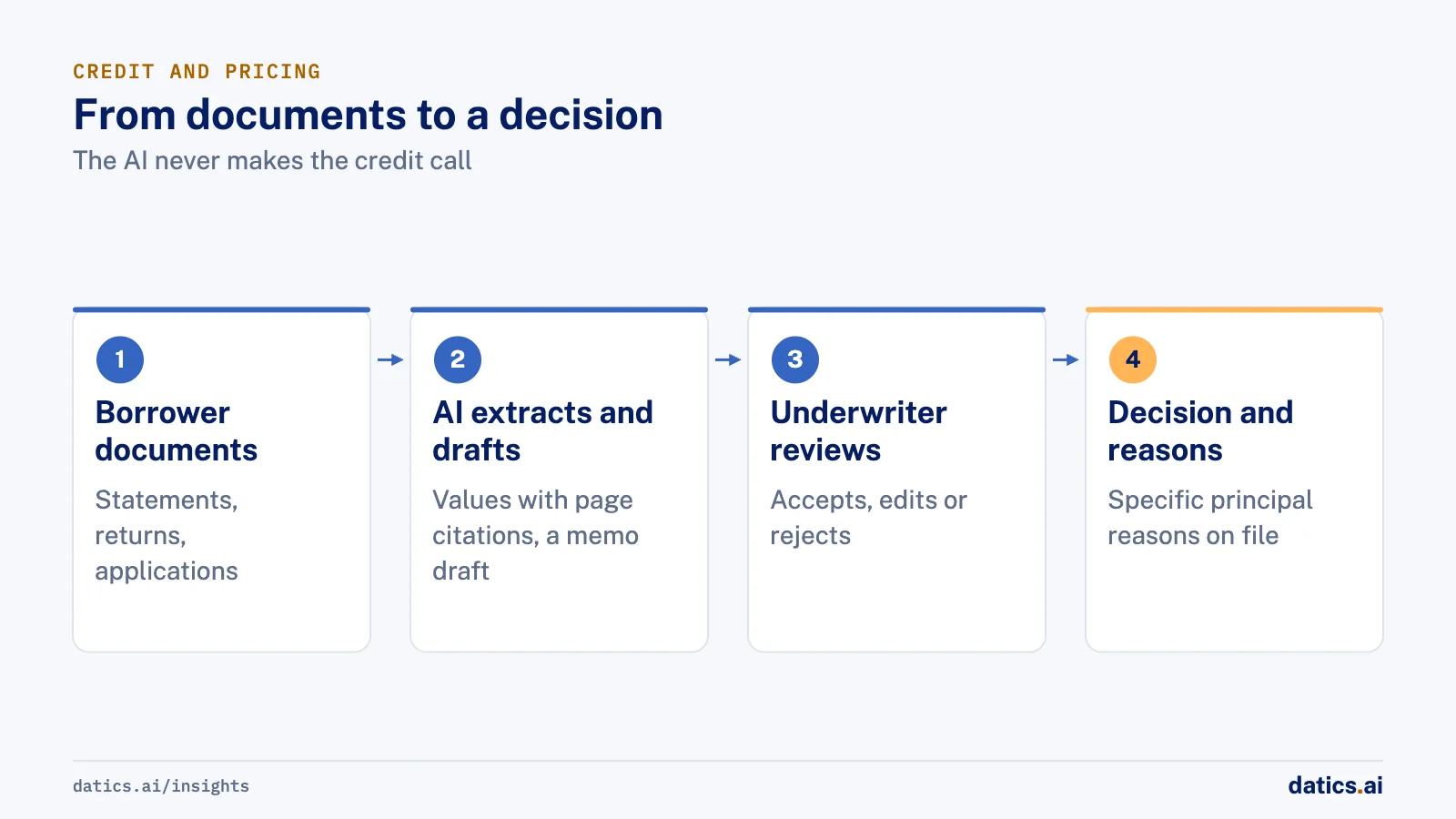
In 2022 the CFPB applied this to complex models directly. Circular 2022-03 said these requirements apply regardless of the technology used, and that a creditor cannot point to the complexity of its algorithm as a reason for failing to give accurate reasons. The CFPB withdrew that circular and Circular 2023-03 on May 12, 2025. The requirement in Regulation B itself did not change.
Our reading: if a language model shapes a decline or a price, you must say which factors drove it, and a fluent paragraph from the model is not a reason. So we keep generative AI out of the decision and use it to prepare the evidence that a person or a validated scoring model decides on.
Fair lending is the second reason. In April 2026 the CFPB finalized amendments to Regulation B on disparate impact and discouragement, effective July 21, 2026. As Venable's summary of the final rule explains, the rule states that ECOA does not provide for disparate impact liability, but it preserves disparate treatment liability, including neutral criteria used as proxies for prohibited characteristics. The same summary notes that the Fair Housing Act still recognizes disparate impact claims, which matters for mortgage and other residential lenders, and that many states allow effects-based claims. For software sold across states and loan types, assume uneven outcomes still need to be found and explained. Confirm how these rules apply to your products with your own counsel and, for regulated lenders, with your regulators.
03What examiners and bank partners will ask about your AI
Lending software usually answers to regulators through its customers: banks, credit unions and lenders who put your product through their model risk and vendor reviews.
Model risk guidance changed this year. On April 17, 2026 the Federal Reserve, OCC and FDIC issued revised model risk management guidance, SR 26-2, which supersedes SR 11-7 and is expected to be most relevant to banking organizations with over $30 billion in total assets. The OCC's version, Bulletin 2026-13, rescinds the old model risk handbook and the 1997 credit scoring model examination guidance, says noncompliance with the guidance will not result in supervisory criticism, and states that generative AI and agentic AI models are not within its scope. The agencies plan a separate request for information on AI.
Out of scope does not mean unexamined. A bank that uses your extraction or memo drafting still governs it under its own risk framework, and it will ask you for the evidence.
Third-party risk is the other door. On September 11, 2026 the OCC, Federal Reserve, FDIC and NCUA proposed guidance to revise and replace the existing third-party risk management guidance, with practices matched to the assessed risk of each relationship. Whatever the final text says, expect lenders to treat an AI feature that touches borrower data as a higher-risk relationship, with questions about which model provider you use, where data is processed and stored, what is retained and who can see it.
04How to build lending AI an examiner can follow
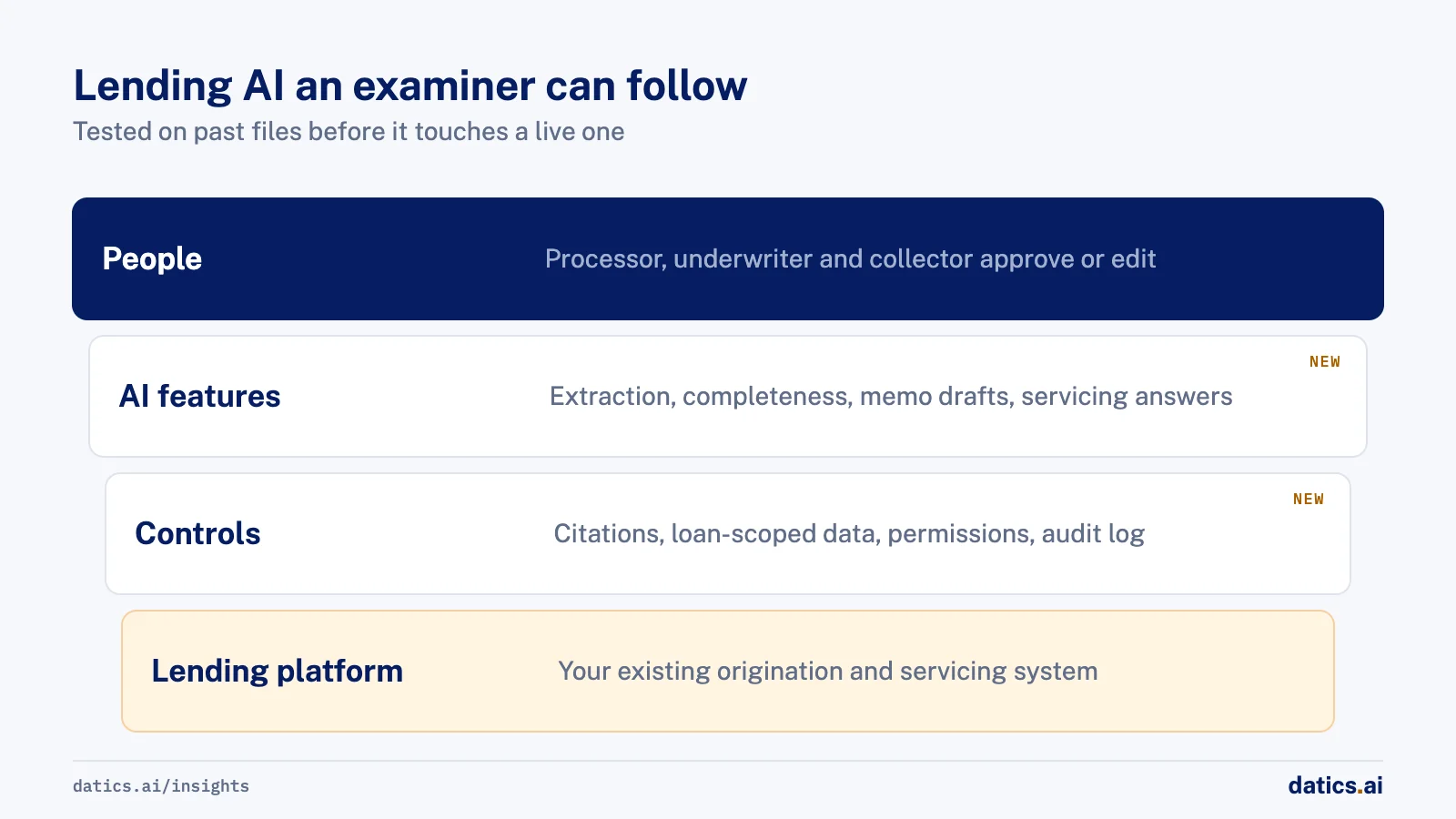
Our test: could someone who was not in the room take one loan file and reconstruct what the AI saw, what it produced, who changed it and who approved it? If yes, the same record answers an examiner, a bank partner and an unhappy borrower.
- 01
Cite the source for every output.
Each extracted value points to its document and page. Each drafted sentence points to its passage. When the documents are silent, the AI says so instead of guessing.
- 02
A named person approves.
The AI suggests, and a processor, underwriter or collector accepts, edits or rejects. Store the AI version next to the human version so you can measure how often people change it. Our piece on human in the loop AI covers where approval steps earn their cost.
- 03
Keep an audit trail.
Log the model and prompt version, the inputs, the output, the reviewer and the time for every step. Our guide to the AI audit trail lists what to capture.
- 04
Keep decision logic out of the language model.
Eligibility rules, pricing grids and credit policy live in code or in a validated model, where they can be tested and explained.
- 05
Scope data to the loan.
The assistant reads only the documents for the file in view and the policies that apply, under the signed-in user's permissions.
- 06
Test on real cases before launch.
Use past files with known right answers: field accuracy for extraction, missed items for completeness checks, factual errors per memo draft. Our article on AI evaluation shows how to build that test set.
- 07
Test for uneven treatment.
Run matched files that differ only in details such as names or neighborhoods, and compare what the AI flags, asks for and writes. Work with your fair lending team on which comparisons fit your products and data.
- 08
Re-run the tests on every change.
A new model version or prompt is a change to the system, and the evidence has to be refreshed before it ships.
05What we see in production
None of this work is a credit decision engine. These are AI features inside regulated fintech platforms built on the same rules: documents in, suggestions out, a person in charge.
On a regulated private investment marketplace running on .NET and SQL Server, a deal creation agent reads up to ten files per upload and suggests a value for each deal field. The issuer applies, edits or rejects every suggestion, and the AI version is stored beside the human version for comparison. A deal publishes only after a person ticks the confirmation, and the AI never publishes or approves a deal or a KYC check. Compliance and legal interpretation stay with the client. Delivered as backend APIs, the agents left the regulated core and its database as they were.
On the investor side of the same kind of platform, the AI is read-only. A deal-scoped assistant answers only from the documents for the deal in view, with nothing retained between sessions, and an AI-drafted expression of interest stays editable until the investor submits it. The AI never executes an investment. That is the pattern we recommend for servicing questions and borrower-facing drafts in lending.
For sensitive records, NenoDoc Lexicon shows how to make cited answers trustworthy. It runs on self-hosted models and OCR with no outside AI service, filters retrieval by the user's permission scope before ranking so restricted passages never shape an answer, and cites every source. Client tests confirmed it declines instead of inventing an answer. The OCR engine was chosen through side-by-side tests on the client's own documents, the same habit we recommend for bank statements and tax returns.
If you are planning AI for a lending product, our fintech work usually starts with a two-week Planning Sprint for $5,000 that ends in a plan and a fixed quote, and the fee counts toward the build. If the AI is already built and you need evidence for a bank partner or examiner, the AI Scorecard tests it on 50 of your own cases over two weeks for $5,000.
Frequently asked questions
Can we use AI to make credit decisions?
Regulation B does not single out any technology, but it requires specific principal reasons for every adverse action, and a lender has to be able to produce them. We recommend keeping generative AI out of the decision itself and using it to prepare the file for an underwriter or a validated scoring model. Any model that does influence a decision belongs in the lender's model risk and fair lending review, and teams should confirm their approach with counsel.
Did the CFPB withdraw its guidance on AI and adverse action notices?
Yes. Circulars 2022-03 and 2023-03 were withdrawn on May 12, 2025. The requirement they discussed sits in Regulation B itself, section 1002.9, which still says the statement of reasons must be specific and indicate the principal reasons for the adverse action.
Does SR 26-2 cover generative AI in lending software?
No. The revised guidance states that generative and agentic AI models are not within its scope, and the agencies plan a separate request for information on AI. Banks still govern these tools through their own risk and vendor reviews, so be ready to show sources, approvals, audit records and test results.
How Datics helps
Building Fintech or investment software? See the AI modules we build for private markets, wealth, trading and market data platforms.
›References (8)
- CFPB: Regulation B, 12 CFR 1002.9, Notifications
- CFPB: Circular 2022-03, Adverse action notification requirements and complex algorithms
- CFPB: Withdrawn guidance
- CFPB: Equal Credit Opportunity Act (Regulation B) final rule, April 2026
- Venable: CFPB Makes Significant Changes to Regulation B
- Federal Reserve: SR 26-2, Revised Guidance on Model Risk Management
- OCC: Bulletin 2026-13, Model Risk Management: Revised Guidance
- OCC: Bulletin 2026-46, Proposed third-party risk management guidance
Related work
Case studies from our projects on the same subject.
Regulated investment platform
Fintech · Private investment marketplace
Pitch decks become drafted deals, and issuers approve each field before publishing
Issuers retyped decks and financials into long deal forms. Now AI suggests each field, and the issuer applies, edits or rejects it.
NenoDoc Lexicon by Neno Technologies
GovTech · Archive knowledge workspace
Archive teams get cited answers in French and English on one client-owned GPU
Sensitive archives could not go to an outside AI. Now teams ask in French or English and get answers cited to the page, all on the client's GPU.
Related answers
Fintech and investment platforms
AI in fintech: what should it do, and what should it not?
AI in fintech should read documents, cite research and prepare deals and orders, while a person makes every regulated decision on money.
Umair MajeedReadProperty management and field operations
AI for property management: where it pays off first
AI for property management pays off first in maintenance triage, turnover scheduling and tenant messages. Keep screening, payments and notices with people.
Umair MajeedReadProperty management and field operations
AI agents for real estate: what to build into your software
AI agents for real estate answer listing questions, book showings and draft follow-ups from live data. Offers, money and legal notices stay with people.
Umair MajeedReadYour customers already expect AI from your product.
Let us make it real inside the product you run today.