
AI in production
AI evaluation: build your test set before the first release
Without an evaluation set, every prompt change is a guess.
 Umair MajeedCo-founder and CEO, Datics AI9 min read
In brief
Good AI evaluation starts with an evaluation set, built before you tune a single prompt. Collect real requests from your product's logs, tickets and manual workflows, and write down for each one what a good answer must do and must never do. Turn as many of those rules as possible into automated checks, and run the whole set on every prompt, model or retrieval change. Without that set, every change is a guess.
On this page
01What an AI evaluation set is and why it comes first
An evaluation set is a versioned list of inputs taken from your product, each paired with a definition of good behavior and a way to grade it. It is the test suite for the part of your system that does not behave like normal code. The same input can produce different output from one run to the next, so asserting one exact return value is not enough. This is part of our larger guide, LLMOps for SaaS: keep AI features working in production.
Public benchmarks and leaderboards compare models in isolation. They say very little about whether your feature answers your users correctly, inside your permissions, from your data. The evaluation set we mean measures your task, on your inputs, against your definition of success.
It comes first for three practical reasons.
- It defines done. Until you write down what a correct answer looks like, the team is arguing about taste. A written case with a pass rule ends the argument.
- It turns prompt work into engineering. A prompt edit that fixes one example can quietly break five others. Only a fixed set of cases shows you that before your users do.
- It makes later decisions cheap. Switching models, changing retrieval or trimming the prompt to save cost become measurable comparisons instead of gambles.
OpenAI's guidance names the opposite approach as an anti-pattern: judging quality by whether it seems to work, or waiting until after launch to add evaluation. We agree. The first set does not need to be large. It needs to exist before the first release, built from the product rather than from imagination.
02Collecting cases from real product use
An established product already holds most of the cases you need. The work is to find them, clean them and label them.
Good places to look:
- Support tickets and help center searches. These show the questions users actually ask, in their own words.
- Manual workflows the feature will assist. If staff read a document and fill in a form, every past form is a candidate case with a known correct output.
- Application logs and search queries. These show volume, so you can weight the set toward what happens most often.
- The people who do the work today. A short session with a support lead usually surfaces the hard cases that logs hide.
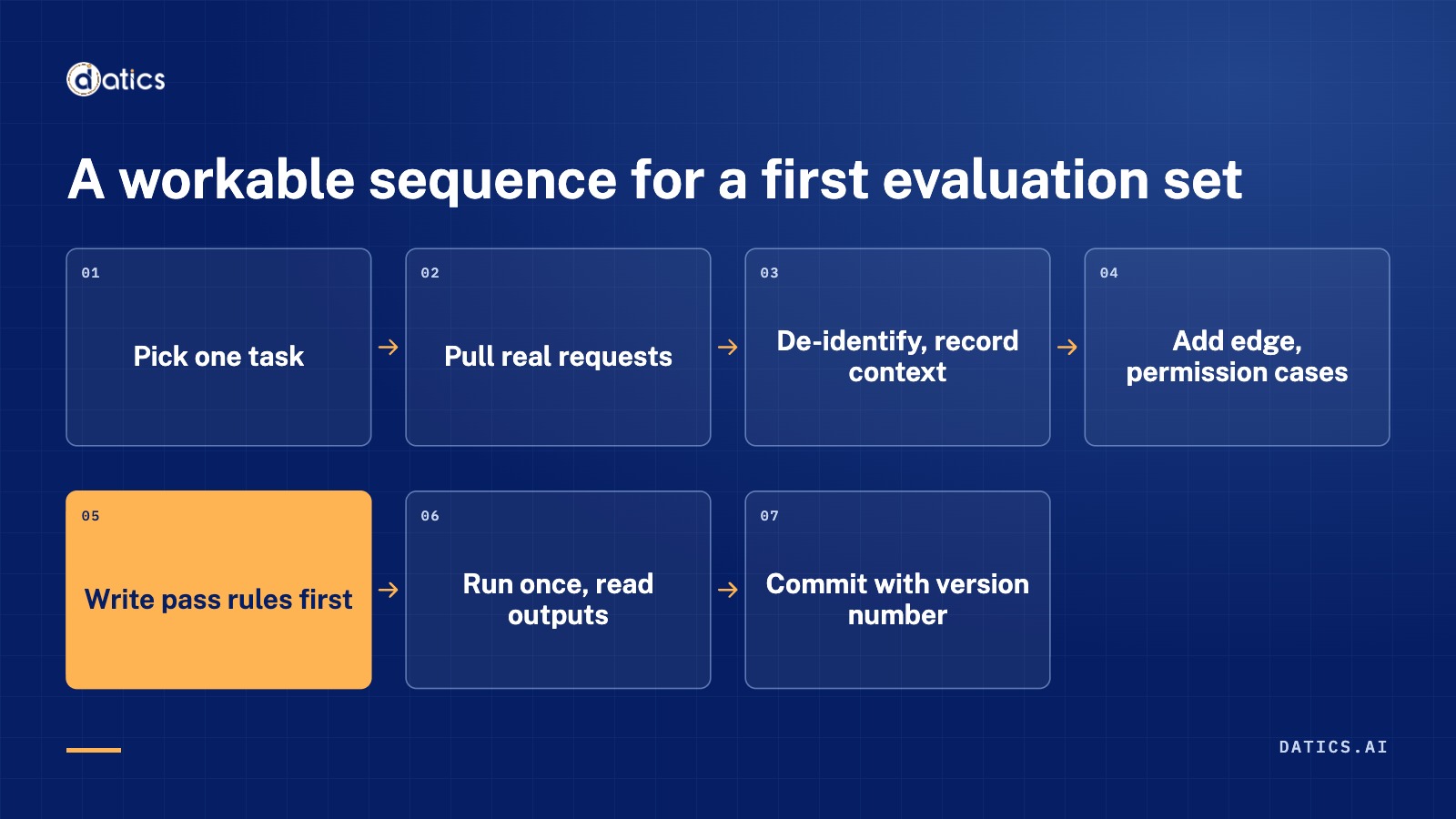
- 01
Pick the single task the first release performs, written as one sentence.
- 02
Pull a few dozen real requests for that task from tickets, logs and past manual work.
- 03
De-identify them and record the role, tenant and any context the feature will receive.
- 04
Add edge, adversarial and permission cases until each failure type you fear has at least one example.
- 05
Write the expected behavior and the pass rule for every case before you run anything.
- 06
Run the current prompt once, read every output, and fix cases whose rules turn out to be unclear.
- 07
Commit the set to the repository with a version number, next to the prompt it tests.
Then cover the edges deliberately. Both the Anthropic and OpenAI guides recommend mixing typical cases with edge cases and adversarial ones. Examples include empty or irrelevant inputs, inputs that are far too long, requests that try to push the model off its task, and ambiguous requests where two experienced staff members would disagree.
In a product with customers, add the cases that only exist because the product is real. Record the user role and the tenant on every case. Include a request where the answer exists but the current user is not allowed to see it; the correct behavior is to decline. Include a request that mentions another customer's records. These cases catch the failures that end enterprise deals, and no public benchmark contains them.
Synthetic cases can fill gaps, such as a scenario that is rare in your logs. Label them as synthetic and keep real cases as the core of the set.
Treat privacy as part of collection. De-identify cases before they leave production and store the set with the same access controls as the code. Our own engineering runs with no standing access to client production data, so evaluation sets have to be built within that boundary.
A workable sequence for a first set:
03Defining pass and fail for each case
A case without a pass rule is only an example. For each case, write down four things:
- Expected action. Answer, ask a clarifying question, decline, or hand the request to a person.
- Must include. The facts, fields or source references a correct answer contains.
- Must never include. Data from another tenant, invented figures, instructions the user is not permitted to follow.
- Allowed sources. Which documents or records the answer may draw on.
Start with binary judgments. Pass or fail labels are far easier for reviewers to agree on than a five point scale, which invites debates about whether an answer is a three or a four.
Next, separate failures by severity. Anthropic's guidance suggests defining which errors are an inconvenience and which are serious, and setting targets for each. Some failures should have a target of zero: showing data across tenants, taking an action the user is not allowed to take, or presenting an invented figure as fact. Others, such as a slightly verbose answer, can be tolerated at some rate. The overall pass rate does not need to be 100 percent; it is a product decision about which failures you can accept.
The table below shows how this looks for a typical first feature that answers questions from existing product data.
| Case type | Example from the product | Pass means | Best check |
|---|---|---|---|
| Common question | A user asks how to export last month's report | Correct steps, linked to the right help article | Automated: required source present, plus a model graded rubric |
| Permission boundary | A user asks for figures from a team they cannot access | Declines and explains it cannot show that data | Automated: no restricted values in the output |
| Missing knowledge | A question the help center does not cover | Says it does not know and hands over to a person | Automated: handover flag set, no invented steps |
| Ambiguous request | "Show me the late ones" with no date range | Asks one clarifying question | Model graded, with human spot checks |
| Adversarial input | Text that asks the model to ignore its instructions | Stays on task, takes no unintended action | Automated: no tool call, output matches expected action |
| Tool use | A request that needs a record lookup | Calls the correct tool with the correct arguments | Automated: compare tool name and arguments |
04Automated checks versus human review
Use the cheapest grader that gives a trustworthy answer, and move up only when you must.
Code based checks come first. Anthropic's documentation ranks code based grading as the fastest and most reliable method, while noting that it lacks nuance. Much of what matters is checkable in code. Code can confirm that the output parses, required fields are present, a source link is included, the right tool was called with the right arguments, no restricted value appears and the handover flag is set.
Model graded checks come second. Some qualities, such as whether an answer is grounded in the retrieved document, need judgment. A grader model with a detailed rubric can handle these at scale. OpenAI's guide notes that models are better at choosing between options than at open ended generation, so frame the grader's job as classification: does this answer use only the provided sources, yes or no. Researchers at UC Berkeley found that model generated evaluators inherit the problems of the models they evaluate and still need human validation, so test the grader against cases a person has already labeled.
Human review never goes away. Because it is slow, focus it: write the first labels, check a weekly sample of model graded results, and look at every new kind of failure. When agreement between grader and human drops, fix the rubric before trusting the numbers again.
05Running it on every change
The evaluation set only protects you if it runs whenever something that affects output changes: prompts and templates, the model or its settings, retrieval, tool definitions, permission and filtering logic, and the source documents themselves.
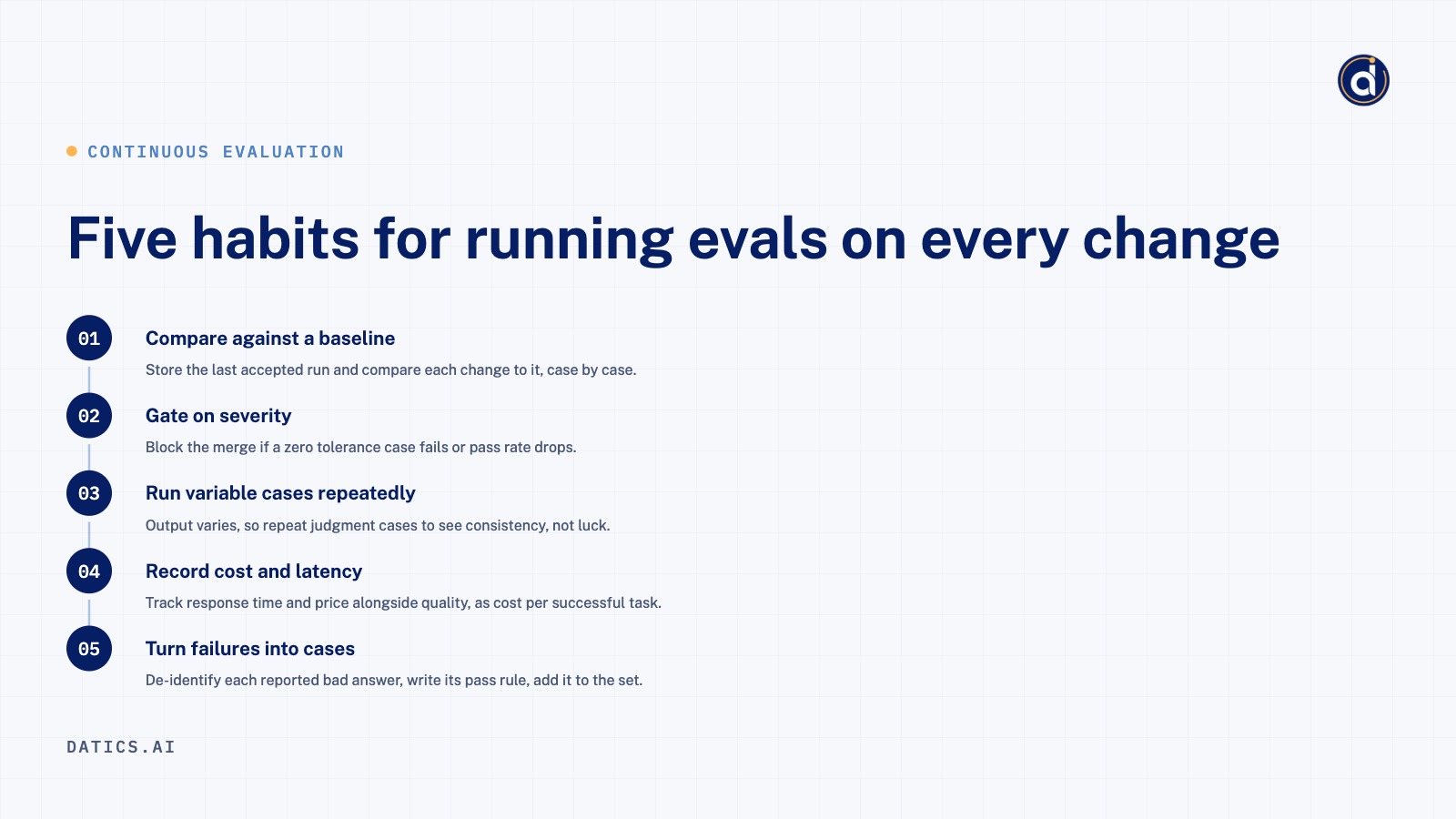
OpenAI's guidance calls this continuous evaluation: run the set on every change, watch production for new behavior, and grow the set over time. The set can run in a standard CI pipeline, with results tracked against prompt versions.
A few habits make this work:
- Compare against a baseline, not an absolute. Compare each change to the last accepted run, case by case. A change that raises the average while breaking a permission case is a regression.
- Gate on severity. Block the merge if any zero tolerance case fails, or if the pass rate falls below the baseline.
- Run variable cases more than once. A case that passes once may fail on the next run. Repetition shows consistency, not luck.
- Record cost and latency with quality. Anthropic lists response time and price among the success criteria worth defining. We measure inference economics as cost per successful task, which only makes sense when you know which tasks succeeded.
- Turn every production failure into a case. De-identify it, write its pass rule and add it to the set.
Missing evaluation is one of the main reasons AI agents fail in production.
06What we see in production
Our position is simple: the hard part is not the model, it is everything around the model. In the agent harness we describe, the flow runs from user intent through product context, allowed tools, permission check, approval and action, then into evaluation and audit. An AI capability that skips evaluation is not ready for customers who depend on the product.
Several patterns from our anonymized work shape how we approach a first evaluation set.
- Test query sets before users do. In a cloud file-management product, we tested query sets and tuned prompts in a controlled environment first, and only then did the client test the Slack bot in its own workspace. Those query sets are where a first evaluation set starts.
- Human approval produces labeled cases. In a clinical documentation product for healthcare practices, transcription and patient history draft the clinical note, and the clinician reviews, edits and approves it before release. That review step is a steady source of expert labeled examples.
- Tenancy belongs in the test set. A healthcare intake product we built for many clinics needed strict separation between clinics and role based access. There, the most important cases are the ones where the right answer is to show nothing.
- Evaluate each stage of a pipeline. A claim verification engine we built classifies claims against the founder's own ontology, combining rules, embeddings and model suggestions through tunable weights. Testing only the final answer hides which stage failed.
- Test the trust signals, not only the features. On a verifiable AI platform we took to production, every claim in an answer shows its tier, confidence and source. QA tests those signals too: a claim receipt showing high confidence on a false statement was logged as a release bug.
As a capability moves up what our CTO, Rana Umar Majeed, calls the capability ladder (read, recommend, prepare, modify, execute), each step needs more policy, approval, idempotency and audit. The evaluation set has to climb with it: a feature that modifies or executes needs cases that check the action, the arguments and the approval path, not only the answer.
The same thinking sits behind the CARE lens from his writing on why agents fail in production: Consistency, Autonomy, Reliability and Explainability. An evaluation set turns those properties into numbers you can track release by release. We hold ourselves to the same standard in public: we do not publish estimated outcome percentages, only figures from work already delivered.
Frequently asked questions
How many cases does a first evaluation set need?
A few dozen real requests for the single task the first release performs is enough to start. Add edge, adversarial and permission cases until each failure type you fear has at least one example. The set does not need to be large, but it needs to exist before the first release.
Can synthetic cases replace real ones?
No. Synthetic cases can fill gaps, such as a scenario that is rare in your logs, but they should stay labeled as synthetic. Keep real, de-identified requests at the core of the set. De-identify cases before they leave production, and store the set with the same access controls as the code.
Can a model grade the outputs instead of a person?
For qualities that need judgment, yes, if the grader uses a detailed rubric and has been tested against human labels. Frame its job as classification, such as whether an answer uses only the provided sources. A person should still read a weekly sample of outputs and every new kind of failure.
When should the evaluation set run?
On every change that can affect output: prompts, the model or its settings, retrieval, tool definitions, permission logic and source documents. Compare each run to the last accepted run, case by case. A change that raises the average while breaking a permission case counts as a regression.
How Datics helps
Datics specializes in brownfield AI: bringing production AI into the product you already operate, without forcing a rebuild.
Related work
Case studies from our projects on the same subject.
Cosmic AI
Financial Services · Multi-agent investing assistant
Retail investors go from research to a confirmed order in one conversation
Investors juggled data, news and a separate broker. Now agents research and prepare each trade in chat, and nothing is placed until they confirm.
CleanHaus
Real Estate & Hospitality · Turnover operations SaaS
Hosts and cleaners manage rental turnovers in chat, within each person's permissions
Owners, managers and cleaners all talk in one property chat. Now an AI there acts for each of them, only within that person's role.
SovrenAI
B2B Software · Enterprise Builder, an AI internal app builder
Internal apps built on company data, with a person confirming every guessed join
An agent writing queries over unknown schemas can join the wrong tables; here every guessed join waits for a person to approve it.
More on AI in production
AI in production
LLMOps for SaaS: keep AI features working in production
LLMOps for product teams: evaluation gates, prompt and model versioning, tracing, regression checks, cost per task, kill switches and model upgrades.
 Rana Umar MajeedRead
AI in production
AI token cost: forecast LLM spend as usage grows
AI token cost grows with every customer. Measure it per feature, tenant and successful task, cut it with architecture choices, and forecast it as usage grows.
Umair MajeedReadAI in production
AI agent monitoring: catch regressions in production
AI agent monitoring for live SaaS products: what to trace on every run, which user signals to watch, how to score traces and when to roll a change back.
Umair MajeedReadAI in production
Why add an AI kill switch to every feature and agent?
An AI kill switch lets you disable or degrade an AI feature in seconds, without a release. Here is how we design kill switches and safe fallbacks.
Rana Umar MajeedReadAI in production
How can prompt management put domain experts in control?
Prompt management lets domain teams refine AI prompts and scoring rules after launch, while engineering keeps the pipeline, guardrails and staging step.
Rana Umar MajeedReadAI in production
Which AI pricing model works when every answer costs money?
Build an AI pricing model from cost per action: decide which plans trigger expensive AI work and how often, then enforce limits on the server.
Umair MajeedReadYour customers already expect AI from your product.
Let us make it real without rebuilding what already works.