
AI in production
AI model evaluation: how do you choose an LLM to build on?
If you cannot rerun your model decision next quarter with one command, you did not make a decision. You made a guess.
 Rana Umar MajeedCo-founder and CTO, Datics AI6 min read
Short answer
Choose the scorecard before you choose the model. Good AI model evaluation starts by writing down the task, the metrics that define success, and a test set drawn from your own data, then running every candidate model through the same test. That turns model selection into an experiment anyone on your team can rerun when the data changes, the vendor ships a new version, or costs move.
On this page
01Why model choice goes wrong in established products
Most teams pick a model the way they pick a laptop: reputation, a few demos, a benchmark chart. Then they build on it for months. When something breaks in production, nobody can say whether the model was the right choice, because nobody wrote down what right meant.
In an established SaaS product the stakes are higher. The model will sit inside workflows your customers already rely on. Its mistakes show up as wrong numbers in a report, a misrouted request or a confident answer to a question it should have declined. Public benchmarks measure general ability. They say little about your data, your users or your edge cases.
So we treat model choice as the first output of the evaluation, not the input to it.
02AI model evaluation starts with the scorecard
The scorecard is a short document that says what the AI must do and how you will measure it. We write it before any model is chosen, and we keep it in the repository next to the code.
- 01
Name the task precisely.
"Classify sentiment" is not a task. "Classify each public comment as positive, negative or neutral, flag sarcasm and toxicity, and do it in the languages our customers use" is a task.
- 02
Pick metrics that match the cost of errors.
For classification, precision tells you how often a positive label is right; recall tells you how many real positives you caught; F1 balances the two; ROC-AUC tells you how well the model ranks cases across thresholds. Choose which one matters most for your product and say why.
- 03
Build a test set from your own data.
Use real examples, labeled by people who know the domain, including the hard cases: slang, mixed languages, sarcasm, empty fields, long documents.
- 04
Set a pass threshold before you run anything.
Otherwise the threshold drifts toward whatever the favorite model scored.
- 05
Add cost and latency to the scorecard.
A model that wins by a point but costs several times more per task may be the wrong choice.
- 06
Write the retraining or re-evaluation plan.
Say when you will rerun the scorecard: on every model upgrade, on every prompt change, and on a schedule as data shifts.
This matches what model vendors themselves recommend. OpenAI's evaluation guidance describes the same loop: define the objective, collect a dataset, define measurable metrics, run and compare, and keep evaluating on every change.
03Match the evaluation method to the task
Not every task has a clean label. The right grader depends on what the model produces.
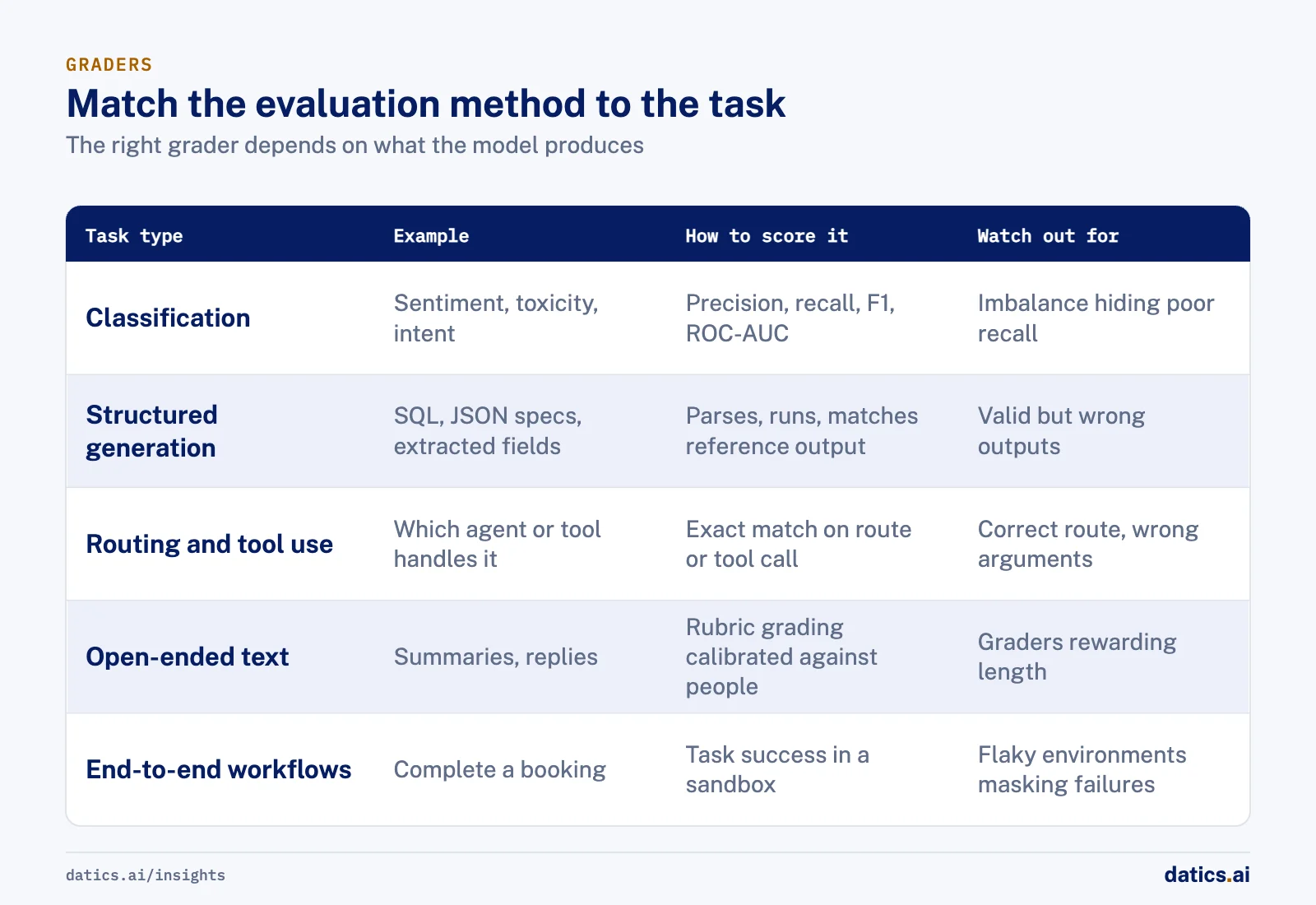
| Task type | Example | How to score it | Watch out for |
|---|---|---|---|
| Classification | Sentiment, toxicity, intent | Precision, recall, F1, ROC-AUC against labeled data | Class imbalance hiding poor recall on rare labels |
| Structured generation | SQL, JSON specs, extracted fields | Code-based checks: does it parse, does it run, does it match reference output | Outputs that are valid but wrong |
| Routing and tool use | Which agent or tool handles a request | Exact match on the chosen route or tool call | Correct route, wrong arguments |
| Open-ended text | Summaries, replies, explanations | Model-based rubric grading, calibrated against human review | Graders that reward length or confidence |
| End-to-end workflows | Build an app, complete a booking | Task success rate in a sandbox with real tools | Flaky environments masking real failures |
Anthropic's engineering guidance on agent evaluation draws the same lines: code-based graders are fast and reproducible, model-based graders handle nuance but need calibration, and human review is the gold standard used to keep the others honest.
04Hybrid choices are usually the answer
When teams run a real scorecard, the result is rarely "one model for everything." More often it looks like this:
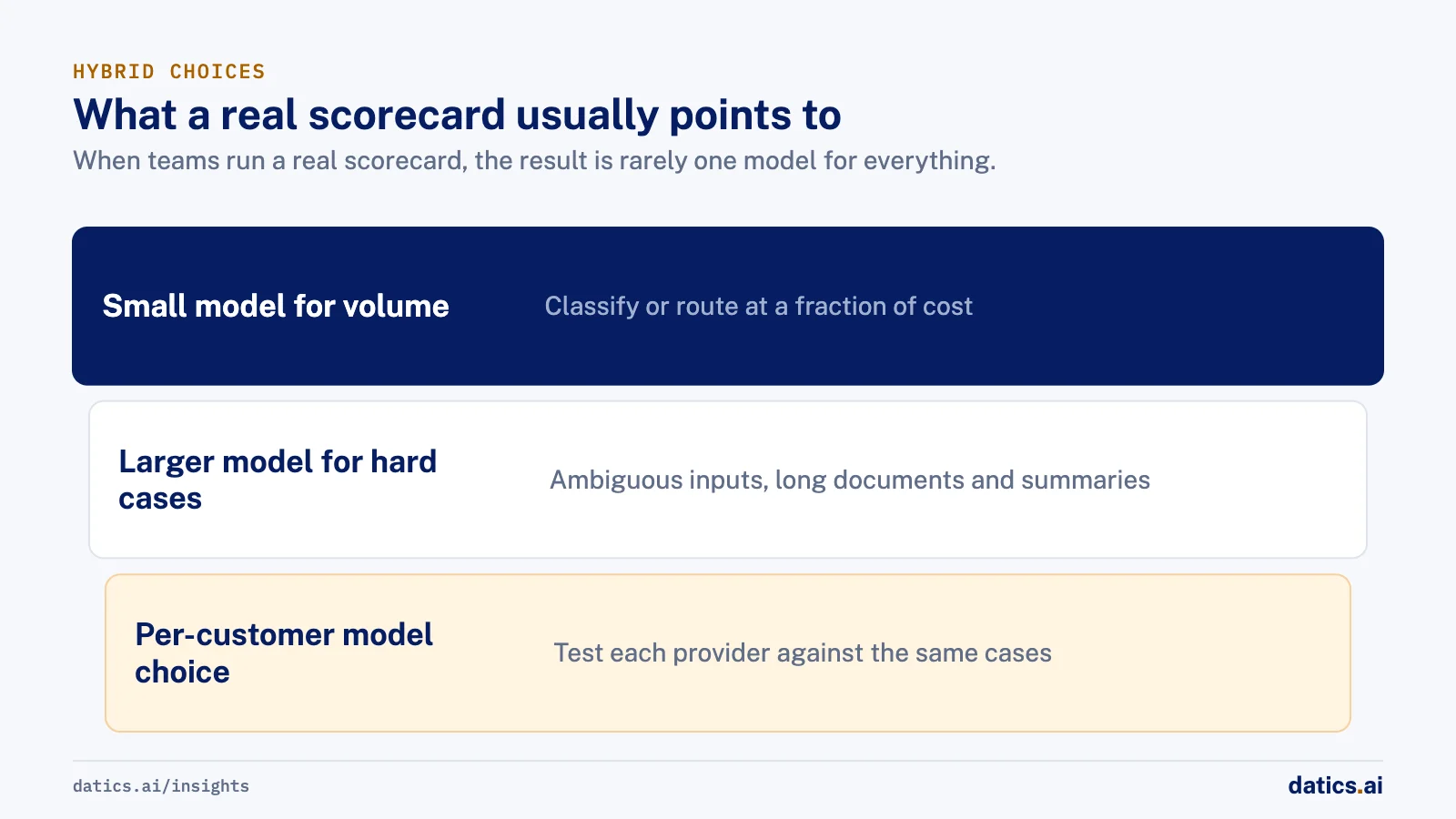
A small, efficient model for volume. If you must classify millions of comments or route every message, a pre-trained or fine-tuned smaller model may meet the threshold at a fraction of the cost.
A larger model for hard cases. Escalate the ambiguous inputs, the long documents and the summaries to a stronger model.
Per-customer model choice. Enterprise buyers may want their own model provider. If your scorecard is a harness rather than a spreadsheet, you can test each provider against the same cases before you switch a customer over.
The scorecard also protects you during upgrades. When a vendor releases a new model, you do not debate it. You run it.
For the cost side of this decision, see how much production AI costs in SaaS.
05What we see in production
For a startup building a sentiment analytics platform for social and influencer marketing campaigns, we started with a paid discovery that ended in an AI blueprint. Social language is full of sarcasm, slang, emojis and mixed languages, and the founder required metrics that are correct and defensible.
So the blueprint named precision, recall, F1 and ROC-AUC, plus a retraining plan, as part of the engine recommendation itself, not as something to add after launch. The recommendation was a hybrid engine: efficient pre-trained models for volume, fine-tuning for social language, and a larger language model held back for hard cases and report summaries. Because the scorecard came first, the model choice became a test that can be rerun as the platform collects its own labeled data. A feedback button that lets users flag wrong results feeds the same loop.
For a governed AI builder that turns company databases into internal apps, we built an evals harness that runs golden prompts through the real build agent in throwaway databases. It scores build success, spec validity, query success, answer accuracy against reference SQL, which tables were used, use of personal data, repairs, AI fallbacks and time. Organizations can route to different models, so the same harness is how a model choice is checked rather than assumed. In an internal test, it ran a set of retail test cases with a full pass rate on its baseline model, and it is the baseline any future model has to match.
For an established short-term rental operations platform with an AI assistant already in production, model changes were real events, including a migration to a newer model generation. We built testing in tiers: unit tests on every push, routing evals, and model-graded quality evals, with traces in an observability tool. A model upgrade became a run of the eval tiers, not a leap of faith.
06A short checklist before you commit to a model
- The task is written in one or two precise sentences.
- Metrics are chosen and justified by the cost of each kind of error.
- The test set comes from your own data and includes hard cases.
- The pass threshold was set before any model was run.
- Cost per task and latency are on the scorecard.
- The evaluation runs from the repository with one command.
- There is a written trigger for rerunning it: model upgrades, prompt changes and data drift.
If you can tick every line, the model you pick is a decision you can defend, and replace, with evidence.
Frequently asked questions
Are public benchmarks enough to choose a model?
No. Public benchmarks measure general ability, but they say little about your data, your users or your edge cases. In an established product, mistakes show up as wrong numbers in a report, a misrouted request or a confident answer to a question the model should have declined. Test candidates on your own data instead.
Which metrics should we use for a classification task?
Pick the metric that matches the cost of errors. Precision tells you how often a positive label is right, and recall tells you how many real positives you caught. F1 balances the two, and ROC-AUC tells you how well the model ranks cases across thresholds. Choose which one matters most for your product and say why.
Should we use one model for everything?
Rarely. A real scorecard usually points to a hybrid: a small, efficient model for volume and a larger model for hard cases such as ambiguous inputs, long documents and summaries. Enterprise buyers may also want their own model provider, so per-customer model choice is tested against the same cases before you switch a customer over.
How do we handle a new model release from a vendor?
Rerun the scorecard. When the evaluation runs from the repository with one command, a new model release is a test, not a debate. Run the candidate through the same cases, compare quality, cost and latency against your pass threshold, and switch only when the evidence supports it.
How Datics helps
Datics specializes in brownfield AI: bringing production AI into the product you already operate, without forcing a rebuild.
Related work
Case studies from our projects on the same subject.
SenTrac
Marketing & Media · Social sentiment analytics SaaS
Agencies see how audiences feel about a campaign, scored fairly across six channels
Agencies copied comments by hand and misread sarcasm and emoji; now SenTrac scores every comment and compares channels on one scale.
SovrenAI
B2B Software · Enterprise Builder, an AI internal app builder
Internal apps built on company data, with a person confirming every guessed join
An agent writing queries over unknown schemas can join the wrong tables; here every guessed join waits for a person to approve it.
CleanHaus
Real Estate & Hospitality · Turnover operations SaaS
Hosts and cleaners manage rental turnovers in chat, within each person's permissions
Owners, managers and cleaners all talk in one property chat. Now an AI there acts for each of them, only within that person's role.
More on AI in production
AI in production
LLMOps for SaaS: keep AI features working in production
LLMOps for product teams: evaluation gates, prompt and model versioning, tracing, regression checks, cost per task, kill switches and model upgrades.
Rana Umar MajeedReadAI in production
AI agent monitoring: catch regressions in production
AI agent monitoring for live SaaS products: what to trace on every run, which user signals to watch, how to score traces and when to roll a change back.
 Umair MajeedRead
AI in production
Why add an AI kill switch to every feature and agent?
An AI kill switch lets you disable or degrade an AI feature in seconds, without a release. Here is how we design kill switches and safe fallbacks.
Rana Umar MajeedReadAI in production
How can prompt management put domain experts in control?
Prompt management lets domain teams refine AI prompts and scoring rules after launch, while engineering keeps the pipeline, guardrails and staging step.
Rana Umar MajeedReadAI in production
Which AI pricing model works when every answer costs money?
Build an AI pricing model from cost per action: decide which plans trigger expensive AI work and how often, then enforce limits on the server.
Umair MajeedReadAI in production
How do you approach AI model testing on messy real data?
AI model testing for document and data extraction: build messy test sets early, compare AI output with human entry and turn each failure into a regression case.
Rana Umar MajeedReadYour customers already expect AI from your product.
Let us make it real without rebuilding what already works.