
AI in production
How do you approach AI model testing on messy real data?
Waiting for real client data before testing is not caution. It is a delay with a quality problem hidden inside it.
 Rana Umar MajeedCo-founder and CTO, Datics AI6 min read
Short answer
Do not wait for clean client data to start AI model testing. Build a test set that is deliberately messy: long, inconsistent, multilingual documents, missing fields and free text that never matches exactly. Test extraction against those cases from the first sprint, compare AI output with what a person would enter, and keep every failure as a regression case. Real data then confirms what you tested, rather than being the first test.
On this page
01Why messy data breaks AI that looked fine in the demo
Demos use tidy inputs. Production does not. Think of a pitch deck with financials in a screenshot, a contract half in English and half in another language, or a product title that says "2015 and up" instead of a model year. These are normal in established products, and they are where AI quietly fails. This is part of our larger guide, LLMOps for SaaS: keep AI features working in production.
Two things make this worse in brownfield work. First, the AI output has to land in an existing system, with existing fields and rules, so a wrong extraction is not just a bad answer. It is a bad record. Second, real customer data is often the last thing to arrive. Legal reviews, access approvals and privacy concerns all slow it down. If testing waits for that data, the team builds for weeks on assumptions.
Google's long-standing guidance on production machine learning makes a related point. The gap between how a model behaves in training and how it behaves on live data is one of the main sources of failure. You should test on data that looks like what the system will actually see.
02Build the messy test set yourself
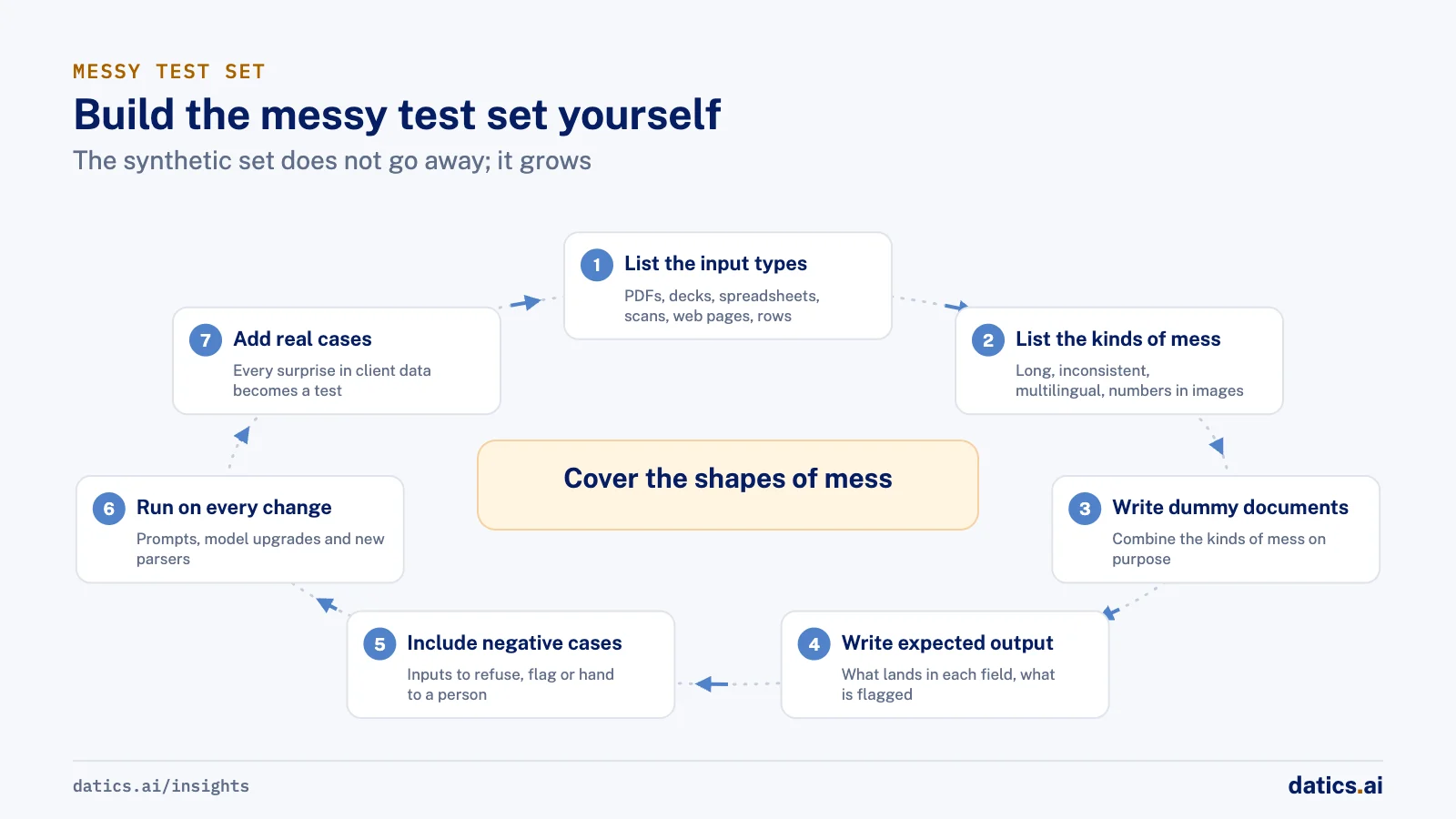
We create test inputs early and on purpose. The goal is to cover the shapes of mess the real data will have, before the real data exists.
- 01
List the input types.
PDFs, slide decks, spreadsheets, scanned images, short videos, scraped web pages, database rows. Each one fails differently.
- 02
List the known kinds of mess.
Long documents, inconsistent layouts, missing sections, multiple languages, numbers in images, free-text fields with no fixed format.
- 03
Write dummy documents that combine them.
A deck with financials split across slides. A bilingual memo. A response from an issuer or user that answers only half the questions.
- 04
Write the expected output for each.
What should land in each field? What should be left empty or flagged? This is your reference.
- 05
Include negative cases.
Inputs the AI should refuse, flag or hand to a person. A test set with only answerable inputs teaches you nothing about failure.
- 06
Run every case on every change.
Prompt edits, model upgrades and new parsers all go through the same set.
- 07
Add real cases as they arrive.
When client data comes in, every surprise becomes a new test case. The synthetic set does not go away; it grows.
03What to measure in AI model testing
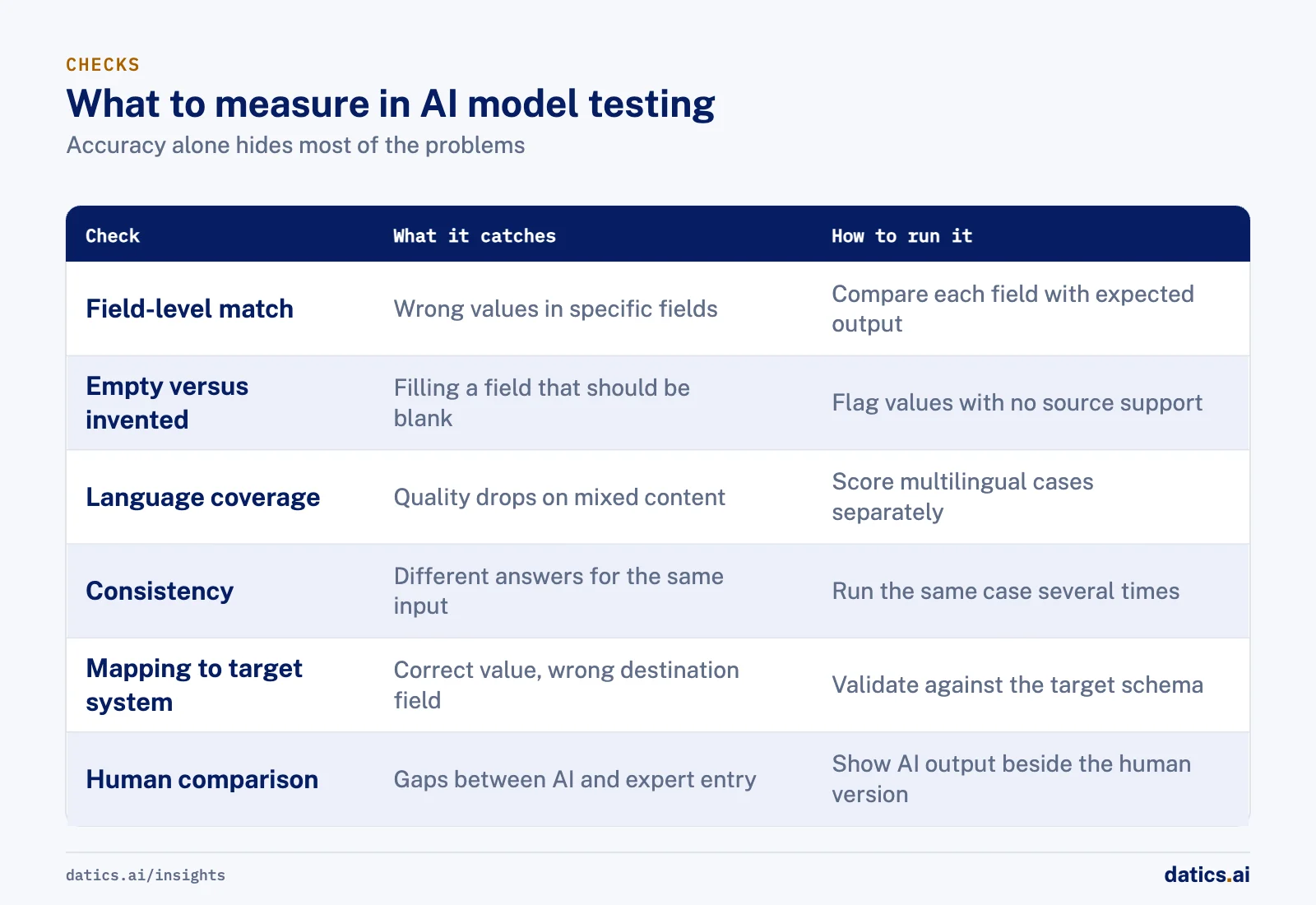
Accuracy alone hides most of the problems. These are the checks we use for extraction and matching work.
| Check | What it catches | How to run it |
|---|---|---|
| Field-level match against reference | Wrong values in specific fields | Compare each extracted field with the expected output |
| Empty versus invented | The model filling a field it should have left blank | Flag any value that has no support in the source document |
| Language coverage | Quality dropping on non-English or mixed content | Score multilingual cases separately |
| Consistency | Different answers for the same input | Run the same case several times and compare |
| Mapping to the target system | Correct value, wrong destination field | Validate output against the target schema |
| Human comparison | Gaps between AI and expert entry | Show AI output beside the human-entered version |
The last row matters most in regulated or high-stakes products. Storing the AI-generated version next to the human-entered one, and showing both, turns every real record into a test case without risking the record itself.
04Trade-offs to plan for
Synthetic data is not proof. Dummy documents tell you the system handles the shapes of mess you imagined. They do not tell you about the ones you did not. Treat them as a floor, not a ceiling.
Reference outputs take expert time. Someone who knows the domain has to say what the correct extraction is. Budget for it. It is usually the most valuable hour in the project.
Rules versus models. For some matching problems, text similarity and rules beat a generative model, because they are predictable and cheap to test. Choose the method by testing both against the same messy set.
Data refresh. If the source data changes daily, the test set needs refreshed samples too, or it will drift away from reality.
For more on evaluating agents before they reach users, see why AI agents fail in production.
05What we see in production
For an established, regulated private investment platform, we built AI agents that read pitch decks, memos and financials and turn them into structured deal records. Deal documents are long, inconsistent and sometimes bilingual, and the extracted data had to land in the right database fields without conflicts. Waiting for real client documents would have delayed any honest testing, so we wrote dummy decks, dummy issuer responses and complex bilingual documents to test extraction early, alongside the requirement and testing documents.
The issuer agent parses a deck into a structured deal template in about 30 seconds. We stored the AI-generated deal next to the human-entered one and showed them side by side, with a pre-publish gate that needs human confirmation, so differences surfaced as review items rather than as published errors.
For a multi-tenant AI sales assistant built for a retail and point of sale sales services company, one assistant had to combine uploaded documents, CSV files and live database rows in a single answer. It also had to return product comparisons in a form a sales widget can show. Our business analyst evaluated every deployment against the user stories before release, and negative scenario queries, the questions the assistant should not answer, were tested and tracked as bugs. That habit catches the failures that a test set of only good questions misses.
Earlier, for an automotive industry executive building an accessory recommendation plugin for dealer websites, the mess was in free text. Vehicle titles on dealer sites and compatibility text on accessory sites, such as a model name followed by "2015 and up", rarely matched exactly, so a plain lookup failed. We separated collection from matching: daily scrapers pulled accessories and compatibility lists into a normalized database, and a text matching algorithm mapped each vehicle title to compatible accessories from the same manufacturer. No generative model was involved. Testing the matcher against those inconsistent titles was the core of the work, because that is where every real-world failure would have come from.
Because the fitment matcher relied on rules and text similarity rather than a model, a person could check every match it made. Every per site crawler returned the same fields into one catalog, so matching never depended on how a single site was built.
06A short checklist for your next AI test plan
- Synthetic messy inputs exist before real data arrives.
- Every input type and every known kind of mess has at least one case.
- Each case has a reference output written by someone who knows the domain.
- Negative cases are part of the set, not an afterthought.
- The set runs on every prompt, parser or model change.
- AI output and human entry are compared side by side once real data flows.
- Every production surprise becomes a new test case.
Frequently asked questions
Should AI model testing wait for real client data?
No. Real customer data is often the last thing to arrive, slowed by legal reviews, access approvals and privacy concerns. If testing waits for it, the team builds for weeks on assumptions. Write dummy documents that combine the known kinds of mess, test extraction from the first sprint, and let real data confirm what you tested.
What should a messy test set include?
Every input type, such as PDFs, slide decks, spreadsheets, scanned images and scraped web pages. It also needs every known kind of mess: long documents, inconsistent layouts, missing sections, multiple languages and free text with no fixed format. Each case needs a reference output from a domain expert, and the set needs negative cases.
Is synthetic test data enough?
No. Synthetic data is a floor, not a ceiling. Dummy documents tell you the system handles the shapes of mess you imagined, not the ones you did not. When client data comes in, every surprise becomes a new test case. The synthetic set does not go away; it grows, and it runs on every change.
When are rules better than a generative model for matching?
For some matching problems, text similarity and rules beat a generative model, because they are predictable and cheap to test. On an accessory fitment matcher for dealer websites, no generative model was involved, and a person could check every match it made. Choose the method by testing both against the same messy set.
How Datics helps
Datics specializes in brownfield AI: bringing production AI into the product you already operate, without forcing a rebuild.
Related work
Case studies from our projects on the same subject.
Regulated investment platform
Financial Services · Private investment marketplace
Pitch decks become drafted deals, and issuers approve each field before publishing
Issuers retyped decks and financials into long deal forms. Now AI suggests each field, and the issuer applies, edits or rejects it.
FLZR
Retail & E-commerce · AI sales assistant
Shoppers compare products side by side, answered from the seller's live database
Shoppers needed product answers at any hour; now an AI assistant answers from the seller's documents, files and live database, with comparison cards.
Apex
Automotive & Dealerships · Dealer accessory matching plugin
A dealer plugin designed to offer only accessories that fit the listed vehicle
Fitment sat on many maker sites in free text; we crawled it into one catalog and designed a one button plugin to match it to listings.
More on AI in production
AI in production
LLMOps for SaaS: keep AI features working in production
LLMOps for product teams: evaluation gates, prompt and model versioning, tracing, regression checks, cost per task, kill switches and model upgrades.
Rana Umar MajeedReadAI in production
AI token cost: forecast LLM spend as usage grows
AI token cost grows with every customer. Measure it per feature, tenant and successful task, cut it with architecture choices, and forecast it as usage grows.
 Umair MajeedRead
AI in production
AI agent monitoring: catch regressions in production
AI agent monitoring for live SaaS products: what to trace on every run, which user signals to watch, how to score traces and when to roll a change back.
Umair MajeedReadAI in production
Why add an AI kill switch to every feature and agent?
An AI kill switch lets you disable or degrade an AI feature in seconds, without a release. Here is how we design kill switches and safe fallbacks.
Rana Umar MajeedReadAI in production
How can prompt management put domain experts in control?
Prompt management lets domain teams refine AI prompts and scoring rules after launch, while engineering keeps the pipeline, guardrails and staging step.
Rana Umar MajeedReadAI in production
Which AI pricing model works when every answer costs money?
Build an AI pricing model from cost per action: decide which plans trigger expensive AI work and how often, then enforce limits on the server.
Umair MajeedReadYour customers already expect AI from your product.
Let us make it real without rebuilding what already works.