
Property management and field operations
AI for property management: where it pays off first
In property software, the best AI is a careful coordinator: it moves the routine work, and it hands every judgment about people and money to a person.
 Umair MajeedCo-founder and CEO, Datics AI8 min read
In brief
AI for property management pays off first in work that repeats all day and follows clear rules: maintenance triage, turnover and cleaning schedules, routine messages to tenants, owners and field staff, and cleanup of listing and unit data. It should never decide alone on tenant screening, money movement or legal notices. The fastest path is to add AI to the platform operators already use, acting under each person's own role, with an approval step wherever a mistake would be expensive.
On this page
01Where AI for property management pays off first
Property platforms run on a steady stream of small, rule-bound tasks between people who rarely sit in the same room: residents, owners, managers, cleaners and contractors. That is exactly where an AI assistant earns its keep, because each task has a clear trigger, a clear record to update and a clear person to tell.
Renters notice the difference. In AppFolio's 2026 Renter Preferences Report, a survey of 3,002 U.S. renters, 79% of residents satisfied with maintenance said issues were resolved within a few days or less, and 56% of residents satisfied with maintenance planned to renew, against 31% of those who were not. Buildium's 2026 Renters Report, a survey of 1,500 U.S. renters, found that 84% expect a response from their property manager within 24 hours, and ranked submitting a maintenance request and waiting for a fix as the most stressful part of renting. Both reports come from software vendors, so read them as direction rather than proof, but they point the same way: speed and follow through on maintenance drive how people feel about their manager.
Here is how we rank the first candidates.
| Workflow | What the AI does | Who stays in charge | Payoff signal |
|---|---|---|---|
| Maintenance intake and triage | Turns a text, photo or call into a categorized work order, asks the missing questions, flags emergencies | Manager or dispatcher assigns and approves spend | Time to first response, time to resolution |
| Turnover and cleaning scheduling | Spots booking gaps, unassigned cleanings and check-in conflicts, drafts assignments | Manager confirms assignments | Turnovers without a cleaner, late cleanings |
| Tenant, owner and staff messages | Answers status questions from live records, in each person's language, by text, chat or voice | Staff take over sensitive or angry threads | Messages answered without a hand-off, hand-off time |
| Listings and unit data cleanup | Normalizes addresses, unit types, floor plans and amenities from messy sources | Data owner reviews changes before publish | Error rate in listings and feeds |
| Inspections from photos | Turns move-in, move-out and job photos into structured notes | Manager signs off on findings and charges | Inspection time, disputed findings |
| Leasing questions | Answers questions about availability, fees and policies from approved content | Leasing staff handle applications and decisions | Lead response time, tours booked |
Maintenance is usually the strongest first choice. Buildium found renters are most open to automation in maintenance, while 40% would prefer not to use automation at all, which is a good reason to keep a person one tap away. Our guide to AI for field service covers the dispatch side of the same problem.
02Where AI should never act alone
Some decisions in property management touch fair housing law, money or legal rights. Here the AI can gather, draft and explain, but a person decides.
Tenant screening and housing decisions. The Fair Housing Act, as summarized by the U.S. Department of Justice, bars discrimination in housing based on race or color, religion, sex, national origin, familial status and disability. In May 2024, HUD issued guidance stating that third-party screening companies, including those using machine learning and AI, must comply with the Fair Housing Act, along with companion guidance warning about ad targeting and delivery on digital platforms. HUD has since withdrawn the digital platforms advertising guidance, effective September 17, 2025, as part of a broader review of non-binding guidance. Guidance comes and goes; the statute does not. Our view is simple: do not let a model score, rank or reject applicants, and do not let it choose who sees a housing ad. State and local rules add further requirements, so teams should confirm their approach with their own counsel.
Money movement. Refunds, deposit deductions, owner payouts, late fees and vendor payments should never leave the system on a model's say. The AI can prepare the entry and the reasoning. A person with the right role approves it.
Legal notices. Notices to pay or quit, lease violations and eviction steps follow state and local law on content, timing and delivery. An AI can remind staff that a notice may be due. It should not draft and send one by itself.
The same holds for anything that changes a lease, a price or a person's access to a home. Our piece on human in the loop AI explains how to design these approval steps so they do not slow down everything else, and AI agent guardrails covers the checks that block an action before it reaches an approver.
03How to add AI to the platform operators already use
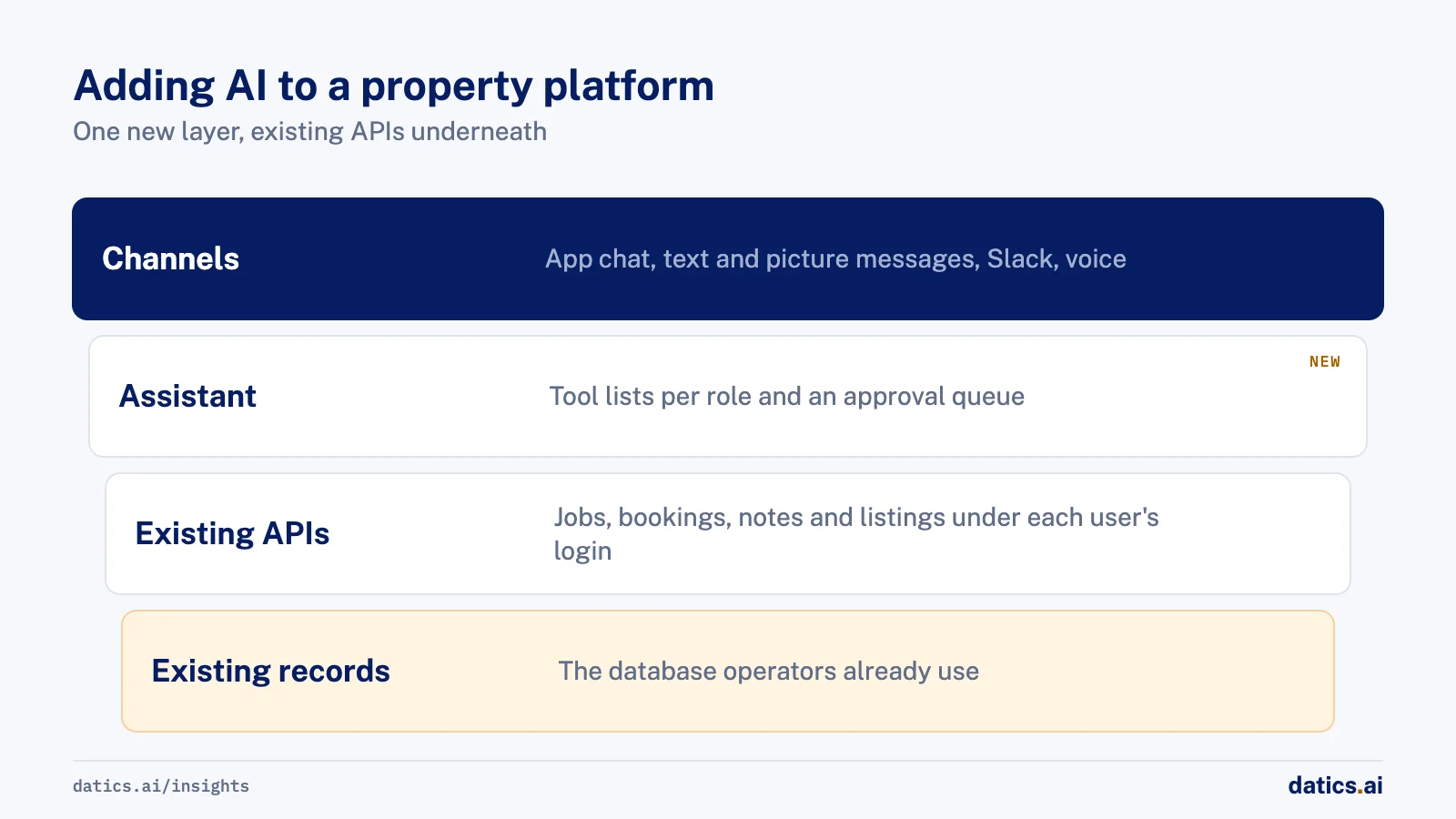
Operators do not want another app. They want the system they already run to do more. That shapes the build.
- 01
Act through your existing APIs.
Every action the assistant takes, from creating a job to adding a note, goes through the same endpoints your web and mobile apps call. No side database, no back door. Our guide to adding AI agents to an existing SaaS product walks through this pattern.
- 02
Run every call under the user's own login.
The assistant should have no permissions of its own. If a cleaner asks, it can only touch that cleaner's jobs. If an owner asks, it cannot do what the owner's role cannot do in the app.
- 03
Give each role its own tool list.
A cleaner session should not even contain owner tools. Removing the tool is stronger than telling the model not to use it.
- 04
Put approvals in the product.
Actions with cost or risk, such as contractor outreach or a vendor spend, wait in an approval queue the right person already checks.
- 05
Meet people where they work.
Field staff live on their phones. Text, picture messages and voice reach them without an app install, as long as each channel signs in to the same account and role.
- 06
Read fresh data, not chat memory.
Before answering "is unit 4B ready?", the assistant checks the live record, not what someone said an hour ago.
- 07
Know when to stay quiet.
In shared threads with owners, managers and cleaners, the assistant must decide whether a message is meant for it at all.
When a conversation needs a person, the hand-off should carry the full context. Our article on chatbot human handoff covers how to do that well.
04What to measure
Count outcomes in the operation, not activity in the chat window. Pick a baseline before launch, then compare the same measures each week.
- Maintenance: time to first response, time to assignment, time to resolution, and the share of requests that needed a follow up question from staff.
- Turnovers: the number of turnovers with no cleaner assigned 24 hours before check-in, late cleanings and same-day reschedules.
- Communication: the share of routine questions answered from live records, average hand-off time to a person, and repeat messages on the same issue.
- Data quality: listing and unit records corrected, feed rejections from listing portals, and errors found after publish. Our article on AI data quality explains how to set these checks up.
- Safety: actions blocked by role rules, approvals rejected, and wrong answers found in review. A rising rejection rate is an early warning, not a failure.
- Business results: renewal rates and owner churn, tracked over quarters, since renters who are happy with maintenance tell surveys they are more likely to stay.
05What we see in production
On CleanHaus, a live short-term rental operations platform where owners, cleaner managers and cleaners coordinate bookings, cleanings, checklists and inventory, we extended an AI assistant that was already running. The assistant acts only through the platform's existing APIs under each user's own login, with no permissions of its own. Cleaners act only on their own jobs, owners cannot assign cleaners, and a cleaner's session has no owner tools at all. A shared-channel step decides whether a message is meant for the assistant, booking tools handle overlaps and check-in conflicts in the client's time zone, and contractor outreach waits for the owner's approval in an inbox unless the owner sets that job to auto. CleanHaus reported its app and AI agent live.
Cleaners report from properties on their phones, often by text and in several languages. So we brought the same assistant to text and picture messages, Slack and voice calls. Every channel signs in to the same account the app uses, photos sent by text become job notes, the assistant replies in each person's language and translates property chat, and voice is limited to cleaners with the role checked on every call.
The scheduling surface matters as much as the AI. For the same platform we built a new mobile app around a role-aware turnover calendar that shows booking bars, cleaning blocks and gaps where a turnover lacks an assigned cleaner, with dates kept correct across property time zones. Role rules are enforced in every view: the owner view has no assign action.
Data work often comes first. RentSpire, a Los Angeles area rental and affordable housing venture, needed listings before it needed a website. We gathered listing data, added public housing authority data for every state, built unit models so each floor plan keeps its own bedrooms, bathrooms and square footage, and shaped the result into an XML rental feed an outside listing portal can read. The data work grew from one metro area to a far larger listing set within two weeks.
06A sensible first step
Pick one workflow from the table, usually maintenance intake or turnover gaps, and put it live with real roles and real approvals before adding the next. Our property management page shows how this fits a wider plan. If you already know the outcome you want, a three-week Build Sprint for $10,000 puts one outcome working in your product's staging, and the fee counts toward production. If you are not sure what to build first, the two-week Planning Sprint ranks it for $5,000.
Frequently asked questions
Can AI be used in tenant screening?
AI can help staff gather documents, check that an application is complete and explain policies to applicants. It should not score, rank or reject applicants, because the Fair Housing Act prohibits discrimination and an automated decision can produce unfair outcomes that are hard to see. Keep the decision with a trained person, and confirm your screening process with your own counsel.
Should the AI talk to tenants directly by text?
Yes, for routine requests such as maintenance status, access instructions and scheduling, as long as it answers from live records and signs in through the same account and role as your app. Give every thread an easy path to a person, since many renters still want a human for urgent or sensitive issues. Emergencies should go straight to staff by phone.
Do we need to replace our property management software to add AI?
No. The assistant can work as one more client of the platform you already run, calling its existing APIs under each user's login. Small additions are common, such as a new endpoint for an action the API never exposed, but the core system and its data stay where they are.
How Datics helps
Building Property Management, rental or field service software? See the AI modules we build for crews, schedules and listings.
›References (5)
- AppFolio: 2026 Renter Preferences Report
- Buildium: 2026 Renters Report
- U.S. Department of Justice: The Fair Housing Act
- HUD archived news release 24-098: Fair Housing Act guidance on tenant screening and advertising through digital platforms
- Federal Register: Notification of Withdrawal of Fair Housing and Equal Opportunity Guidance Documents (April 6, 2026)
Related work
Case studies from our projects on the same subject.
CleanHaus
Property Management · Turnover operations SaaS
Hosts and cleaners manage rental turnovers in chat, within each person's permissions
Owners, managers and cleaners all talk in one property chat. Now an AI there acts for each of them, only within that person's role.
CleanHaus
Property Management · Field operations mobile app
Rental cleaners see only their jobs in a role-aware turnover calendar app
An aging mobile app slowed every turnover. Now one React Native app shows each owner, manager and cleaner the calendar their role allows.
RentSpire
Property Management · Affordable housing listings platform
Renters search affordable housing listings built on property data we structured first
A listings site with no listings is no use to renters; we structured the property data first, then built search and an owner dashboard on it.
Related answers
Brownfield AI
AI for field service and compliance software
AI for field service and compliance software drafts inspection reports, checks records against rules and prepares follow-ups, while a named person approves.
Umair MajeedReadAI agents
Where should AI agent security enforce permissions?
AI agent security in a multi-role SaaS product rests on one rule: the agent gets the user's permissions and nothing more, enforced in code, never in the prompt.
 Rana Umar MajeedRead
Automotive and dealerships
AI for car dealerships: where it pays in dealer software
AI for car dealerships pays in sales, BDC follow-up and service booking first, grounded in live inventory and wired into each dealer's CRM and DMS.
Umair MajeedReadYour customers already expect AI from your product.
Let us make it real inside the product you run today.