
Automotive and dealerships
AI for car dealerships: where it pays in dealer software
Dealership AI earns its keep when every answer comes from real stock and every conversation ends in the CRM.
 Umair MajeedCo-founder and CEO, Datics AI8 min read
In brief
AI for car dealerships pays first where speed and accuracy decide the outcome: answering shoppers from live inventory, following up every lead, booking service and keeping ads in line with stock. For dealership software companies, that means AI inside the CRM, portal or website tools dealers run every day, grounded in each dealer's inventory feed and wired into the CRM and DMS. Start with one workflow, prove it with a few dealers, then widen.
On this page
- 01Where AI for car dealerships pays, department by department
- 02Sales and BDC: fast answers from real stock
- 03Service, inventory, F&I and marketing
- 04Data and integration realities: DMS, CRM and inventory feeds
- 05How to add AI to a dealership CRM
- 06What we see in production
- 07What to build first
- Frequently asked questions
01Where AI for car dealerships pays, department by department
Shoppers already use AI. In the 2025 Cox Automotive Car Buyer Journey Study, 19% of all buyers and 25% of new vehicle buyers used AI tools while shopping, and buyers named real-time answers and personalized recommendations among the top benefits. The same study shows a gap between what buyers want to do online and what they actually do: 48% want to apply for credit online but 33% do, and 40% want to select F&I products online while only 16% do.
That gap is where dealership software has room to grow. Here is how we rank the departments for a first AI feature.
| Department | Where AI helps | Data it needs | Risk if it is wrong | Where we usually start |
|---|---|---|---|---|
| Sales | Answer shoppers, recommend units, capture leads | Live inventory feed, dealer FAQs | A unit that is sold or priced wrong | Often first |
| BDC | Follow up every lead, set appointments, summarize history | CRM records, call and text history | Annoyed shoppers, consent problems | First or second |
| Service | Book visits, explain estimates, answer status questions | Scheduler, repair orders, labor times | Wrong price or wrong time slot | Second |
| Inventory | Pricing against the market, aging alerts | Own stock plus competitor listings | A bad pricing call | Data first, AI later |
| F&I | Payment estimates, product explanations, document checks | Rates, products, deal jackets | Compliance and privacy exposure | Later, with strong controls |
| Marketing | Ads and campaigns that follow stock, audience building | Inventory, CRM and DMS lists | Spend on cars already sold | Quick win if feeds are clean |
The pattern is simple. Sales, BDC and service share one problem: people wait, and waiting loses deals and repair orders. AI that answers in seconds, from the right data, fixes that. Inventory and F&I need more groundwork before AI adds anything a dealer can trust.
02Sales and BDC: fast answers from real stock
Most dealer websites still rely on search filters and static forms. A shopper who wants a trailer that sleeps six and is safe to tow with a half-ton truck has to work that out alone, and the dealer gets a thin lead with a name and a phone number.
A sales assistant inside dealership software should do three things well. It should recommend only units that are in the dealer's feed right now. It should explain why each unit fits, using the facts on the listing. And it should end in the CRM, with the shopper's needs, the units discussed and a short summary attached, so the salesperson starts the call already knowing the story.
The BDC side is follow-up. Leads arrive from the dealer website, third-party sites and the OEM. AI can draft the first reply in seconds, keep follow-up going on a schedule a manager sets, and hand the conversation to a person when the shopper asks for one or gets frustrated. Calls and texts need care here, because consent rules apply to automated outreach, so the follow-up schedule should respect what each shopper agreed to.
What we would avoid: letting the model do math. Towing capacity, payments and trade values belong in tools that compute them from real numbers. The model asks the questions and explains the answer. It never guesses the number.
03Service, inventory, F&I and marketing
Service is the department dealers are losing. The Cox Automotive Service Industry Study found dealerships handle 12% fewer service visits than in 2018, and only 54% of owners of cars two years old or newer went back to their selling dealer for service in 2025, down from 72% in 2023. Owners who do service at the dealership are much more likely (74%) to buy their next car there. The top complaints are unexpected costs and poor communication. AI that books a visit after hours, explains an estimate in plain words and answers "is my car ready" without a phone call goes straight at those complaints.
Inventory is a data problem before it is an AI problem. Pricing a unit well needs a clean view of what competing lots hold and what they ask. Once that data is captured daily and mapped to one make, model and trim catalog, AI can flag aging units, suggest price moves and alert a dealer when a matching unit appears nearby.
F&I carries the most risk. The FTC treats most dealers that finance or arrange financing as financial institutions under the Safeguards Rule, which calls for a written information security program with safeguards such as access controls, encryption and oversight of service providers that touch customer information, as the FTC's FAQ for dealers explains. We would start F&I AI with explanation and payment estimates computed by tools, and keep credit data out of model prompts until the controls are in place.
Marketing is often the quickest win. Ads that follow live inventory stop spending money on units that sold yesterday, and audience building from a dealer's own CRM or DMS list is a well defined job with clear inputs.
04Data and integration realities: DMS, CRM and inventory feeds
The AI is rarely the hard part. The hard part is the data plumbing every dealer group does a little differently.
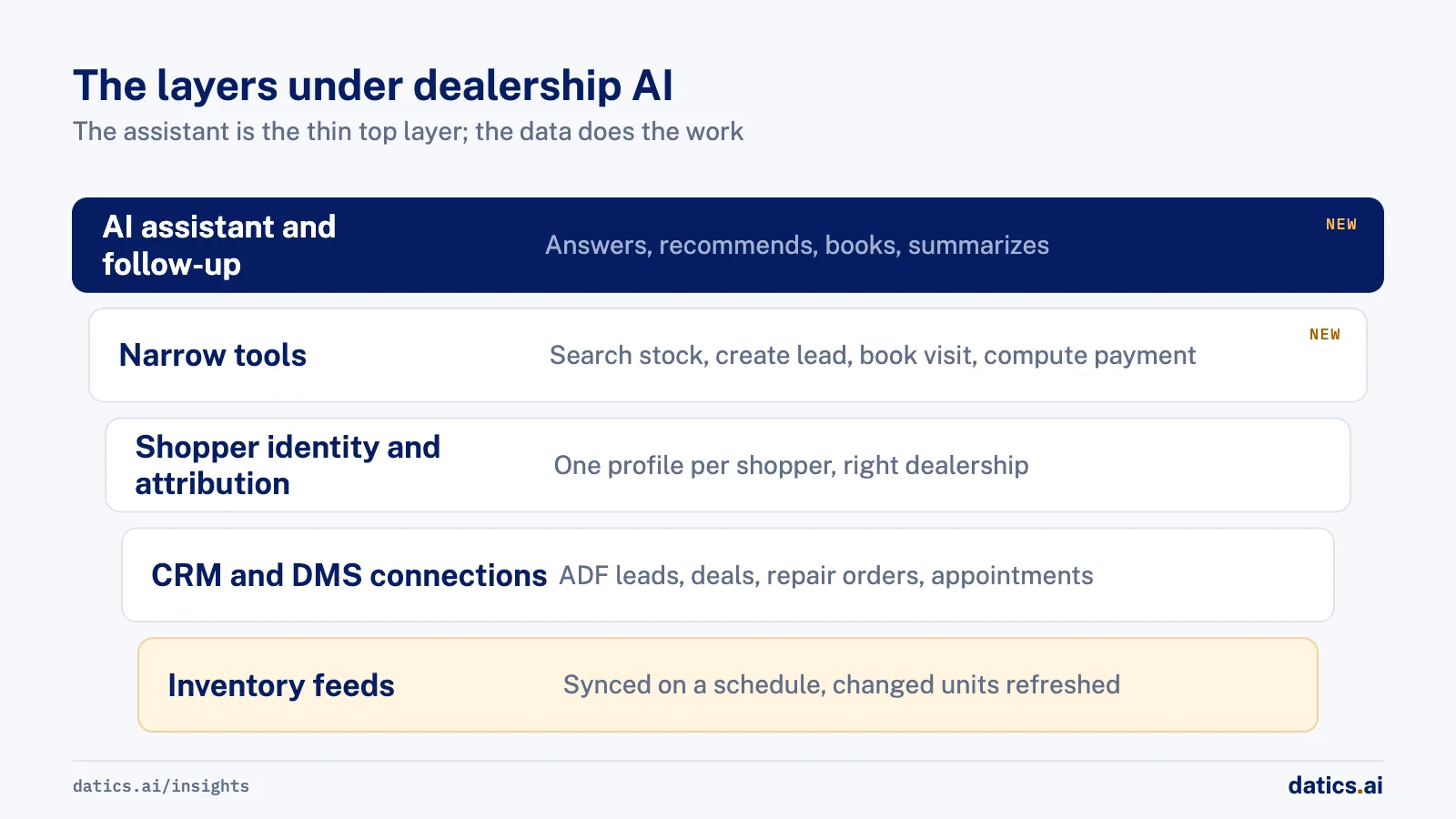
Inventory feeds. Dealers publish stock through feeds that update on their own schedule. An assistant has to sync on a fixed cadence and refresh only units that changed, or prices go stale and indexing costs climb. Every dealer's content has to stay in its own tenant, so one dealer's FAQ never answers for another.
CRMs. Dealer groups use different CRMs, and many still take leads as ADF, an XML lead format that each CRM reads a little differently. Plan for a mapping layer per CRM, duplicate checks before a lead is created, and validation of emails and phone numbers before any outreach.
DMS. The DMS holds deals, customers, repair orders and parts. Access depends on the DMS provider and on each dealer's authorization, so plan time for it early. Standards are improving: STAR, the automotive retail IT standards body, published a Deal API in 2025 that standardizes deal data such as customer, vehicle, price, financing and status, designed to integrate with DMS and CRM platforms. Use standards where your partners support them, and keep your own internal model so a new DMS does not ripple through the product.
Identity and attribution. Visitor data, pixel data and lead feeds arrive from several vendors on their own schedules. Matching them to one shopper profile and the right dealership is the foundation for any AI that says "this shopper is back."
05How to add AI to a dealership CRM
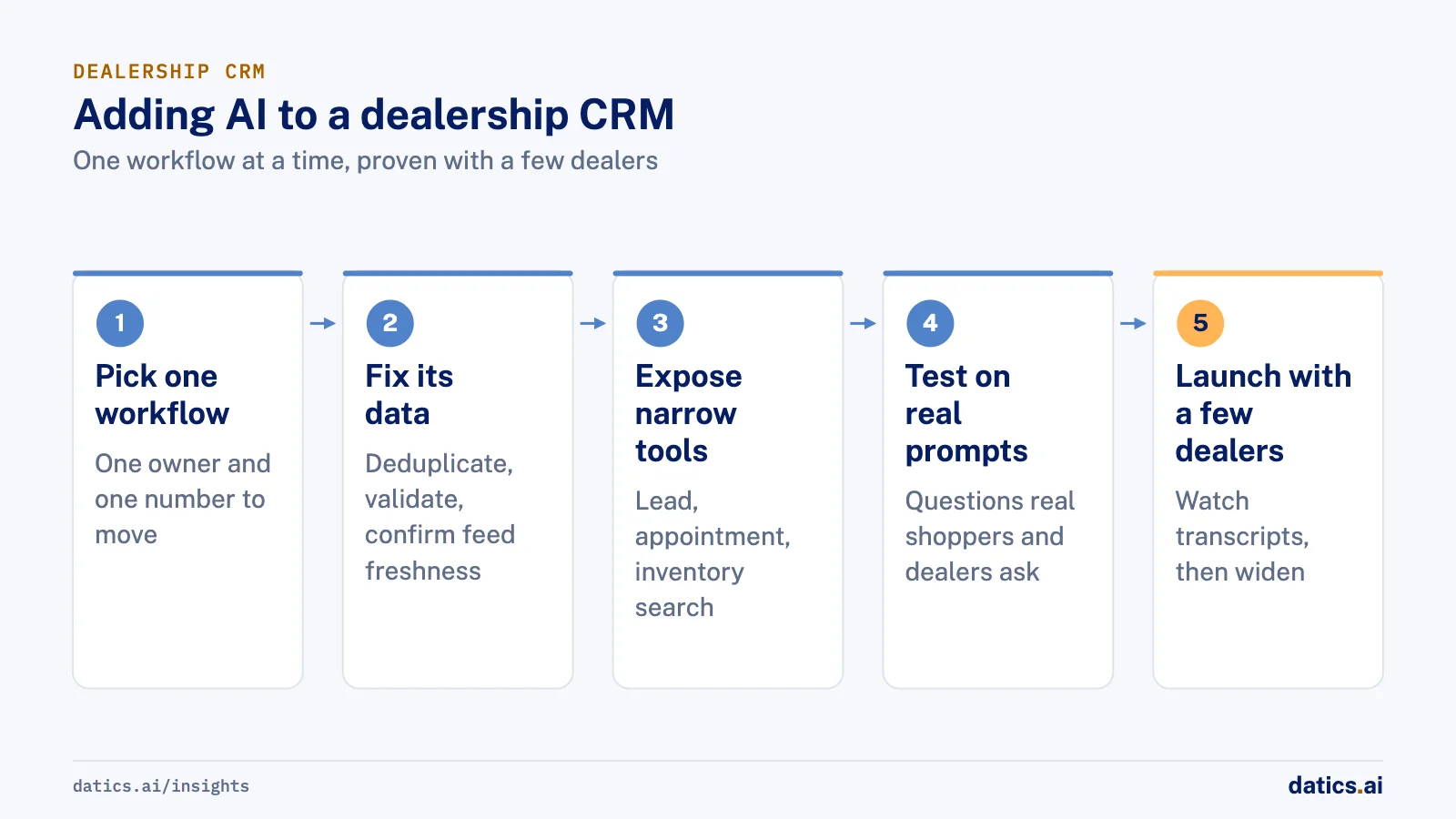
Teams often ask us how to add AI to a dealership CRM they already sell. This is the order we follow.
- 01
Pick one workflow and one measure.
For example, "every web lead gets a useful reply in under a minute" or "returning visitors go to the same salesperson." Give it one owner.
- 02
Fix the data that workflow reads.
Deduplicate leads, validate contact details and confirm the inventory feed is fresh.
- 03
Expose actions as narrow tools, and ground every answer.
Create a lead, book an appointment, search inventory: the AI can act only through these, under the user's or dealer's permissions. Inventory facts come from the feed, policies from the dealer's own pages and documents, and numbers from tools. Our article on designing tools for LLM tool calling goes deeper.
- 04
Test on real dealer prompts.
Collect the questions real shoppers ask and the edge cases dealers worry about, and run them before each release.
- 05
Launch with a few live dealers, then widen.
Watch transcripts, fix what breaks, then add dealers. Give every conversation a clear path to a salesperson or service advisor, with the summary attached, as described in our piece on chatbot human handoff.
06What we see in production
For a dealer software company that sells a customer intelligence and engagement portal to RV, auto, powersports and marine dealers, we built the white label AI sales assistant that runs on its dealers' websites. An hourly sync indexes each dealer's inventory feed for keyword and vector search and re-indexes only units whose content changed, which fixed stale prices and cut embedding calls. Each dealer's website pages, FAQs and documents are indexed per tenant. A tool-using agent asks follow-up questions built from inventory facets, routes service, parts, finance and trade questions to the right department, and leaves towing and payment math to tools that match a truck's payload against real GVWR. Leads, contacts and appointments go into the platform's CRM with an AI summary of the chat, and from there to each dealer's own CRM. We stabilized it with a few live dealers before scaling, and it runs in production, in English and Spanish, in the client's own AWS account.
The assistant works because of the groundwork underneath. On the same dealer data platform, we rebuilt how pixel, geo fence and lead feed data is matched, de-duplicated and attributed to the right dealership, and connected dealers' own CRMs, including VinSolutions, DealerSocket and DP360 over ADF, plus text and email providers. Emails and phone numbers are validated and duplicates are blocked before a lead is created.
For inventory, we built and run a competitive inventory engine that captures competitor listings from dealer websites every day, maps them to one make, model and trim catalog, and shows dealers price comparisons and alerts when matching units appear. That is the data layer any pricing AI needs first.
07What to build first
Choose the first feature by data readiness, not by excitement. These signs tell you a workflow is ready:
- Its data has one owner and refreshes on a known schedule.
- Its result lands in a system dealers open every day, such as the CRM, the scheduler or the portal.
- You can name one number that will move, such as reply time, appointments set or show rate.
- A wrong answer is cheap to catch and fix, or a person reviews it before it reaches a shopper.
- Dealers can switch it on per rooftop, so you can start with a few.
- You know which customer data it touches and how your Safeguards Rule controls cover it.
For most dealership software companies that points to the sales assistant or BDC follow-up first, service booking second, and F&I last. If you want a plan and a fixed quote before you commit, a two-week Planning Sprint ends with exactly that, and its fee counts toward the build.
Frequently asked questions
What is the best first AI feature for dealership software?
Usually a sales assistant grounded in live inventory, or AI follow-up on web leads. Both have clean inputs, land in the CRM and move a number dealers already watch. Service booking is a strong second because dealers are losing service visits to independent shops.
Do we need DMS access to launch dealership AI?
Not always. A sales assistant can start with the inventory feed, the dealer's own website content and a CRM connection. Service status, repair orders and deal data need DMS access, which depends on the DMS provider and each dealer's authorization, so plan that time early.
How do you keep a dealership AI from quoting the wrong price or a sold unit?
Recommend only from the current feed, refresh it on a fixed schedule, and re-index changed units right away. Compute payments, towing and trade values in tools, not in the model, and test every release on real dealer prompts before it reaches shoppers.
How Datics helps
Datics specializes in brownfield AI: bringing production AI into the product you already operate, without forcing a rebuild.
›References (4)
- Cox Automotive: Car Buyer Journey Study finds efficiency, digital tools and AI drive record satisfaction
- Cox Automotive: Dealerships have lost 12% of service visits to competition since 2018
- FTC: Automobile Dealers and the FTC's Safeguards Rule, Frequently Asked Questions
- STAR: Deal Standards API for the automotive industry
Related work
Case studies from our projects on the same subject.
Coast Technology
Automotive & Dealerships · AI sales assistant for dealers
RV shoppers get units from live stock, with towing fit computed, not guessed
Dealer sites offered static forms and filters. Now shoppers ask in plain words and get real units from the hourly feed, with the reason each one fits.
Coast Technology
Automotive & Dealerships · Dealership customer data platform
Dealers see who shopped them online and push each lead to their CRM
Shopper data, messaging and CRMs sat in separate tools. Now dealers see each shopper in one profile and send an email, a text or a CRM lead.
Coast Technology
Automotive & Dealerships · Competitive inventory intelligence engine
Dealers see rival stock, prices and sales daily, captured from many changing websites
Dealers checked rival lots by hand, site by site. Now one engine captures competitor stock daily and the portal compares prices and sends alerts.
Related answers
RAG and AI assistants
How do you make AI product search match how buyers shop?
AI product search works when it learns how buyers decide, such as a monthly payment budget, and turns that into precise filters over live inventory.
 Bilal HassanRead
RAG and AI assistants
Knowledge graph vs RAG: what does an AI agent need?
Knowledge graph vs RAG vs tools for AI agents: when live tools and search are enough, and when connected questions justify a knowledge graph.
 Rana Umar MajeedRead
Brownfield AI
How do you know if your product has AI ready data?
AI ready data means outside feeds arrive through logged pipelines that match, de-duplicate, validate and attribute records before any model sees them.
Umair MajeedReadYour customers already expect AI from your product.
Let us make it real inside the product you run today.