
RAG and AI assistants
How do you make AI product search match how buyers shop?
Buyers do not shop by sticker price. Many shop by what they can pay each month.
 Bilal HassanAI Product Designer and UI/UX Manager, Datics AI7 min read
Short answer
You make AI product search match how buyers shop by learning the terms buyers actually use to decide, such as a monthly payment, a towing need or a location. Then you turn those terms into precise filters over live inventory. The language model understands the request. The search engine finds real items. Every answer stays grounded in current stock, and the assistant says so honestly when nothing matches.
On this page
01AI product search starts with how buyers decide
Most product search is built around the catalog's fields: make, model, year, price. Buyers often think in other terms. In vehicle and RV sales, many buyers know what they can pay each month, not the price they can afford. In Canada, many think in payments every two weeks. A search that only filters on sticker price forces the buyer to do the arithmetic, and a chat assistant that cannot do it gives a vague answer. This is part of our larger guide, How do you build a RAG chatbot on your knowledge base?.
The U.S. Consumer Financial Protection Bureau has long noted how much the monthly payment shapes car buying. Its auto loan shopping guidance warns that a lower monthly payment often comes from a longer loan and more interest, and encourages buyers to compare total cost. Whatever you think of payment-led shopping, it is how many buyers start, so a search tool that ignores it ignores the buyer.
The first step is research, not engineering. Read real search logs and chat transcripts. List the ways buyers describe what they want. Group them into constraints the product can turn into filters, and constraints it cannot.
02Turn natural language into precise filters
We built and run a white-label AI sales assistant for dealer websites, serving RV, marine and vehicle dealers. On it, buyers ask in natural language with follow-ups: towing questions, payment budgets, location limits and changes of mind. Supporting payment-based filtering by country turned a common question into a precise inventory search instead of a vague answer.
The pattern behind it is to let each component do what it is good at:
- 01
The language model reads the request and extracts structured constraints
category, budget and its period, towing need, location, new or used.
- 02
Code converts constraints into filters the search engine understands, using rules per country, such as monthly payments in the U.S. and biweekly payments in Canada.
- 03
The search engine applies hard filters first, then ranks within them using keyword and vector similarity.
- 04
The model explains the results it was given, with the reasons each unit fits, and never adds units or prices of its own.
- 05
If nothing matches, the assistant says so and offers the nearest useful alternative or a person to talk to.
Hybrid search fits this well. Elastic's documentation describes running full-text search and vector search in one request and merging the two result lists with reciprocal rank fusion. Keyword matching handles exact model names and trims; vector similarity handles descriptions like a family camper that sleeps six.
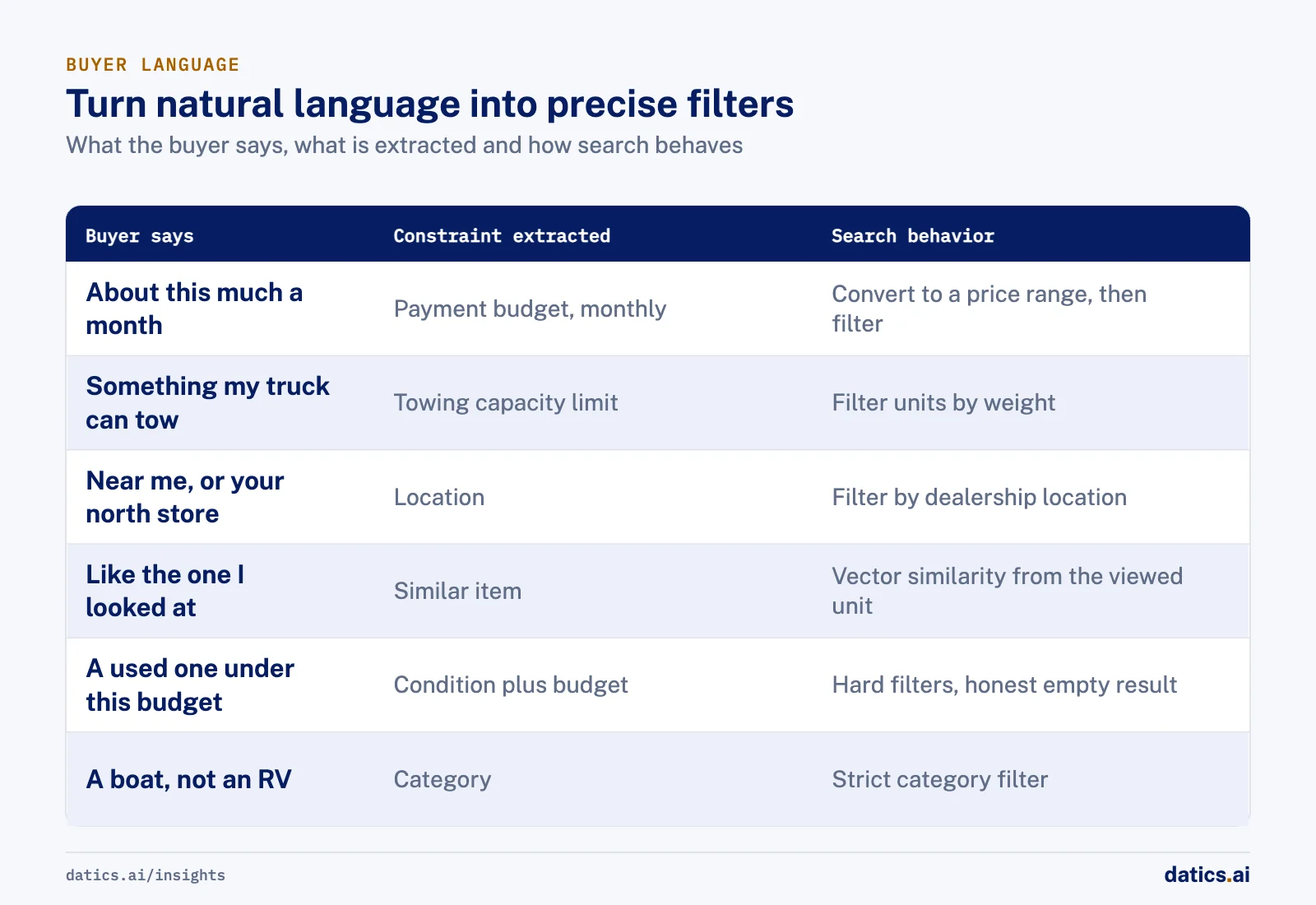
The table shows how common buyer phrasing maps to search behavior.
| Buyer says | Constraint extracted | Search behavior |
|---|---|---|
| I can pay about this much a month | Payment budget, monthly | Convert to a price range with the country's payment rules, then filter |
| Something my truck can tow | Towing capacity limit | Filter units by weight against the stated capacity |
| Near me, or at your north store | Location | Filter by dealership location |
| Like the one I just looked at | Similar item | Vector similarity from the viewed unit |
| Do you have a used one under this budget | Condition plus budget | Hard filters, honest empty result if none |
| A boat, not an RV | Category | Strict category filter across mixed inventory |
03Keep every answer grounded in live inventory
Inventory changes constantly. In the dealership assistant, each dealer's inventory feed syncs into the search index every hour, and answers are grounded in the dealer's own inventory, website and FAQ content. The rule that could never break was that the assistant must never invent stock or prices.
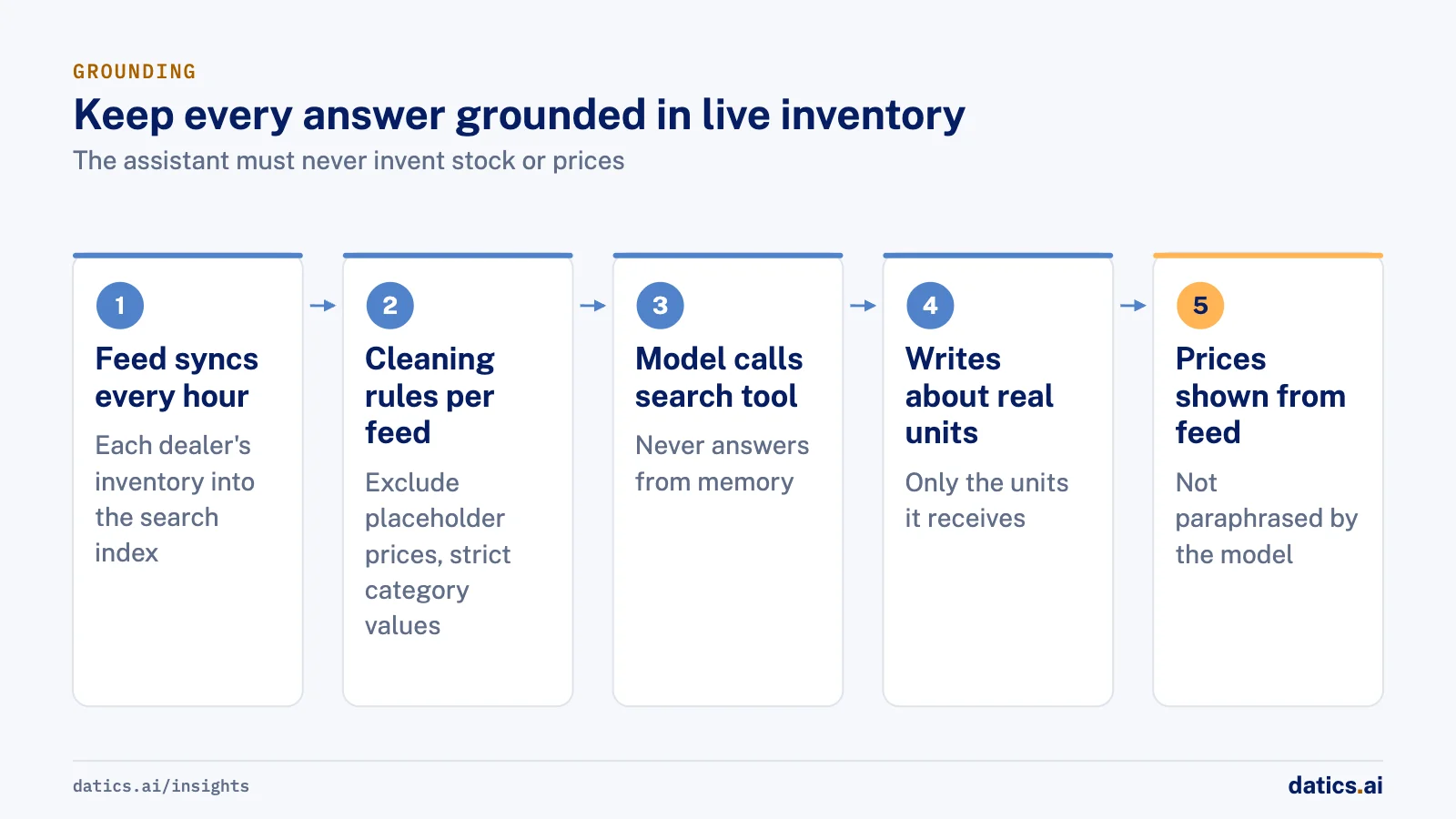
That rule shapes the architecture. The model never sees the whole catalog and never answers from memory. It calls a search tool, receives real units, and writes about those units only. Prices and availability are displayed from the feed, not paraphrased by the model. When a buyer asks about a unit that sold an hour ago, the next sync removes it.
Messy data is the other half of grounding. Dealer feeds differ: missing prices, duplicate classification fields, placeholder prices, RVs and boats mixed in one file, and different page address schemes. Early dealer tests showed context loss and wrong categories. Cleaning rules per feed, such as excluding placeholder prices from payment math and enforcing strict category values, matter as much as the model. Exclusion rules and new-versus-used rules are set per dealer.
04Route the questions search cannot answer
Not every buyer question is a search. Service, parts, finance and trade-in questions need to reach the right department, and some buyers want a person. The dealership assistant routes questions by intent and captures leads and appointments into the client's existing CRM with a transcript summary, the filters applied and the vehicle data. It also supports hand-off to a human agent. English and Spanish are both supported, and each dealer's data is isolated.
The lesson for any commerce product is to decide early which intents the search assistant owns and which it hands off. A search tool that tries to answer a finance question with inventory results frustrates buyers more than one that says it will connect them to the finance team.
05Test with the questions buyers really ask
Search quality is easy to overestimate when the test questions are written by the team that built the search. Buyers phrase things in ways engineers do not expect, combine several constraints in one sentence, and change their minds halfway through a conversation.
We build the test set from real conversations wherever we can. Each test records the buyer's words, the constraints that should be extracted, and the units that should and should not appear. A test passes only if the filters are right and no unit outside the constraints shows up. We also keep tests for the empty case, where the honest answer is that nothing matches, because that is where an assistant is most tempted to stretch.
These checks run whenever the prompt, the model, the feed rules or the search settings change. A fix for towing questions should not quietly break payment questions, and only a stable test set shows that.
06What we see in production
The dealership sales assistant has been live in production on dealer websites since early 2026, for a dealership software company serving RV, marine and auto dealers in the U.S. and Canada. Leads and appointments flow into the existing CRM. A few lessons stand out.
Payment questions are among the most common ways buyers start, and country rules matter. A payment filter that assumes U.S. monthly terms gives Canadian buyers wrong results. Handling the period per country is a small piece of code with a large effect on answer quality.
Towing-capacity matching and pricing sync needed fixes after real buyer conversations. Test sets built from real dealer prompts caught more problems than any synthetic list we wrote ourselves. Stabilizing with a small number of live dealerships before scaling gave us those prompts early.
We also see that the simplest search architecture that stays grounded wins. Moving from a general data agent to search-backed inventory lookup, and later rebuilding the flow as a tool-using agent with search filters and similarity search, made answers more precise and easier to test. Token usage is logged per conversation, which keeps cost visible as traffic grows. For more on that side, see how much production AI costs in SaaS.
Frequently asked questions
How does AI product search handle monthly payment budgets?
The language model extracts the budget and its period from the buyer's words. Code then converts it into a price range using rules per country, such as monthly payments in the U.S. and biweekly payments in Canada, and the search engine filters on that range. Handling the period per country is a small piece of code with a large effect on answer quality.
How do you stop the assistant from inventing stock or prices?
The model never sees the whole catalog and never answers from memory. It calls a search tool, receives real units and writes about those units only. Prices and availability are displayed from the feed, not paraphrased by the model. Each dealer's inventory feed syncs into the search index every hour, so a unit that sold disappears at the next sync.
Why use hybrid search instead of vector search alone?
Buyers mix exact terms with loose descriptions. Keyword matching handles exact model names and trims, while vector similarity handles descriptions like a family camper that sleeps six. Hybrid search runs both in one request and merges the result lists with reciprocal rank fusion. Hard filters such as budget, category and location come first, and ranking happens within them.
How do you test AI product search before release?
Build the test set from real buyer conversations. Each test records the buyer's words, the constraints that should be extracted and the units that should and should not appear. A test passes only if the filters are right and no unit outside the constraints shows up. Keep tests for the empty case, and rerun them whenever the prompt, model, feed rules or search settings change.
How Datics helps
Datics specializes in brownfield AI: bringing production AI into the product you already operate, without forcing a rebuild.
Related work
Case studies from our projects on the same subject.
Coast Technology
Automotive & Dealerships · AI sales assistant for dealers
RV shoppers get units from live stock, with towing fit computed, not guessed
Dealer sites offered static forms and filters. Now shoppers ask in plain words and get real units from the hourly feed, with the reason each one fits.
FLZR
Retail & E-commerce · AI sales assistant
Shoppers compare products side by side, answered from the seller's live database
Shoppers needed product answers at any hour; now an AI assistant answers from the seller's documents, files and live database, with comparison cards.
SenTrac
Marketing & Media · Social sentiment analytics SaaS
Agencies see how audiences feel about a campaign, scored fairly across six channels
Agencies copied comments by hand and misread sarcasm and emoji; now SenTrac scores every comment and compares channels on one scale.
More on RAG and AI assistants
RAG and AI assistants
How do you build a RAG chatbot on your knowledge base?
How to build a RAG chatbot on your knowledge base: a retrieval path per source, one merge step, and strict limits on what each assistant may read.
 Rana Umar MajeedRead
RAG and AI assistants
How do you stop hallucination in AI document extraction?
AI document extraction from long documents gets reliable with type detection, retrieval per field, clear field definitions and empty values, not guesses.
Rana Umar MajeedReadRAG and AI assistants
Fine tuning vs RAG: when should you train on your own data?
Fine tuning vs RAG: use retrieval when the model lacks facts, fine tune when it does a narrow task badly, and collect user corrections first.
 Umair MajeedRead
RAG and AI assistants
What makes a good chatbot human handoff to a live agent?
How to design a chatbot human handoff: set escalation triggers up front, let admins set agent hours, and pass the full conversation to a shared inbox.
Rana Umar MajeedReadRAG and AI assistants
RAG evaluation: how do you test that citations hold up?
RAG evaluation must check more than whether citations exist. Test that each cited passage supports its claim and that answers decline when sources are silent.
Rana Umar MajeedReadRAG and AI assistants
How does natural language search map to product data?
Natural language search over a product catalog works when the agent maps buyer words to attributes your feed actually holds, then filters on them, not guesses.
Rana Umar MajeedReadYour customers already expect AI from your product.
Let us make it real without rebuilding what already works.