
RAG and AI assistants
How does natural language search map to product data?
The model should interpret the question. The data should answer it.
 Rana Umar MajeedCo-founder and CTO, Datics AI6 min read
Short answer
To make natural language search work on structured product data, translate what buyers say into the attributes your feed actually stores, then let the system filter on those attributes. Natural language search fails when the model is asked to guess which units match. It works when concepts such as "family friendly" or "can my truck tow it" become explicit filters on real fields, combined with keyword and similarity search, and answered only from live records.
On this page
01Why "just ask the model" breaks on real catalogs
A demo of natural language search usually runs on a clean sample: a few hundred items, consistent fields, sensible prices. A production catalog looks different. Fields are missing, duplicated or used differently by each supplier. Prices can be placeholders. One file can mix product types that share no attributes. URLs follow different schemes per seller.
Buyers, meanwhile, do not speak in fields. They describe concepts ("something for weekends with the kids"), constraints ("under a certain monthly payment"), compatibility ("will my vehicle pull it"), and location ("near me"). They also follow up: "show me the cheaper one", "what about used?".
If you pass the whole catalog, or a large slice of it, to a language model and ask it to pick, you get answers that sound right and are sometimes wrong. The model may invent a unit, misread a price or ignore a constraint. In a sales context, that is worse than no answer.
02Build a vocabulary layer for natural language search
The core of the work is a mapping from the language buyers use to the attributes the data contains. We build it in three parts.
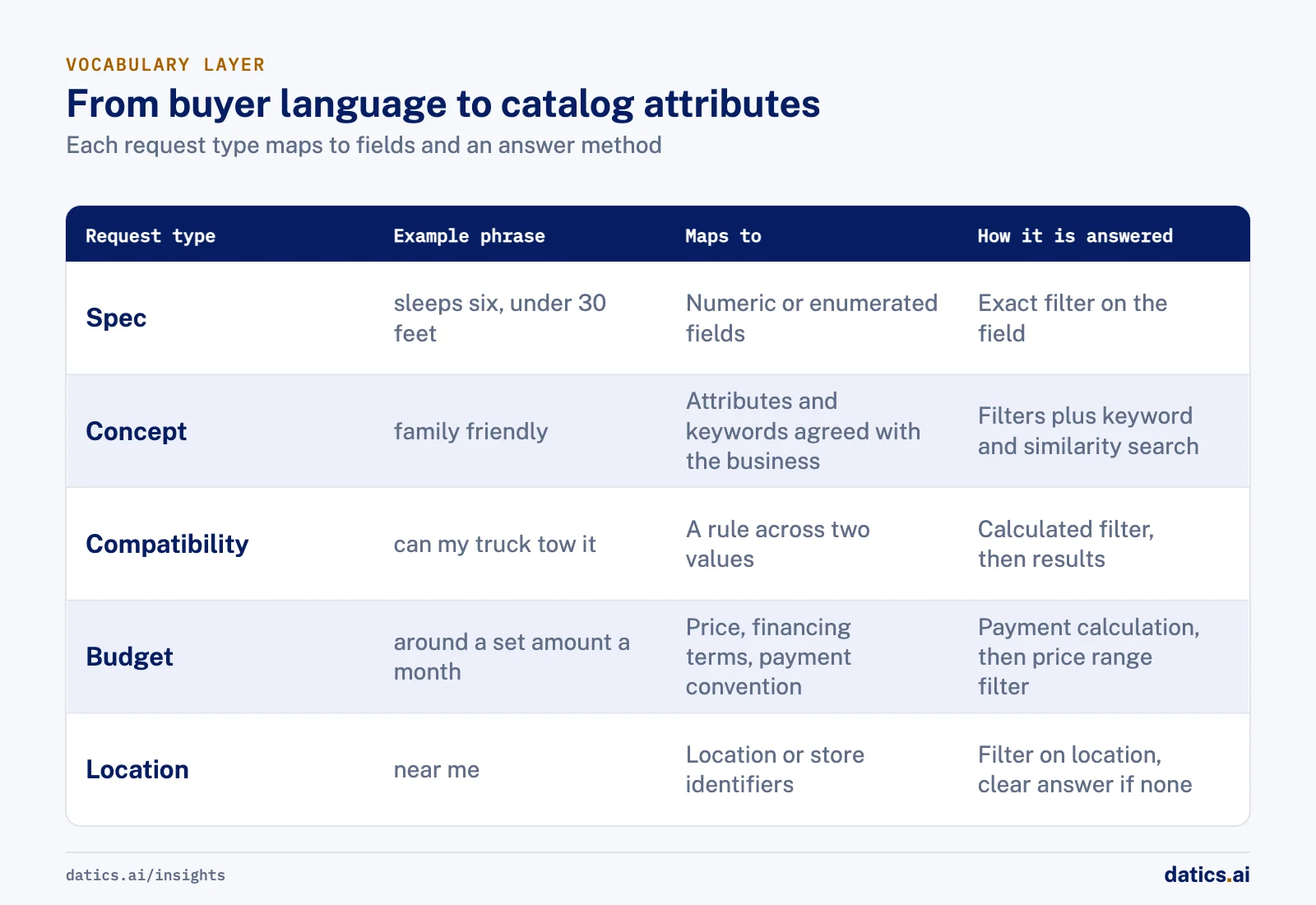
| Request type | Example phrase | Maps to | How it is answered |
|---|---|---|---|
| Spec | "sleeps six", "under 30 feet" | Numeric or enumerated fields | Exact filter on the field |
| Concept | "family friendly", "for off grid trips" | A set of attributes and keywords agreed with the business | Filters plus keyword and similarity search |
| Compatibility | "can my truck tow it" | A rule across two values, such as towing capacity and unit weight | Calculated filter, then results |
| Budget | "around a set amount a month" | Price, financing terms and the local payment convention | Payment calculation, then a price range filter |
| Location | "near me", "at your north store" | Location or store identifiers in the feed | Filter on location, with a clear answer if none match |
Concept mappings are where most of the value sits, and they are a business decision, not a model decision. Someone who knows the catalog has to agree what "family friendly" means in fields. Write those definitions down, version them and test them like code.
03Let the model call tools, not invent results
Once the mapping exists, the model's job becomes much narrower: understand the request, decide which tools to call and with which parameters, and explain the results. Modern model APIs support this directly through function or tool calling, where the model returns a structured call that your code executes. OpenAI's documentation, for example, describes a strict mode that makes the call follow a JSON schema exactly, which is useful when the parameters are filters on real fields.
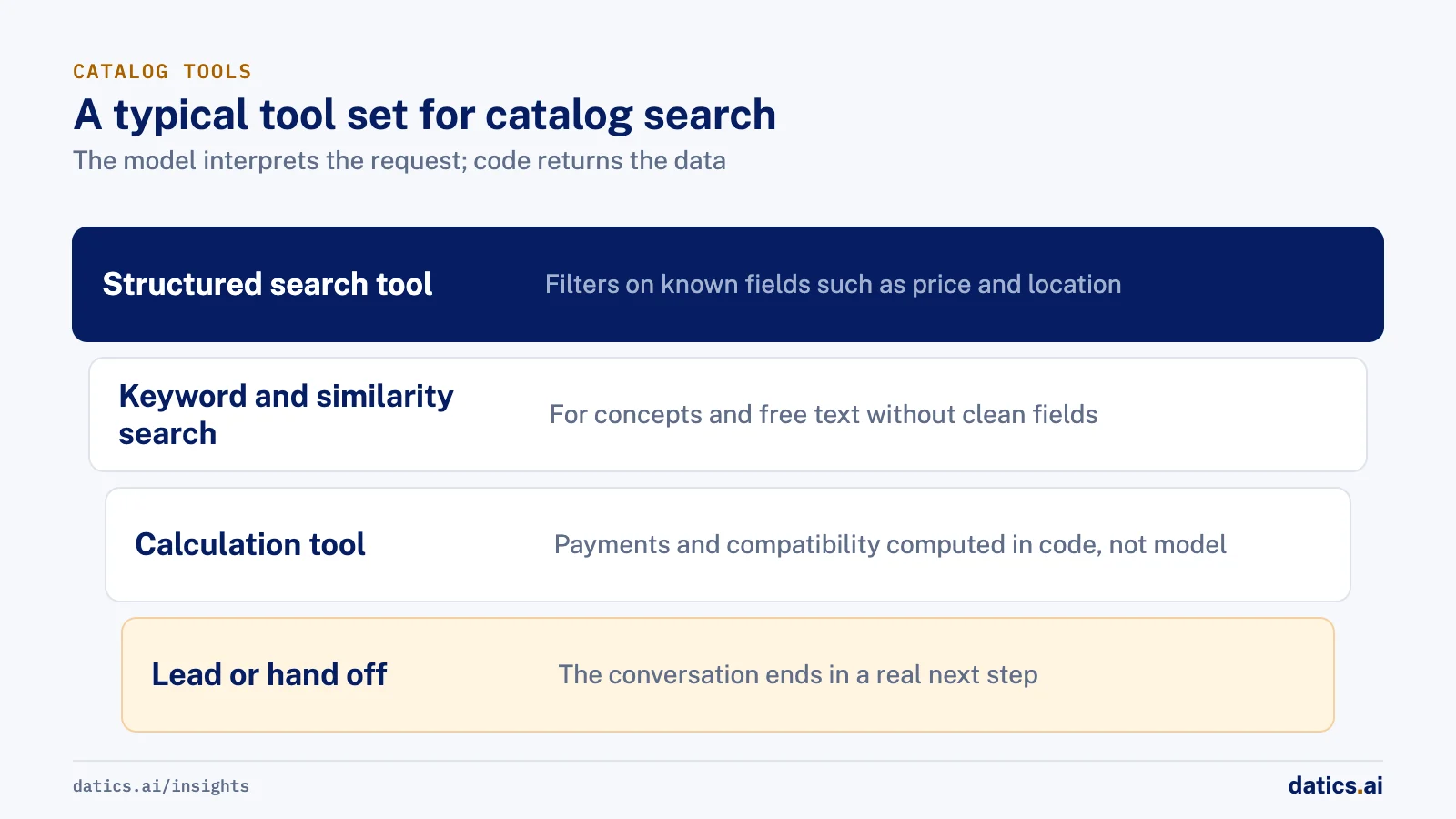
A typical tool set for catalog search looks like this:
- 01
A structured search tool that accepts filters on known fields (type, condition, price range, length, capacity, location).
- 02
A keyword and similarity search tool for concepts and free text that do not map cleanly to fields.
- 03
A calculation tool for payments or compatibility, so arithmetic happens in code, not in the model.
- 04
A lead or hand off tool, so the conversation can end in a real next step.
Hybrid retrieval helps with the second tool. Elastic's documentation describes hybrid search as running lexical and vector search in one request and merging the rankings, which suits catalog text where exact model names and loose descriptions both matter.
04Keep the data honest underneath
The mapping only works if the fields it relies on are reliable. Before tuning prompts, clean the data the filters use:
- Normalize the fields each supplier fills differently, and pick one source of truth when two fields overlap.
- Treat placeholder prices as missing, not as real values, so the bot never quotes them.
- Separate product types that share a file but not attributes.
- Sync the search index on a schedule that matches how often inventory changes.
- Store explicit rules for what may never be shown, such as excluded units or condition rules.
Then decide what the system says when nothing matches. An honest "we do not have that in stock, here is the closest option and why" builds more trust than a stretched match.
05Trade-offs to decide early
A few choices shape the whole system, and they are easier to make on day one than to reverse later.
- Filters versus similarity. Strict filters are precise but brittle when a buyer uses an unexpected word. Similarity search is forgiving but can drift. We use filters for anything the buyer states as a requirement and similarity for preference and description, and we log which path produced each result.
- Index freshness versus load. Syncing inventory more often keeps answers current but costs more and can strain the source systems. Match the sync schedule to how often stock really changes, and show the last sync time to the team.
- One model call versus several. A single call that does everything is simpler to build and harder to debug. Separate steps for intent, filter building and explanation make each failure visible.
- Clarifying questions versus guessing. Asking "new or used?" adds a turn but avoids a wrong list. Ask when the missing value would change the results a lot; otherwise, pick a sensible default and say which one you picked.
Write these decisions down with the reason. When a dealer or a product manager asks why the assistant behaves a certain way, the answer should be a documented rule, not a prompt someone tuned months ago.
06What we see in production
We built a multi-tenant AI sales assistant for a dealership software company that serves RV, marine and vehicle dealers. It runs on dealer websites, recommends real units from live inventory, explains why, qualifies the buyer and hands a complete lead with the transcript to the dealer's CRM.
The inventory data differs by dealer: missing prices, duplicate classification fields, placeholder prices, RVs and boats in one file, and different page URL schemes. Buyers ask in natural language with follow ups, tow vehicle questions, payment budgets that are monthly in the U.S. and biweekly in Canada, and location constraints.
Our early approach read inventory through a generic file based agent. We moved to search backed by an index that syncs from each dealer's inventory feed every hour, and later rebuilt the flow as a tool using agent with a lead tool, vector similarity search and structured filters. We mapped concept and spec queries to inventory attributes so the agent filters on what the feed actually contains, instead of hoping the model guesses.
Payment based filtering and towing capacity matching became explicit features. Answers are grounded in each dealer's own inventory, website and FAQ content, with inventory exclusion and new versus used rules, and an honest fallback when no unit matches. Dealer data is isolated per tenant, and the assistant works in English and Spanish.
On a sales assistant for a retail sales services company, the mapping is set by people: the assistant reads a seller's database only through the tables or SQL view an admin selects, and comparison answers merge database rows and CSV data into tables and cards, so shoppers see products side by side.
07How to test the mapping
Test the vocabulary layer separately from the conversation. Keep a list of real buyer phrases and the filters each one should produce, and check that list every time the mapping or the prompt changes. When a phrase produces the wrong filter, fix the mapping first; tuning the prompt to cover one phrase tends to break others. We cover broader evaluation in why AI agents fail in production.
Frequently asked questions
Why not let the model pick results from the catalog?
Because the answers sound right and are sometimes wrong. A model given the whole catalog may invent a unit, misread a price or ignore a constraint, and in a sales context that is worse than no answer. Let the model interpret the question and call tools, and let the data answer it.
Who decides what a concept like "family friendly" means?
Someone who knows the catalog. Concept mappings are where most of the value sits, and they are a business decision, not a model decision. The business agrees which attributes and keywords each concept maps to. Write those definitions down, version them and test them like code.
What should the assistant say when nothing matches?
It should say so honestly, then offer the closest option and explain why. An honest "we do not have that in stock, here is the closest option and why" builds more trust than a stretched match. It also keeps the assistant from presenting a weak match as a fit.
How do you test the mapping behind natural language search?
Test the vocabulary layer separately from the conversation. Keep a list of real buyer phrases and the filters each one should produce, and check it every time the mapping or the prompt changes. When a phrase produces the wrong filter, fix the mapping first, because tuning the prompt for one phrase tends to break others.
How Datics helps
Datics specializes in brownfield AI: bringing production AI into the product you already operate, without forcing a rebuild.
›References (2)
Related work
Case studies from our projects on the same subject.
Coast Technology
Automotive & Dealerships · AI sales assistant for dealers
RV shoppers get units from live stock, with towing fit computed, not guessed
Dealer sites offered static forms and filters. Now shoppers ask in plain words and get real units from the hourly feed, with the reason each one fits.
FLZR
Retail & E-commerce · AI sales assistant
Shoppers compare products side by side, answered from the seller's live database
Shoppers needed product answers at any hour; now an AI assistant answers from the seller's documents, files and live database, with comparison cards.
SenTrac
Marketing & Media · Social sentiment analytics SaaS
Agencies see how audiences feel about a campaign, scored fairly across six channels
Agencies copied comments by hand and misread sarcasm and emoji; now SenTrac scores every comment and compares channels on one scale.
More on RAG and AI assistants
RAG and AI assistants
How do you build a RAG chatbot on your knowledge base?
How to build a RAG chatbot on your knowledge base: a retrieval path per source, one merge step, and strict limits on what each assistant may read.
Rana Umar MajeedReadRAG and AI assistants
How do you stop hallucination in AI document extraction?
AI document extraction from long documents gets reliable with type detection, retrieval per field, clear field definitions and empty values, not guesses.
Rana Umar MajeedReadRAG and AI assistants
How do you make AI product search match how buyers shop?
AI product search works when it learns how buyers decide, such as a monthly payment budget, and turns that into precise filters over live inventory.
 Bilal HassanRead
RAG and AI assistants
Fine tuning vs RAG: when should you train on your own data?
Fine tuning vs RAG: use retrieval when the model lacks facts, fine tune when it does a narrow task badly, and collect user corrections first.
 Umair MajeedRead
RAG and AI assistants
What makes a good chatbot human handoff to a live agent?
How to design a chatbot human handoff: set escalation triggers up front, let admins set agent hours, and pass the full conversation to a shared inbox.
Rana Umar MajeedReadRAG and AI assistants
RAG evaluation: how do you test that citations hold up?
RAG evaluation must check more than whether citations exist. Test that each cited passage supports its claim and that answers decline when sources are silent.
Rana Umar MajeedReadYour customers already expect AI from your product.
Let us make it real without rebuilding what already works.