
RAG and AI assistants
Fine tuning vs RAG: when should you train on your own data?
Retrieval gives a model knowledge. Fine tuning gives it a habit. Most teams need the first long before the second.
 Umair MajeedCo-founder and CEO, Datics AI6 min read
Short answer
In the fine tuning vs RAG decision, use retrieval (RAG) when the model needs facts it does not have, such as your documents, records or catalog. Fine tune when the model already has the facts but performs a narrow task poorly, such as classifying sentiment in slang heavy text, and you have enough labeled examples of your own. Most products should start with pre-trained models and prompting, measure the gaps, and collect user corrections so fine tuning is possible later.
On this page
01Fine tuning vs RAG: two different problems
Fine tuning and retrieval augmented generation are often presented as rival answers to the same question. They are not. They fix different problems.
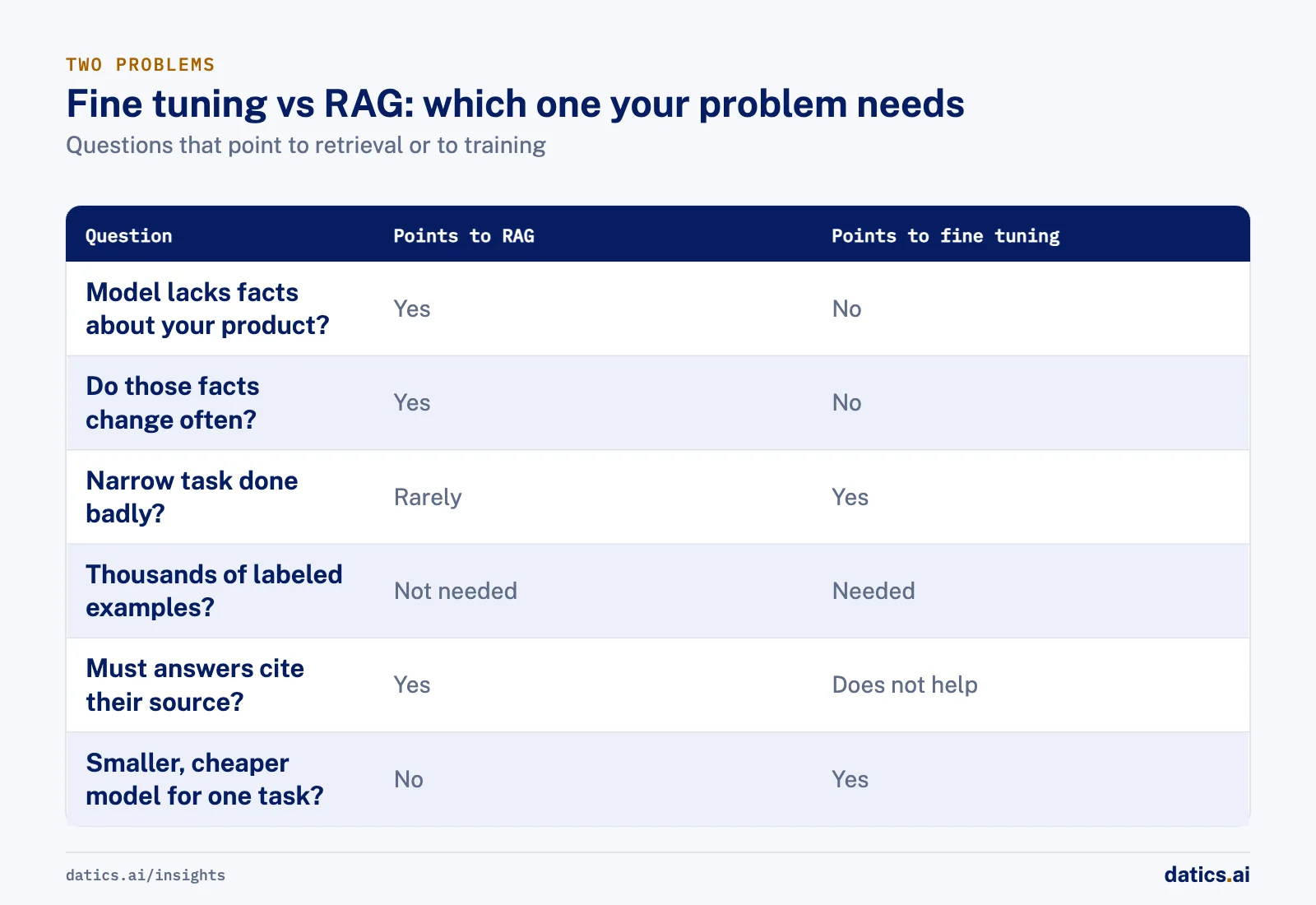
Retrieval augmented generation, introduced in research from 2020, pairs a language model with a retriever that fetches relevant documents at query time, so the model answers from evidence rather than from memory alone. It is the right tool when the problem is missing knowledge: the model does not know your help center, your contract terms or today's inventory. Knowledge changes, and retrieval lets you update it by updating the index, without retraining anything.
Fine tuning changes the model itself by training it further on examples. It is the right tool when the problem is behavior: the model knows the language but handles a specific task, format or style poorly, and better prompts do not close the gap. OpenAI's own optimization guide treats fine tuning as an optional step in a loop that starts with evaluations and prompt engineering, and it lists the cases where fine tuning earns its place: you have more examples than fit in a prompt, you want shorter prompts for cost and latency, you need to train on data you do not want to send in every request, or you want a smaller model to do one task well.
| Question | Points to RAG | Points to fine tuning |
|---|---|---|
| Does the model lack facts about your product or customers? | Yes | No |
| Do those facts change often? | Yes | No |
| Is the problem a narrow task done badly, like classification? | Rarely | Yes |
| Do you have thousands of labeled examples from your own users? | Not needed | Needed |
| Must answers cite their source? | Yes | Does not help |
| Do you want a smaller, cheaper model for one task? | No | Yes |
02How we decide in a live product
We do not start with either. We start with a baseline and a measurement, because without one there is no way to tell whether fine tuning improved anything. Our order of work:
- 01
Define the task and the metric.
For classification, that means labels, a test set and a score such as accuracy or F1. For question answering, it means questions with known correct answers.
- 02
Run a pre-trained model with careful prompting.
Many tasks are solved here. If not, the baseline tells you how far off you are.
- 03
Find the type of failure.
If the model answers with wrong or missing facts, add retrieval. If it understands the facts but misreads the input, consider a specialized model or fine tuning.
- 04
Route by difficulty.
Efficient models handle volume, and a larger model is held back for hard cases and summaries. This often closes much of the quality gap without any training.
- 05
Collect labeled data from real use.
Build the feedback path into the product so users can flag wrong results, and store those corrections for review.
- 06
Fine tune only when the data and the gap justify it.
Train on reviewed corrections, compare against the baseline on the same test set, and keep the old model ready as a fallback.
Step five is the one most teams skip, and it is the one that decides whether fine tuning is ever possible. Fine tuning needs labeled examples from your own domain. Public datasets rarely match how your customers write. The only reliable source of those labels is the product itself.
There is also a vendor point worth noting. Hosted fine tuning ties a custom model to one provider's training service, and providers change those services over time. OpenAI's optimization guide itself notes that its fine tuning platform is winding down for new users. A team that keeps its own labeled dataset can retrain elsewhere. A team that only kept the fine tuned model cannot.
03What we see in production
On a new sentiment analytics platform for social and influencer marketing campaigns, the core of the product is classification: sentiment, emotion, toxicity and sarcasm on public comments and reactions, across many channels and post formats. Social language is full of sarcasm, slang, emojis and mixed languages, so plain sentiment models misread it. The founder also required metrics that are correct and defensible, because the product positions itself as expert grade.
After a paid discovery, we recommended a hybrid AI engine. Efficient pre-trained models handle volume. Fine tuning for social language improves them on the kind of text the platform sees. A larger language model is held back for hard cases and for the report summaries, which users can edit before sharing. Scores are normalized across channels and formats so campaigns can be compared fairly, and reactions get their own scoring because each platform offers different reactions.
Fine tuning on the product's own labeled data is planned as a later step, not a launch requirement. What makes it possible is a small feature: a feedback button that lets users flag wrong results. Those flags are stored for review and model improvement. Over time they become a labeled dataset drawn from exactly the comments, platforms and campaigns the product serves. The platform is not live yet, and no accuracy results have been published, so the honest summary is that the engine was designed to start useful on pre-trained models and to earn its fine tuning from real corrections.
This is a classification product, so retrieval plays a small role in the sentiment engine itself. Where retrieval does matter is in the admin assistant that answers natural language questions about the data, which shows a confidence indicator based on how much data supports the answer. That split is typical: classification tasks lean toward specialized or fine tuned models, and question answering over changing data leans toward retrieval.
04Mistakes we see teams make
- Fine tuning to add knowledge. Training facts into a model is slow, hard to update and hard to audit. If the problem is missing facts, use retrieval.
- Fine tuning without a baseline. If you never measured the pre-trained model, you cannot show the fine tuned one is better.
- No feedback path. Without stored user corrections, you will never have the domain labels fine tuning needs.
- Ignoring cost and latency. A smaller fine tuned model can be cheaper per call, but training, evaluation and retraining are ongoing costs. Our article on how much production AI costs in SaaS covers how those costs show up.
- Locking into one provider. Keep the labeled dataset and the evaluation set as your own assets, so the model can move. See when an AI workload should move between clouds for the wider picture.
05A practical rule of thumb
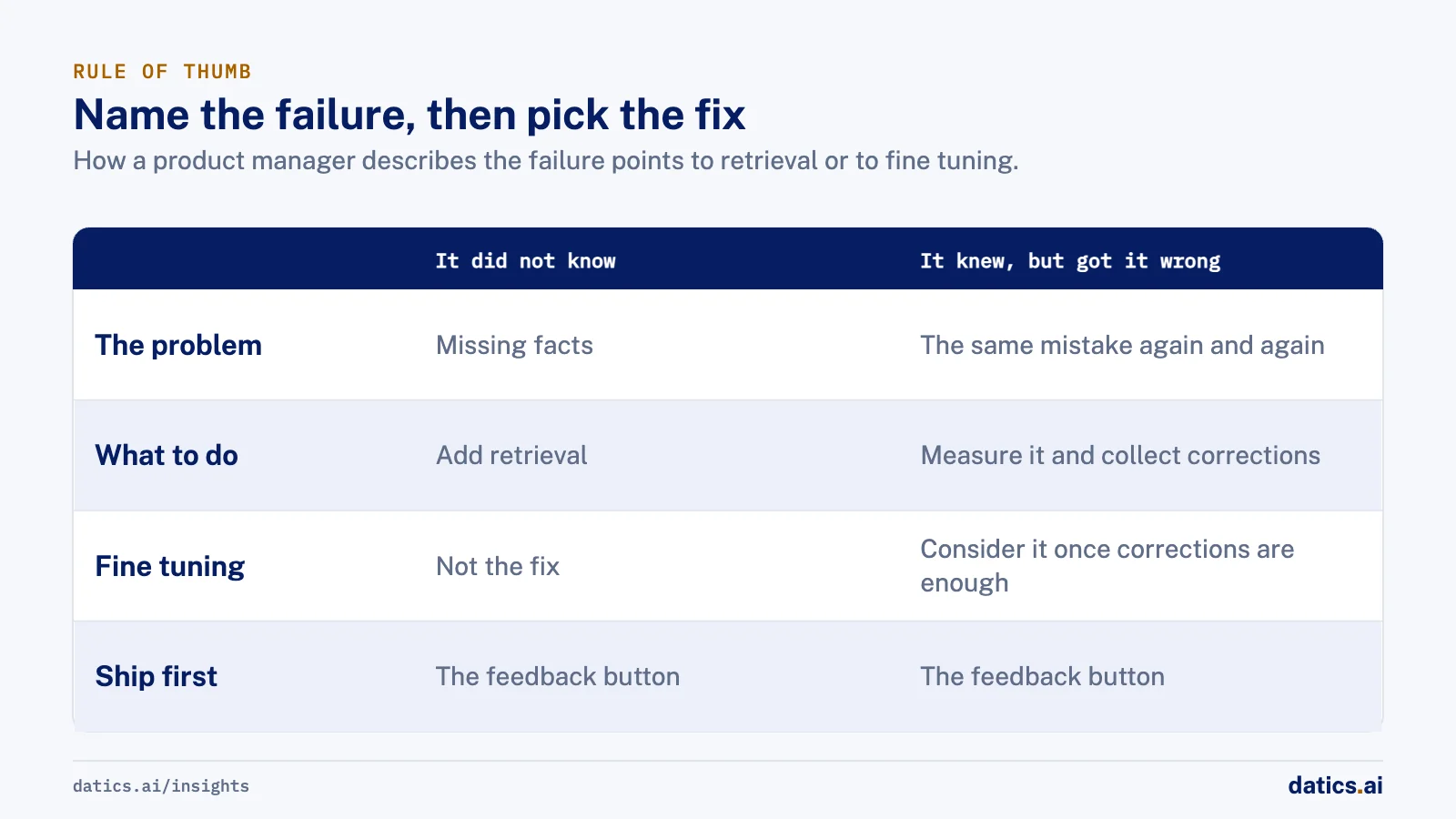
If a product manager can describe the failure as "it did not know," add retrieval. If they describe it as "it knew, but it got it wrong in the same way again and again," measure it, collect corrections, and consider fine tuning once you have enough of them. In both cases, ship the feedback button first.
Frequently asked questions
Can we use RAG and fine tuning together?
Yes, because they fix different problems. Retrieval gives the model facts it does not have, and fine tuning improves a narrow task it performs poorly. A typical split is a classification task on a specialized or fine tuned model, with an assistant that answers questions over changing data through retrieval.
How many labeled examples do we need to fine tune?
Enough labeled examples from your own domain that the gap justifies training, typically thousands from your own users. Public datasets rarely match how your customers write. The reliable source is the product itself: a feedback path that lets users flag wrong results, with those corrections stored and reviewed.
Does fine tuning lock us into one provider?
It can. Hosted fine tuning ties a custom model to one provider's training service, and providers change those services over time. Keep the labeled dataset and the evaluation set as your own assets. A team that keeps its own labeled dataset can retrain elsewhere, while a team that only kept the fine tuned model cannot.
How Datics helps
Datics specializes in brownfield AI: bringing production AI into the product you already operate, without forcing a rebuild.
Related work
Case studies from our projects on the same subject.
SenTrac
Marketing & Media · Social sentiment analytics SaaS
Agencies see how audiences feel about a campaign, scored fairly across six channels
Agencies copied comments by hand and misread sarcasm and emoji; now SenTrac scores every comment and compares channels on one scale.
Coast Technology
Automotive & Dealerships · AI sales assistant for dealers
RV shoppers get units from live stock, with towing fit computed, not guessed
Dealer sites offered static forms and filters. Now shoppers ask in plain words and get real units from the hourly feed, with the reason each one fits.
FLZR
Retail & E-commerce · AI sales assistant
Shoppers compare products side by side, answered from the seller's live database
Shoppers needed product answers at any hour; now an AI assistant answers from the seller's documents, files and live database, with comparison cards.
More on RAG and AI assistants
RAG and AI assistants
How do you build a RAG chatbot on your knowledge base?
How to build a RAG chatbot on your knowledge base: a retrieval path per source, one merge step, and strict limits on what each assistant may read.
 Rana Umar MajeedRead
RAG and AI assistants
How do you stop hallucination in AI document extraction?
AI document extraction from long documents gets reliable with type detection, retrieval per field, clear field definitions and empty values, not guesses.
Rana Umar MajeedReadRAG and AI assistants
How do you make AI product search match how buyers shop?
AI product search works when it learns how buyers decide, such as a monthly payment budget, and turns that into precise filters over live inventory.
 Bilal HassanRead
RAG and AI assistants
What makes a good chatbot human handoff to a live agent?
How to design a chatbot human handoff: set escalation triggers up front, let admins set agent hours, and pass the full conversation to a shared inbox.
Rana Umar MajeedReadRAG and AI assistants
RAG evaluation: how do you test that citations hold up?
RAG evaluation must check more than whether citations exist. Test that each cited passage supports its claim and that answers decline when sources are silent.
Rana Umar MajeedReadRAG and AI assistants
How does natural language search map to product data?
Natural language search over a product catalog works when the agent maps buyer words to attributes your feed actually holds, then filters on them, not guesses.
Rana Umar MajeedReadYour customers already expect AI from your product.
Let us make it real without rebuilding what already works.