
Brownfield AI
AI for field service and compliance software
The AI drafts and checks. A named person signs. The audit trail keeps both.
 Umair MajeedCo-founder and CEO, Datics AI10 min read
In brief
AI for field service and compliance software is most useful on the writing and checking that surround the work. That means drafting inspection and service reports from the data technicians already capture, checking records against the rules your customers follow, and preparing follow-up actions for a person to confirm. It should not sign off, close findings or change records on its own. A named person approves, and every draft, source and decision stays in the audit trail.
On this page
01Where the repetitive work sits
Most compliance and field service software already does the hard part well. It schedules the visit, routes the technician, captures the checklist, stores the photos and keeps the asset history. The product works. What still eats hours is the work on either side of the visit.
Before the visit, someone reads the asset history, the open findings and the procedure that applies, then briefs the technician. During the visit, the technician types notes on a phone, often in a hurry and sometimes in a second language. After the visit, an office coordinator turns those notes, readings and photos into a report the customer can read. Then a compliance lead checks that report against the inspection rules, chases missing items, opens corrective actions and, when the audit comes, assembles evidence from a dozen screens.
That is a lot of repetitive writing and checking, and it all happens inside the system you already sell. This is why AI belongs inside the product, not in a chat window beside it. The data, the workflow, the permissions and the record of who did what are already there. AI only needs to work with them.
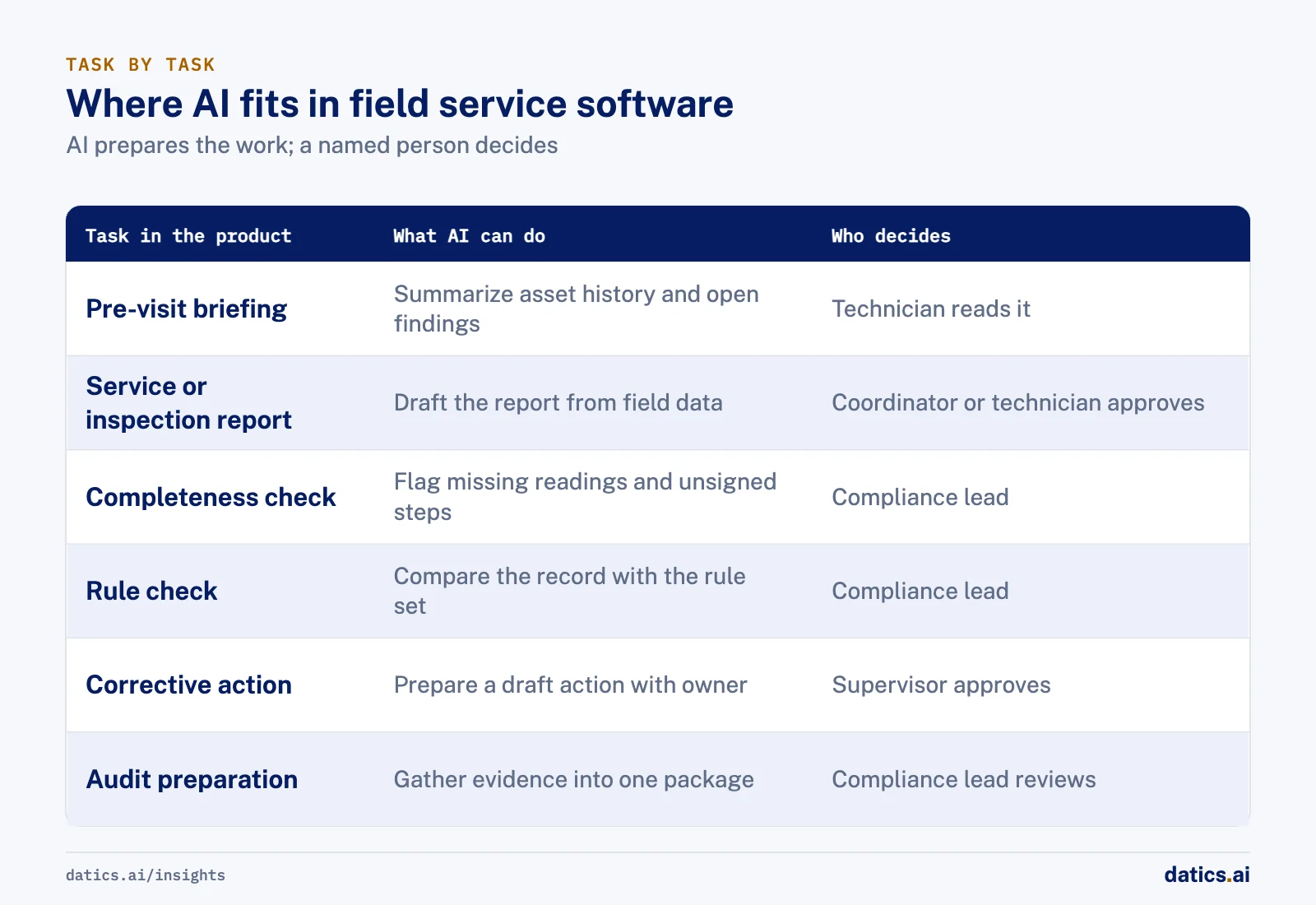
Here is where it fits, task by task:
| Task in the product | What AI can do | Who decides | What the audit trail keeps |
|---|---|---|---|
| Pre-visit briefing | Summarize asset history, open findings and the procedure that applies | Technician reads it; nothing changes | The summary and the records it read |
| Service or inspection report | Draft the report from checklist answers, readings, notes and photos | Coordinator or technician edits and approves | Draft, edits, final version, approver |
| Completeness check | Flag missing readings, unsigned steps and photos that do not match the asset | Compliance lead accepts or dismisses each flag | Each flag, its reason and the decision |
| Rule check | Compare the record with the rule set the customer follows and cite the clause | Compliance lead | The rule version used and the outcome |
| Corrective action | Prepare a draft action with owner and due date | Supervisor approves before it is created | Who approved, when, and what was created |
| Audit preparation | Gather evidence for a sample of records into one package | Compliance lead reviews before release | The package contents and their sources |
Every row has the same shape. The AI prepares. A person with the right role decides. The product records both.
02AI for field service: drafting reports from field data
Report drafting is usually the best first step because the output is easy to review and nothing in the system of record changes until a person approves it.
A good draft is built only from what the product already holds for that job. That means the checklist answers, the meter readings, the technician notes, the photo captions, the asset record and the template your customer uses. Each sentence in the draft should point back to the field it came from, so the reviewer can click from "pressure reading below the threshold" to the reading itself. Where the data is missing, the draft should say so and list the gap. It should never fill the gap with plausible text.
That last point is not a style preference. The NIST Generative AI Profile names confabulation as a core risk. It describes it as "the production of confidently stated but erroneous or false content." In an inspection report, a confident sentence about a reading nobody took is worse than a blank field. It can survive review, reach the customer and end up as evidence.
A few design choices keep drafting safe in field service software:
- Ground the draft in the job record only, not in general knowledge about the equipment.
- Mark the draft clearly as a draft, with a status the workflow understands, so it cannot be submitted by accident.
- Keep the technician's original notes alongside the draft, unchanged, in any language they were written in.
- Show the reviewer what changed between the AI draft and the approved version. Over time, that difference is your best evaluation data.
Done this way, the coordinator moves from writing the report to reading and correcting it. That is a real saving, and it does not ask anyone to trust the model blindly.
03Checking records against rules
Checking is where compliance software earns its keep, and it is also where AI needs the most care.
Start with what does not need AI at all. If a rule can be written as logic (a reading must be within a range, a step must be signed, a photo must exist), keep it as logic. Deterministic checks are cheaper, faster and easier to explain to an auditor.
AI helps with the checks that logic cannot reach because the evidence is unstructured. Does the free-text note describe the condition the checklist says was fine? Does the photo show the asset named on the work order? Does the corrective action actually address the finding it closes? Is the procedure the technician followed the current version of the procedure the customer's rule cites?
For these checks, the output should be a flag, not a verdict. Each flag carries the rule it relates to, the evidence it looked at and a plain reason. The compliance lead accepts or dismisses it, and both outcomes are logged.
There is a human risk here as well. The NIST profile describes automation bias as "excessive deference to automated systems." If reviewers see a green check from the AI on every record, they stop looking. Three habits help:
- Show the evidence next to every flag and every pass, so the reviewer is checking the record, not the AI.
- Route a sample of records the AI passed to a person anyway, and track how often that person disagrees.
- Version the rule set, and log which version every check ran against, so a later rule change never rewrites the history of an earlier check.
04Keeping the audit trail intact
An auditor does not need to understand the model. They need to see who did what, on what evidence, under whose authority, and whether the record can be trusted afterward. AI adds a new actor to that story, so the audit trail has to grow with it.
These are the controls we expect an auditor to look for when AI works inside compliance or field-operations software:
- 01
A distinct identity for the AI. Every draft, flag and suggestion is attributed to the AI capability, separately from the person who approved it.
- 02
Source links. Every statement in a draft or flag points to the record, reading, photo or rule clause it came from.
- 03
Approval before change. The AI prepares; a person with the right role approves before anything is written to the system of record or sent to a customer.
- 04
Draft and final both kept. The AI version, the human edits and the approved version are stored, never overwritten.
- 05
Model, prompt and rule versions logged. If a check ran last March, you can say exactly which configuration produced it.
- 06
Permissions and tenant boundaries respected. The AI sees only what the requesting user could already see, and never data from another customer.
- 07
Evaluation history retained. The test sets, results and changes over time are kept. The NIST profile suggests a document retention policy that keeps the history of testing, evaluation, validation and
- 08
Recovery. A wrong action can be reversed, and the reversal is logged like any other change.
None of this replaces the audit trail your product already has. It extends the existing one so that AI activity sits in the same log, under the same retention and the same access rules. Avoid building a separate AI log that auditors have to reconcile.
05How far to let AI act
Rana Umar Majeed, our co-founder and CTO, describes a capability ladder in why AI agents fail in production: read, recommend, prepare, modify, execute. Each step up needs more policy, approval, idempotency and audit.
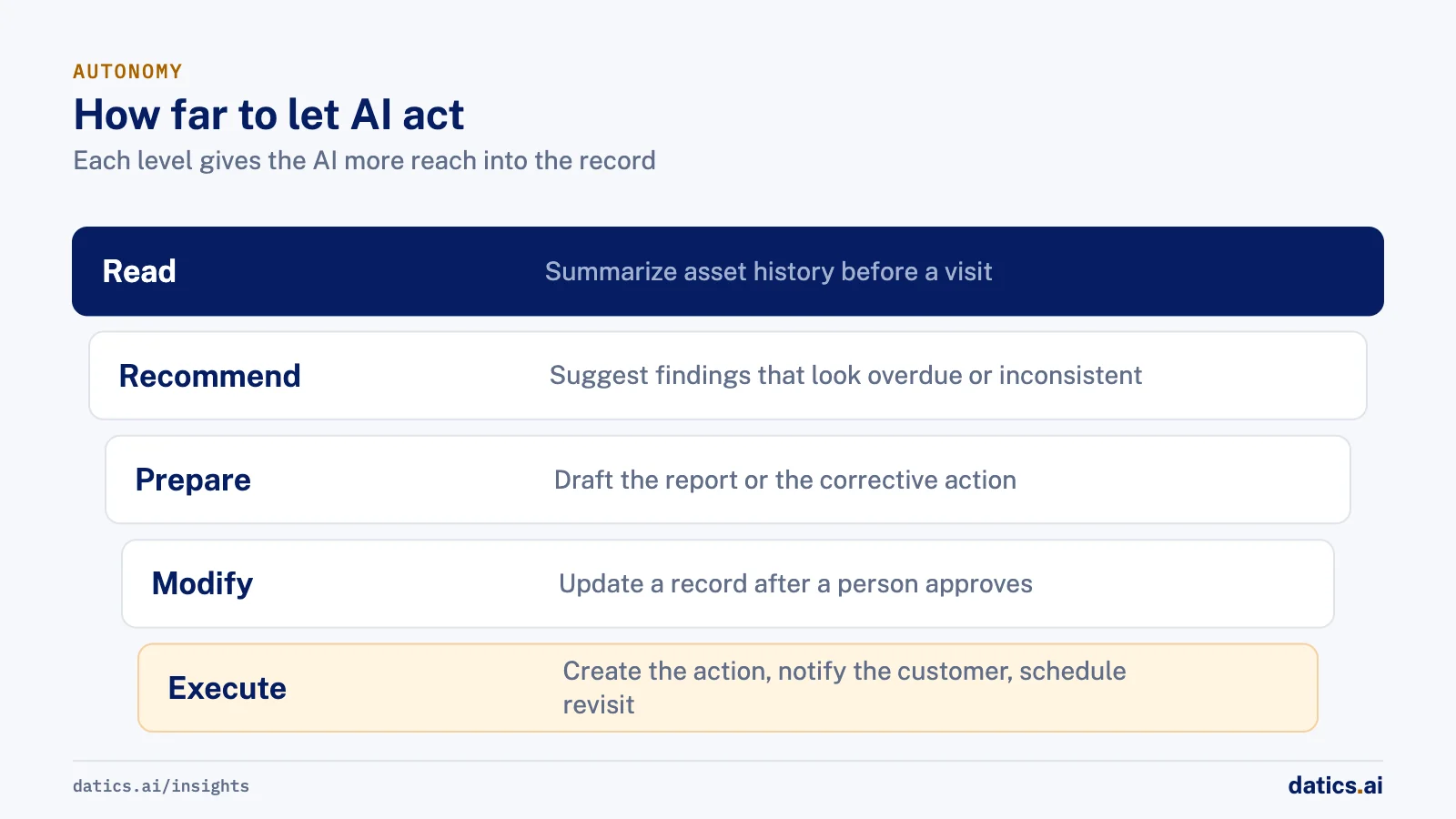
For compliance and field service software, the ladder maps neatly onto the work:
- Read: summarize asset history before a visit.
- Recommend: suggest which findings look overdue or inconsistent.
- Prepare: draft the report or the corrective action.
- Modify: update a record after a person approves.
- Execute: create the action, notify the customer, schedule the revisit.
Most products should start at read, recommend and prepare, where a person sees every output before anything is recorded. Moving up the ladder is a decision about controls, not about model quality. The same Insight frames this with the CARE lens: consistency, autonomy, reliability and explainability. In regulated work, explainability and reliability usually set the pace.
It also pays to measure the right thing. Count cost per successful task, meaning a report a reviewer approved with light edits or a flag a lead confirmed, not cost per model call. A cheap draft that needs a rewrite is not a saving.
If your customers include utilities or other critical infrastructure operators, expect their questions to sharpen. On April 7, 2026, NIST released a concept note for an AI RMF profile on trustworthy AI in critical infrastructure. The profile is meant to guide operators toward specific risk management practices when they adopt AI-enabled capabilities. The AI RMF itself is intended for voluntary use, and it gives you and your buyers a shared vocabulary for these conversations.
The same rules apply when you add AI agents to an existing SaaS product.
06What we see in production
Compliance and field operations is one of the industries we ship AI into. A few patterns repeat across our anonymized work.
In a field-operations platform, we built an AI-enabled operations layer with role-aware assistance, multilingual interaction and mobile task coordination. Role awareness was built in, not left to the prompt: each channel and role got its own graph and tool allowlist, so a cleaner's session simply has no owner tools. A field worker and an operations manager asking the same question should not get the same answer or see the same data.
In a governed AI verification platform, the requirement was that AI content be traceable, classified, verified and audit-gated before publication. That is the same discipline an inspection report needs: nothing leaves the system until it has passed a gate a person controls.
In a clinical documentation product, live transcription and patient history draft the clinical notes, and the clinician reviews, edits and approves before release. The domain is different, but the pattern is exactly the one we recommend for service and inspection reports.
In a claim verification product, claims are broken down through an ontology that combines rules, embeddings, retrieval and LLM reasoning. Rules where rules work, models only where they are needed, is how we approach record checks too.
In a regulated financial platform, AI and automation were added through services around the existing core application, so document, onboarding and compliance workflows could evolve without replacing the regulated system. Compliance software rarely needs a rebuild to gain AI. It needs a careful boundary.
And in a cloud file-management product, we put reliability and regression coverage in place first, before AI ingestion and retrieval. In products customers depend on daily, the tests that protect today's behavior come before the feature that changes it.
07Checklist
Before AI ships inside your compliance or field service software, check that:
- The first capability produces drafts or flags a person reviews, with nothing recorded until approval.
- Every draft and flag links to the record, reading, photo or rule clause behind it.
- Missing data is listed as missing, never filled in.
- Deterministic rules stay as code; AI handles only the unstructured evidence.
- The AI acts within the requesting user's permissions and one customer's data.
- AI activity is attributed to the AI and sits in your existing audit trail, with model, prompt and rule versions.
- A sample of AI passes is still reviewed by a person, and disagreement is tracked.
- Evaluation sets and results are retained and rerun on every release.
- Every AI action can be reversed, and the reversal is logged.
- Success is measured as cost per successful task, not cost per call.
Frequently asked questions
Can AI sign off an inspection or service report?
No. AI can draft the report and flag gaps, but a named person with the right role approves it. The audit trail keeps the AI draft, the human edits, the approved version and the name of the approver. The AI should never sign off, close findings or change records on its own.
What is the best first AI capability for compliance or field service software?
Report drafting from field data is usually the best place to start. The output is easy to review, and nothing in the system of record changes until a person approves it. A good draft uses only what the product already holds for that job. Where data is missing, the draft lists the gap instead of filling it.
Do rule checks need AI?
Most do not. If a rule can be written as logic, keep it as code. AI is useful only where the evidence is unstructured, such as free-text notes, photos or whether a corrective action actually addresses a finding. Even then, it should raise a flag for a person to decide, not deliver a verdict.
What will an auditor want to see about AI activity?
The same things they want to see about any activity: who did what, on what evidence, under whose authority, and whether the record can be trusted afterward. In practice, that means a distinct identity for the AI, source links, approval before any change, stored drafts and final versions, logged model, prompt and rule versions, respected permissions, retained evaluation history and logged recovery.
Is there a shared framework for these conversations with buyers?
The NIST AI Risk Management Framework is intended for voluntary use, and its Generative AI Profile names risks such as confabulation and automation bias. It describes the first as confidently stated but erroneous content. For critical infrastructure customers, NIST has also published a concept note for a dedicated profile.
How Datics helps
Datics specializes in brownfield AI: bringing production AI into the product you already operate, without forcing a rebuild.
Related work
Case studies from our projects on the same subject.
Where Do You Nom
Healthcare & Wellness · Food search and recommendations
Restaurant dishes linked to their recipes, so nutrition comes from ingredient data
Branded dish names linked to nothing, so no dish showed nutrition. Now each menu item reaches its recipe and ingredients.
Coast Technology
Automotive & Dealerships · Competitive inventory intelligence engine
Dealers see rival stock, prices and sales daily, captured from many changing websites
Dealers checked rival lots by hand, site by site. Now one engine captures competitor stock daily and the portal compares prices and sends alerts.
Social music collaboration app
Marketing & Media · Audio search and discovery
A prototype lets musicians search by instrument, read from the audio itself
No field held instruments, so search could not find a pianist or drummer; our prototype read real tracks and tagged what each one is.
More on Brownfield AI
Brownfield AI
AI integration for SaaS: add AI without a rebuild
AI integration for an existing SaaS product: keep your core as the system of record, reuse your APIs and auth, and ship one AI workflow without a rebuild.
Umair MajeedReadBrownfield AI
AI implementation challenges: lessons from 50+ projects
The AI implementation challenges behind 53 AI projects since 2018: integration, data, permissions, approvals and testing, and what to settle first.
Umair MajeedReadBrownfield AI
Is vibe coding enough for mature SaaS?
Vibe coding in SaaS is fast for prototypes. Mature products need server-side permissions, regression tests, evaluation and review before AI code ships.
Umair MajeedReadBrownfield AI
Entity matching: how do you map supplier data to a catalog?
Entity matching for product data works when you agree on mapping rules first, normalize before you compare, and route uncertain matches to people.
 Rana Umar MajeedRead
Brownfield AI
AI data integration: connect AI without a new platform
AI data integration without a migration: leave customer data where it lives, give AI governed paths to it, and index only what retrieval really needs.
Umair MajeedReadBrownfield AI
Brownfield vs greenfield: retrofit AI or start fresh?
Brownfield vs greenfield for AI: what a mature SaaS platform has that an AI startup lacks, where legacy code slows it down, and how to move just as fast.
Umair MajeedReadYour customers already expect AI from your product.
Let us make it real without rebuilding what already works.