
Brownfield AI
Brownfield vs greenfield: retrofit AI or start fresh?
The model is not the bottleneck. The product around it is.
 Umair MajeedCo-founder and CEO, Datics AI8 min read
Short answer
In brownfield vs greenfield AI, a mature SaaS platform starts with assets a startup cannot buy quickly: proprietary data, distribution, customer trust and paying users. The price is working around legacy code, existing permissions and uptime commitments. A greenfield AI startup moves faster on architecture but starts without data or customers, and its prototypes often stall during production hardening. Mature SaaS teams win by adding AI as services around the system of record and shipping narrow, measurable features quickly.
On this page
- 01What advantages does a mature platform already have?
- 02Where does legacy architecture slow AI work down?
- 03Why do greenfield AI prototypes struggle to reach production?
- 04Brownfield vs greenfield: cost, speed and risk compared
- 05How can a mature SaaS company move as fast as an AI startup?
- 06What we see in production
- Frequently asked questions
01What advantages does a mature platform already have?
Boards comparing their company with AI-native competitors often frame the question as speed. That framing misses what the incumbent already owns. The brownfield vs greenfield AI SaaS debate is really about which side holds the hard-to-copy parts of a useful AI feature.
A mature vertical SaaS product already has five things an AI startup has to earn:
- Data in context. Years of records, documents and transactions sit inside real workflows, labeled by how customers actually use them. A startup has a model; you have the context the model needs.
- Business logic and tools. Pricing rules, approval chains, integrations and edge cases are encoded in your code. These are exactly the actions an agent needs to call, and an AI-native newcomer cannot fake them.
- Permissions and tenancy. You already know who can see what, per customer and per role. That is the hardest part of a safe AI feature to build from scratch.
- Distribution. A feature you ship reaches every paying account through the screens they already use. A startup has to win each account, one sales cycle at a time.
- Trust. Your customers have already passed you through security review, procurement and renewal. A new vendor starts that process at zero.
02Where does legacy architecture slow AI work down?
Most mature products were built for people clicking through screens and for application code calling known functions. They were not built for a model that decides at run time which action to take. In our experience, AI work slows down in a handful of predictable places:
- Logic trapped in the interface. When a rule lives in a form or a controller instead of a service, an agent has nothing clean to call.
- Implicit permissions. If access is enforced by which page a user can reach, rather than by a check on each data request, an AI feature can read past those boundaries.
- Tenant boundaries that were never tested against retrieval. Search and retrieval for AI must respect the same tenant separation as the rest of the product, and that has to be proven, not assumed.
- Uptime and release discipline. A live product with paying customers cannot absorb a risky migration to make room for AI.
- A team already at capacity. The engineers who understand the system of record are usually busy keeping it running.
None of these is a reason to rewrite. Research on machine learning systems has made the same point for years: the model is a small part of the system. The NeurIPS paper on hidden technical debt in machine learning shows that only a small fraction of a real-world system is the model code, while the surrounding infrastructure is vast. A mature product already has much of that infrastructure. The job is to expose it safely, not to replace it.
03Why do greenfield AI prototypes struggle to reach production?
Greenfield teams can pick any architecture, any model and any stack, and they can reach a convincing demo in weeks. The trouble starts when the demo meets real customers.
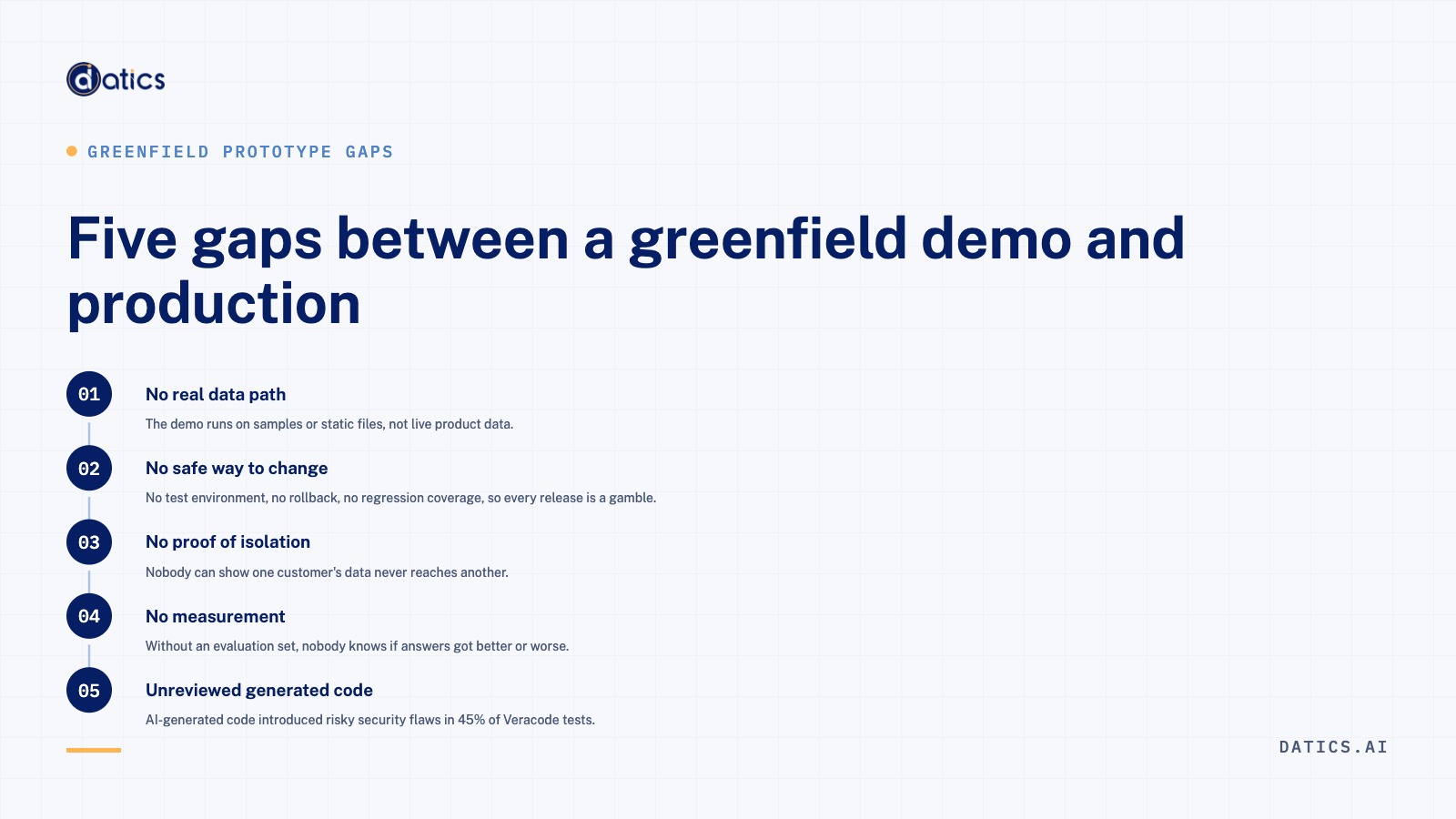
Industry data points the same way. Gartner predicted in 2024 that at least 30% of generative AI projects would be abandoned after proof of concept by the end of 2025, citing poor data quality, inadequate risk controls, escalating costs or unclear business value. In 2025 it predicted that over 40% of agentic AI projects would be canceled by the end of 2027, citing escalating costs, unclear business value or inadequate risk controls. Those causes are not model quality. They are the work around the model.
Greenfield prototypes tend to share the same gaps:
- No real data path. The demo runs on samples or static files, not a live connection to the data the product will depend on.
- No safe way to change things. There is no test environment, no rollback and no regression coverage, so every release is a gamble.
- No proof of isolation. Nobody can show that one customer's data, credits or documents can never reach another.
- No measurement. Without an evaluation set, nobody can say whether a change made answers better or worse.
- Code that was generated faster than it was reviewed. An academic study of GitHub Copilot found that about 40% of the programs it produced in security-relevant scenarios contained vulnerabilities, and a Stanford user study found that people with an AI assistant wrote less secure code while being more confident that it was secure.
04Brownfield vs greenfield: cost, speed and risk compared
The comparison below uses eight dimensions that decide whether an AI feature reaches production. The evidence column draws on retrofits we have delivered and startup prototypes we have hardened.
| Dimension | Retrofit into a mature SaaS platform | Greenfield AI startup | What we see in production |
|---|---|---|---|
| Data access | Rich, proprietary, already in context, but often spread across systems and formats | Clean slate, but little real data until customers arrive | Retrofits win when AI reads data where it already lives; startups often lack a live data path at launch |
| Customers and distribution | Paying users reach a new feature through screens they already use | Every account has to be won first | A narrow feature inside an existing workflow gets used; a standalone tool has to earn adoption |
| Speed to first demo | Slower, because the demo must run against the real system | Fast, often weeks | Demo speed rarely predicts production speed on either path |
| Time to production | Steady once the first capability is scoped narrowly | Often long, because hardening starts late | In the startup prototypes we hardened, isolation, access control and payment safeguards had to be added before launch |
| Architecture freedom | Constrained by legacy code, release cycles and uptime | Full freedom of stack and model | Building AI as services around the existing core avoids most constraints without a rewrite |
| Permissions and tenancy | Already defined, but must be enforced on every AI request | Must be designed and proven from nothing | A patient intake prototype we hardened had to gain clinic isolation before it could serve more than one clinic |
| Operational risk | High blast radius if AI touches live records carelessly | Low blast radius, few users to harm | Retrofits stay safe by starting with read and recommend, with human approval before anything is recorded |
| Hardening effort | Moderate; much of the scaffolding exists | High; logging, audit, evaluation and recovery must all be built | The model is the small part on both paths; the surrounding controls decide the outcome |
The pattern is consistent. Greenfield wins on early speed and freedom. Retrofit wins on data, customers, permissions and the amount of hardening already done. The risk on the retrofit side is concentrated in one place: letting AI change live records before the controls exist. That risk is manageable with sequencing.
05How can a mature SaaS company move as fast as an AI startup?
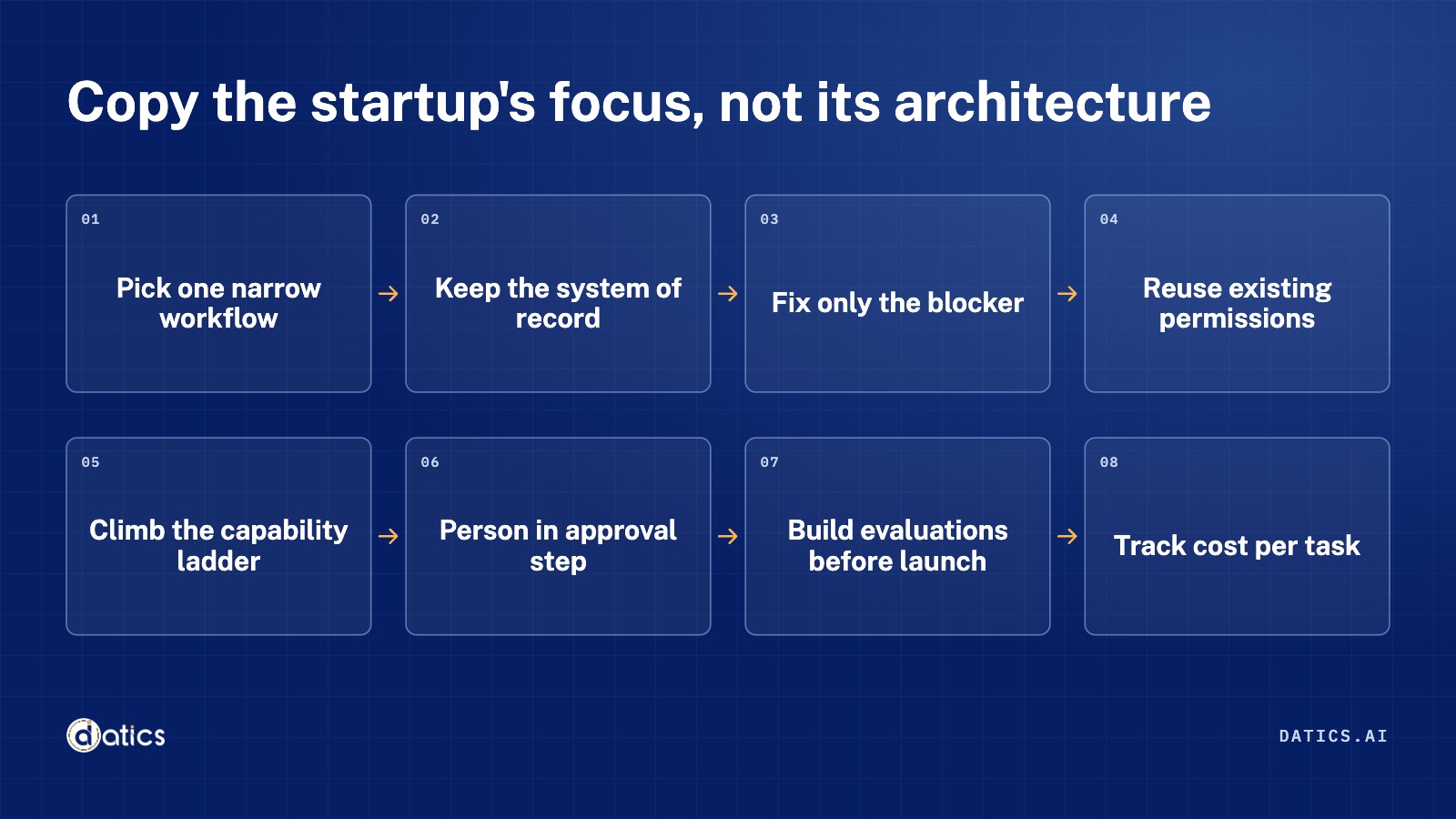
An incumbent does not need to copy the startup's architecture to match its pace. It needs to copy its focus. This is the sequence we use:
- 01
Pick one narrow workflow with a measurable outcome.
Choose a task where success can be counted, such as time to prepare a document or questions answered without a ticket.
- 02
Keep the system of record.
Build AI as separate services that call the existing product through defined interfaces, so the core application does not have to change.
- 03
Change only what the capability requires.
If one API or one data path blocks the feature, fix that one, and leave the rest alone.
- 04
Reuse existing permissions on every request.
The AI should see exactly what the signed-in user can already see, checked at each tool call, inside each tenant boundary.
- 05
Climb the capability ladder slowly.
Start with read and recommend, then prepare drafts, and only later modify or execute. Each step up needs more policy, approval and audit.
- 06
Put a person in the approval step.
Anything sent to a customer or written to a record is reviewed first.
- 07
Build the evaluation set before launch.
Test on real cases from your own domain and rerun the set on every release.
- 08
Track cost per successful task.
Model spend only matters relative to work actually completed.
Shipped behind a feature flag and delivered in small pull requests, this approach lets a mature product put a working AI capability in front of customers while competitors are still finding theirs.
Speed alone is not the answer either: see why vibe coding is not enough for a mature SaaS product.
06What we see in production
We work on both sides of this question: retrofitting AI into established products and taking startup prototypes to production. The details below are anonymized.
An established investment platform in a regulated market. Issuers were copying deal information by hand from documents such as decks, memos and financial statements into long forms, and much of the review and analysis around each deal was manual. The goal was AI that reads the documents, assembles the deal record and supports market and risk analysis while staying audit ready. We kept the existing application as the system of record and built AI as services around it. Each step of the deal workflow got its own agent with a narrow job. The regulated core was never replaced; the workflows around it changed.
A claim verification product at an early-stage AI company. The founder wanted to break claims into small units, classify them against a fixed scheme, score them and keep a provable record. The prototype proved the idea but could not be measured, scaled, audited or integrated. We began with a gap analysis before writing code. We kept rule-based pattern matching as a fast, explainable anchor, added semantic embeddings, and limited the language model to suggestions with a confidence score, merged through calibrated weights. We also designed a ledger that signs each claim's record. The lesson for boards: the model became one input among several, not the decision maker.
A patient-intake prototype that became a multi-clinic product. An adaptive intake prototype had to grow clinic isolation, role-based access, onboarding, provider configuration and billing before it could serve more than one clinic.
Retrofits where the core stayed put. On a cloud file-management product, we added reliability and regression coverage before any AI ingestion or retrieval. On a multi-tenant fulfillment platform, only the legacy storefront layer that blocked progress was replaced. On an investor CRM, data synchronization was added with no replacement of the core.
On a food and nutrition app, we worked from the client's existing exports and its 200,000 labeled menu items rather than collecting new data, and linked each dish to its recipe before building any recommender on top of those links.
Across this work, the deciding factor was never the model. It was data paths, isolation, evaluation, approval and audit.
Frequently asked questions
Are AI native startups a real threat to vertical SaaS incumbents?
They are a real threat when incumbents wait. Startups move quickly and can make a buyer question the roadmap. They rarely hold the data, workflows, permissions and customer trust that make AI useful in a vertical market, and many of their prototypes stall in hardening. An incumbent that ships narrow, working AI inside the product its customers already use removes most of the opening a startup is counting on.
Should we rewrite our product to be AI first?
In most cases, no. A rewrite puts your proven workflows, integrations and customer trust at risk to gain architectural freedom you mostly do not need. The better path is to build AI as services around the system of record and change only the parts a specific capability actually requires, such as one missing API or one permission check. The product customers rely on keeps running while it gains new abilities.
Is AI generated code enough to retrofit a mature platform?
No. AI coding tools speed up writing code, but they do not know your tenancy model, hidden business rules or the edge cases your customers depend on. Independent academic research found vulnerabilities in about 40% of programs an AI coding assistant generated for security-relevant tasks. In a mature platform, generated code needs review by engineers who understand the system, regression coverage, and evaluation before it reaches paying customers.
How do we organize teams for AI work in a legacy product?
Keep your core team focused on the system of record and pair it with a small group that owns the AI capability end to end: evaluation, permissions, approval flows and cost. Engineers embedded close to the product and its users, sometimes called forward deployed engineers, shorten the feedback loop. Agree on narrow interfaces between the two groups so AI work ships without destabilizing the core release cycle.
How Datics helps
Datics specializes in brownfield AI: bringing production AI into the product you already operate, without forcing a rebuild.
›References (5)
- Gartner: 30% of generative AI projects will be abandoned after proof of concept by end of 2025
- Gartner: Over 40% of agentic AI projects will be canceled by end of 2027
- Sculley et al., Hidden Technical Debt in Machine Learning Systems (NeurIPS 2015)
- Pearce et al., Asleep at the Keyboard? Assessing the Security of GitHub Copilot's Code Contributions (IEEE S&P 2022)
- Perry et al., Do Users Write More Insecure Code with AI Assistants? (ACM CCS 2023)
Related work
Case studies from our projects on the same subject.
Where Do You Nom
Healthcare & Wellness · Food search and recommendations
Restaurant dishes linked to their recipes, so nutrition comes from ingredient data
Branded dish names linked to nothing, so no dish showed nutrition. Now each menu item reaches its recipe and ingredients.
Coast Technology
Automotive & Dealerships · Competitive inventory intelligence engine
Dealers see rival stock, prices and sales daily, captured from many changing websites
Dealers checked rival lots by hand, site by site. Now one engine captures competitor stock daily and the portal compares prices and sends alerts.
Social music collaboration app
Marketing & Media · Audio search and discovery
A prototype lets musicians search by instrument, read from the audio itself
No field held instruments, so search could not find a pianist or drummer; our prototype read real tracks and tagged what each one is.
More on Brownfield AI
Brownfield AI
AI integration for SaaS: add AI without a rebuild
AI integration for an existing SaaS product: keep your core as the system of record, reuse your APIs and auth, and ship one AI workflow without a rebuild.
Umair MajeedReadBrownfield AI
Is vibe coding enough for mature SaaS?
Vibe coding in SaaS is fast for prototypes. Mature products need server-side permissions, regression tests, evaluation and review before AI code ships.
Umair MajeedReadBrownfield AI
Entity matching: how do you map supplier data to a catalog?
Entity matching for product data works when you agree on mapping rules first, normalize before you compare, and route uncertain matches to people.
 Rana Umar MajeedRead
Brownfield AI
AI data integration: connect AI without a new platform
AI data integration without a migration: leave customer data where it lives, give AI governed paths to it, and index only what retrieval really needs.
Umair MajeedReadBrownfield AI
AI product strategy: embed AI or launch a separate product?
An AI product strategy for an established SaaS: when to build AI into the product you have, when a separate AI product makes sense, and how to decide.
Umair MajeedReadBrownfield AI
How does data quality monitoring catch bad AI inputs?
Data quality monitoring for AI features: watch input completeness per source and run, then block or flag statistics, dashboards and AI answers when it drops.
Rana Umar MajeedReadYour customers already expect AI from your product.
Let us make it real without rebuilding what already works.