
Brownfield AI
Entity matching: how do you map supplier data to a catalog?
Collecting the data takes sprints. Agreeing what it means takes more.
 Rana Umar MajeedCo-founder and CTO, Datics AI6 min read
Short answer
Entity matching for product data works in four steps: agree on the target catalog and mapping rules with the people who own it, clean and normalize supplier records before comparing anything, generate candidate matches cheaply and score them carefully, and send uncertain matches to a person. Budget most of the effort for the mapping and the agreement on the data model, not for collecting the data. Collection is the visible part; mapping is the work.
On this page
01Why entity matching for products is harder than it looks
Supplier and manufacturer data arrives in every shape. One site lists a model with its year in the title, another puts it in a separate field, a third uses a marketing name that appears nowhere in your catalog. Specifications use different units and labels. Some fields are missing, some are wrong, and the same product can appear several times with small differences. This is part of our larger guide, AI integration for SaaS: add AI without a rebuild.
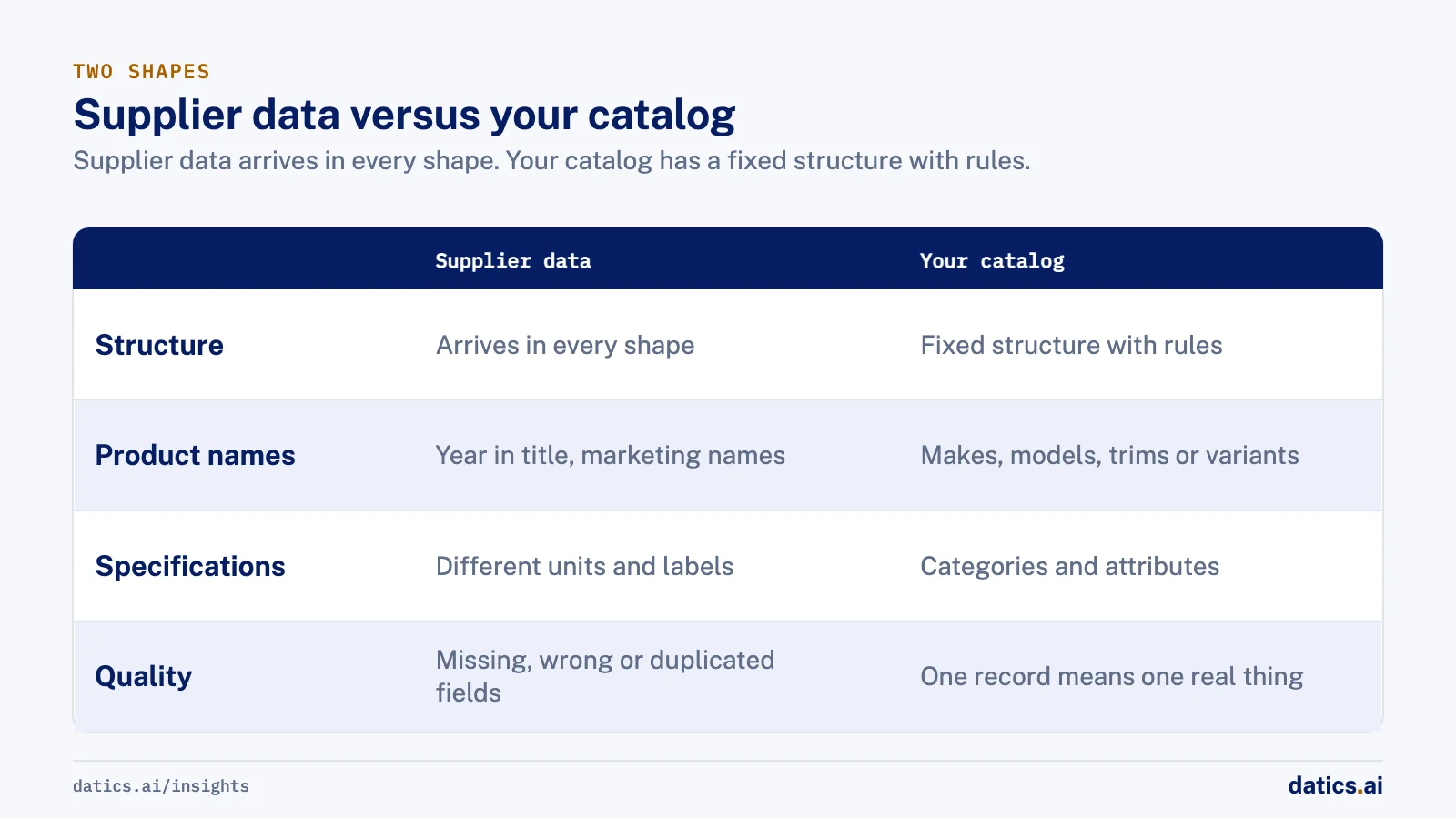
Your catalog, on the other hand, has a fixed structure: makes, models, trims or variants, categories and attributes, each with rules your product depends on. Search, reports, pricing and every future AI feature assume that a record in the catalog means one real thing.
Matching connects the two. It is called entity matching, record linkage or entity resolution, and it has a long research history. Open-source tools such as Splink, built on the Fellegi-Sunter model of record linkage, score pairs of records with a match probability rather than a yes or no. That framing is the right one for product data too: every match has a confidence, and confidence decides what happens next.
02Agree on the data model before you match
The first mistake is to treat matching as a data engineering task that starts once data is collected. It starts earlier, with agreement on the target.
Before any matching runs, settle these with the catalog owner:
- 01
The target schema.
Which fields exist, which are required, and what each one means. "Trim" and "variant" mean different things to different teams.
- 02
The level of a match.
Is a match to the model enough, or must it reach the trim and year? A dealer comparing prices needs the second.
- 03
Normalization rules.
Units, capitalization, abbreviations, how marketing names map to catalog names.
- 04
What happens to no-match.
Create a new catalog entry, hold for review, or drop?
- 05
Who decides disputes.
Someone on the client side must own the mapping, or every review round reopens the rules.
This step usually becomes a meeting about how the mapping itself will be managed: where mapping files live, who edits them and how changes are reviewed. Plan for it. It is not a delay; it is the work that makes the rest repeatable.
03Clean and normalize before you compare
Matching raw strings is slow and inaccurate. Clean first, then link.
- Split compound fields. An ingredient line or a listing title often packs several facts into one string: quantity, unit, item and preparation, or year, make, model and trim. Parse them into separate fields.
- Normalize names. Remove branded prefixes, standardize abbreviations and produce a generic name next to the original.
- Merge duplicates inside each source before matching across sources.
- Keep the original. Store the raw value beside the normalized one, so a reviewer can always see what the supplier actually said.
04Generate candidates cheaply, then score carefully
Comparing every supplier record with every catalog record does not scale. Splink's documentation notes that a dataset of one million records produces around 500 billion pairwise comparisons. The standard answer is to split the work into two stages.
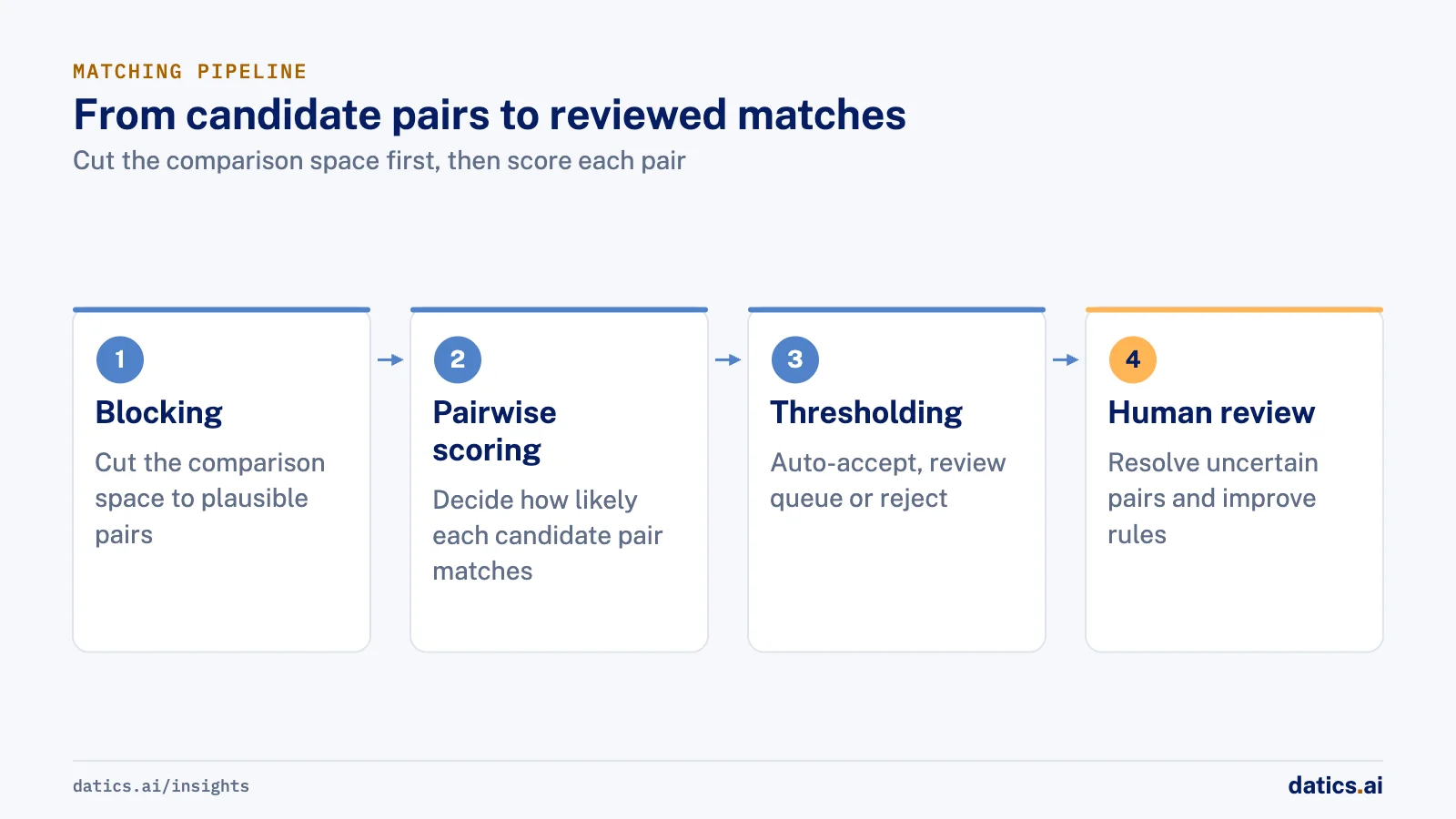
| Stage | Purpose | Typical techniques |
|---|---|---|
| Blocking or candidate generation | Cut the comparison space to plausible pairs | Exact keys such as make or category, n-gram indexes, locality sensitive hashing on embeddings |
| Pairwise scoring | Decide how likely each candidate pair is a match | Field-by-field similarity, probabilistic models, embeddings, fine-tuned language models |
| Thresholding | Turn scores into actions | Auto-accept, review queue, reject |
| Human review | Resolve uncertain pairs and improve rules | Side-by-side review with the raw and normalized records |
For scoring, research has moved quickly. A widely cited paper on Ditto showed that fine-tuning pretrained language models for entity matching beat earlier methods by up to 29% in F1 on benchmarks and needed far less labeled data. That does not mean every product team needs a fine-tuned model. Field-level rules plus a simple similarity model often handle most of a catalog, and a stronger model can be saved for the hard remainder.
Whatever the method, use more than one blocking rule. A single rule misses true matches with a typo in the key field; a small set of rules catches them while keeping comparisons manageable.
05Plan for the long tail
Matching is never finished, because sources keep changing. Manufacturer sites are redesigned, dealer websites change templates without notice, and new brands arrive. Plan for ongoing work:
- Monitor coverage. Track how many records failed to collect or failed to match, by source, every cycle.
- Fix wrong matches, not just missing ones. A wrong product in the catalog does more harm than a missing one, because people trust it.
- Reuse by template. Many sources share a platform. Group them so one fix covers many.
- Keep the mapping versioned so you can tell which rule produced which match.
Clean product data is also what any later AI feature in your product will stand on. If you are planning AI on top of this data, the cost side is covered in how much production AI costs in SaaS.
06What we see in production
For a dealership marketing and software company, we built structured product data capture for powersports and marine manufacturers, feeding the inventory module of its multi-tenant dealership portal. Manufacturer sites differed widely: one used several product layouts, and a dynamic site needed several fetching approaches. We wrote one collector per brand, then per-brand mapping files into the client's own data format. Extraction was planned and built in the first sprints. The later sprints went to mapping files, and the mapping was revised with the client over two rounds of feedback. A later phase added an inventory data API and automatic population of inventory data inside the portal.
For a competitive inventory intelligence product serving RV and automotive dealerships, where we run scoping, engineering and crawler operations end to end, data comes from hundreds of public dealer websites that use different templates, change without notice, block bots or go offline. We group sites into reusable crawler types per site platform rather than one scraper per dealer, and map listings to a consistent make, model and trim catalog with management commands. Listings arrive with messy titles, conditions and missing fields, so offer-to-product mapping and cleanup of wrong products are continuous work, and every sprint includes a crawler health pass so coverage does not decay. The product has been live and in continuous use since at least 2022.
For a food discovery and nutrition startup, we cleaned and linked menu items, recipes and ingredients that nothing connected before. Ingredient lines were split into quantity, unit, item and preparation, and branded menu names were given a generic second name. We trained word2vec on the cleaned names, used unigram and bigram search for lookup and locality sensitive hashing to make similarity search over the large set several times faster. Nutrition values came from the linked recipe and ingredient data, never from a model.
Agreeing on the target included the category list itself: in the menu and recipe linking work, categories such as Starters and Beginnings were folded into Appetizers. We worked from the client's existing exports and its 200,000 labeled menu items rather than collecting new data.
The lesson across all three: the matching method mattered less than agreement on the target catalog and a mapping that both sides could review.
Frequently asked questions
Do we need a fine-tuned language model for entity matching?
Not always. Fine-tuned language models such as Ditto beat earlier methods by up to 29% in F1 on benchmarks and needed far less labeled data. Field-level rules plus a simple similarity model often handle most of a catalog, and a stronger model can be saved for the hard remainder.
What should happen to records that do not match?
Decide that with the catalog owner before any matching runs: create a new catalog entry, hold the record for review, or drop it. Uncertain pairs go to a person, who reviews the raw and normalized records side by side. Each resolved case also improves the rules for the next cycle.
Why does mapping take longer than collecting the data?
Because the mapping depends on agreement about what the data means. The target schema, the level of a match, normalization rules and who decides disputes all have to be settled with the client. In one project, extraction was built in the first sprints, while the later sprints went to mapping files revised over two rounds of feedback.
Is entity matching ever finished?
No, because sources keep changing. Manufacturer sites are redesigned, dealer websites change templates without notice and new brands arrive. Track how many records failed to collect or failed to match by source every cycle. Fix wrong matches as well as missing ones, and keep the mapping versioned so you can tell which rule produced which match.
How Datics helps
Datics specializes in brownfield AI: bringing production AI into the product you already operate, without forcing a rebuild.
Related work
Case studies from our projects on the same subject.
Coast Technology
Automotive & Dealerships · Competitive inventory intelligence engine
Dealers see rival stock, prices and sales daily, captured from many changing websites
Dealers checked rival lots by hand, site by site. Now one engine captures competitor stock daily and the portal compares prices and sends alerts.
Where Do You Nom
Healthcare & Wellness · Food search and recommendations
Restaurant dishes linked to their recipes, so nutrition comes from ingredient data
Branded dish names linked to nothing, so no dish showed nutrition. Now each menu item reaches its recipe and ingredients.
More on Brownfield AI
Brownfield AI
AI integration for SaaS: add AI without a rebuild
AI integration for an existing SaaS product: keep your core as the system of record, reuse your APIs and auth, and ship one AI workflow without a rebuild.
 Umair MajeedRead
Brownfield AI
AI implementation challenges: lessons from 50+ projects
The AI implementation challenges behind 53 AI projects since 2018: integration, data, permissions, approvals and testing, and what to settle first.
Umair MajeedReadBrownfield AI
Is vibe coding enough for mature SaaS?
Vibe coding in SaaS is fast for prototypes. Mature products need server-side permissions, regression tests, evaluation and review before AI code ships.
Umair MajeedReadBrownfield AI
AI data integration: connect AI without a new platform
AI data integration without a migration: leave customer data where it lives, give AI governed paths to it, and index only what retrieval really needs.
Umair MajeedReadBrownfield AI
Brownfield vs greenfield: retrofit AI or start fresh?
Brownfield vs greenfield for AI: what a mature SaaS platform has that an AI startup lacks, where legacy code slows it down, and how to move just as fast.
Umair MajeedReadBrownfield AI
AI product strategy: embed AI or launch a separate product?
An AI product strategy for an established SaaS: when to build AI into the product you have, when a separate AI product makes sense, and how to decide.
Umair MajeedReadYour customers already expect AI from your product.
Let us make it real without rebuilding what already works.