
Brownfield AI
How do you build a data ingestion pipeline for many sources?
A small schema you trust beats a large export nobody has checked.
 Rana Umar MajeedCo-founder and CTO, Datics AI6 min read
Short answer
A data ingestion pipeline that feeds a product, and later its AI features, starts with a small core schema that matches how your product thinks about the domain: a parent record, its child records and their media. Map every source into it with documented field rules. Then deliver in stages, summary fields first, detail fields next and reference data last, and check each layer before adding the next so nobody trusts a large raw export blindly.
On this page
01Why outside data needs a product schema, not a copy
When a product depends on records from many outside websites, partners or vendors, the first instinct is to copy everything. Pull every field from every source, store it, and decide later. It feels safe because nothing is lost. This is part of our larger guide, AI integration for SaaS: add AI without a rebuild.
In practice it creates a mess the product cannot use. One source calls it a listing, another a unit, a third a property. One stores price as text with currency symbols, another as a number with no period. Some fields mean the same thing under different names; some share a name and mean different things. An AI feature reading this layer will produce fluent output on top of contradictions.
The fix is to decide what the product needs before deciding what to collect. The core schema is the product's view of the domain. Sources are mapped into it, not the other way round.
02Start the data ingestion pipeline with a small core schema
Most domains fit a simple shape: a parent record, its child records and their media. In housing that is a building, its units and their photos. In retail it might be a product, its variants and their images. In training it might be a course, its lessons and their files.
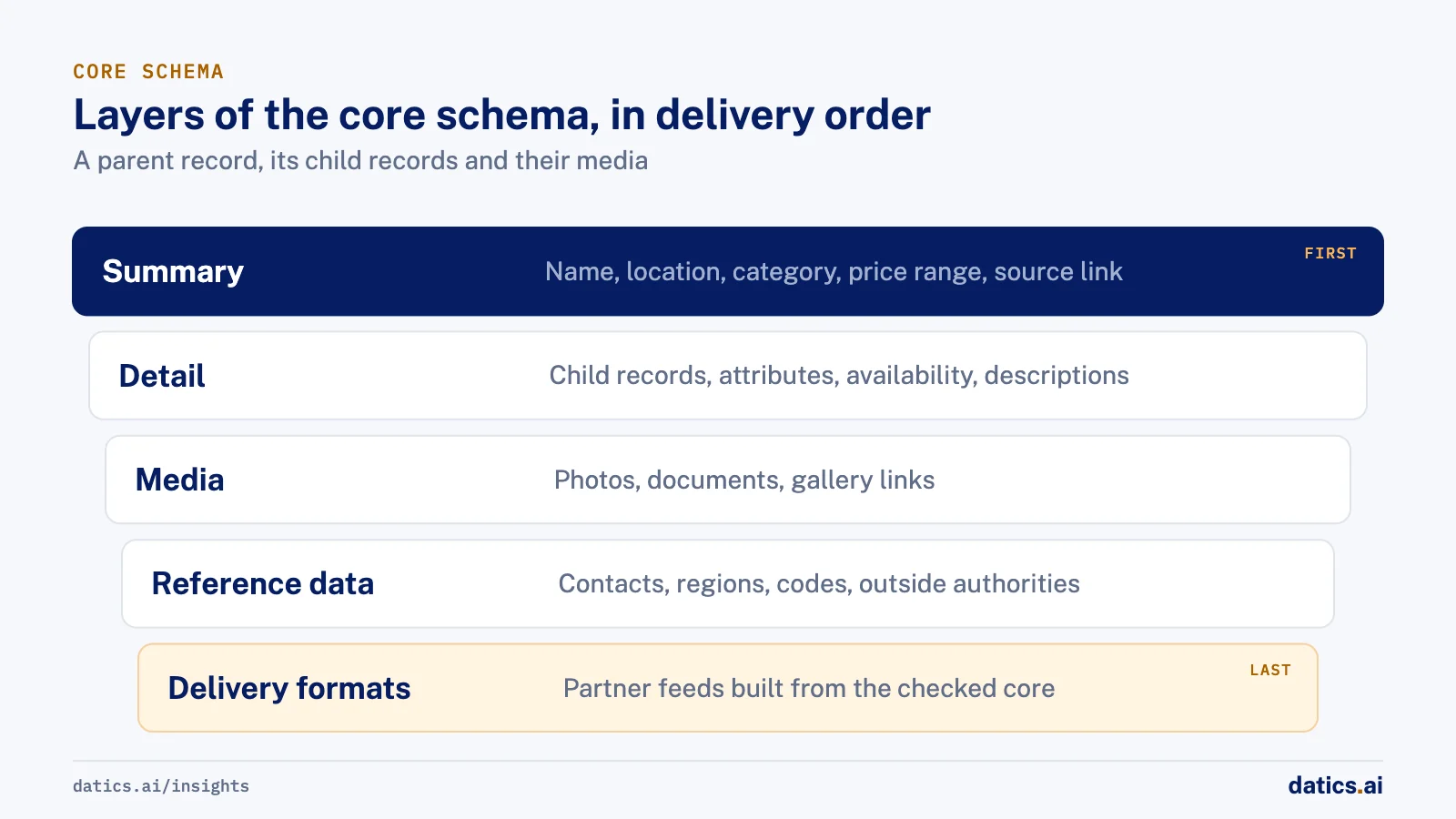
Keep the first version small. Include the fields the product will show, filter or compute on, and nothing else. Add a source field and a pulled-at date to every record. Every other field can wait until a feature needs it.
| Layer | Example fields | Why it comes in this order |
|---|---|---|
| Summary | Name, location, category, price range, source link | Enough to list, search and filter; easy to check against the source |
| Detail | Child records, attributes, availability, descriptions | Depends on correct parent records; more fields means more mapping rules |
| Media | Photos, documents, gallery links | Needs stable parent and child keys to attach to |
| Reference data | Contacts, regions, codes, outside authorities | Enriches records; checked once records are stable |
| Delivery formats | Feeds or exports for partners | Built last, from the checked core, not from raw data |
03Write field rules down
For each source, write a mapping document a product manager can read. For every target field: which source field feeds it, how the value is transformed, what happens when it is missing, and which source wins when two disagree.
This document does three jobs. It lets the client check the logic before anything is loaded. It lets a new engineer add a source without guessing. And it turns quality problems into specific questions: is the rule wrong, or is the source wrong?
Teams that use a transformation tool often formalize this as a staging layer. dbt's guidance, for example, recommends one staging model per source table, where columns are renamed and types are cast consistently, and joins and aggregations are kept out of that layer. The principle holds with any tool: standardize each source on its own before combining them.
04Deliver in stages and check each one
We deliver outside data in layers, and each layer is reviewed before the next is added. This is the order we follow.
- 01
Pull a small sample from each source.
Map it into the core schema and review it with the client, field by field, against the live source.
- 02
Deliver the summary layer at full scale.
Check counts by source and region, required fields and duplicates.
- 03
Add the detail layer.
Check that every child record links to a parent and that no parent lost its children.
- 04
Attach media.
Check that links resolve and that each item belongs to the right record.
- 05
Add reference data.
Contacts, regions and codes, matched to existing records.
- 06
Build outbound formats last.
Feeds and exports for partners are generated from the checked core.
- 07
Automate the checks.
Turn every manual check into a rule that runs on each refresh and alerts when it fails.
The last step is what makes the pipeline last. Validation tools such as Great Expectations describe the idea well: expectations are verifiable assertions about data, run against each batch, much like unit tests for code. Counts within a range, required fields present, keys unique, prices positive. When a source changes its page layout, the check fails before a customer sees the damage.
05Plan for growth and refresh
Scope grows. A pilot covering one city becomes a national dataset. A handful of sources becomes dozens. Two decisions keep that growth manageable.
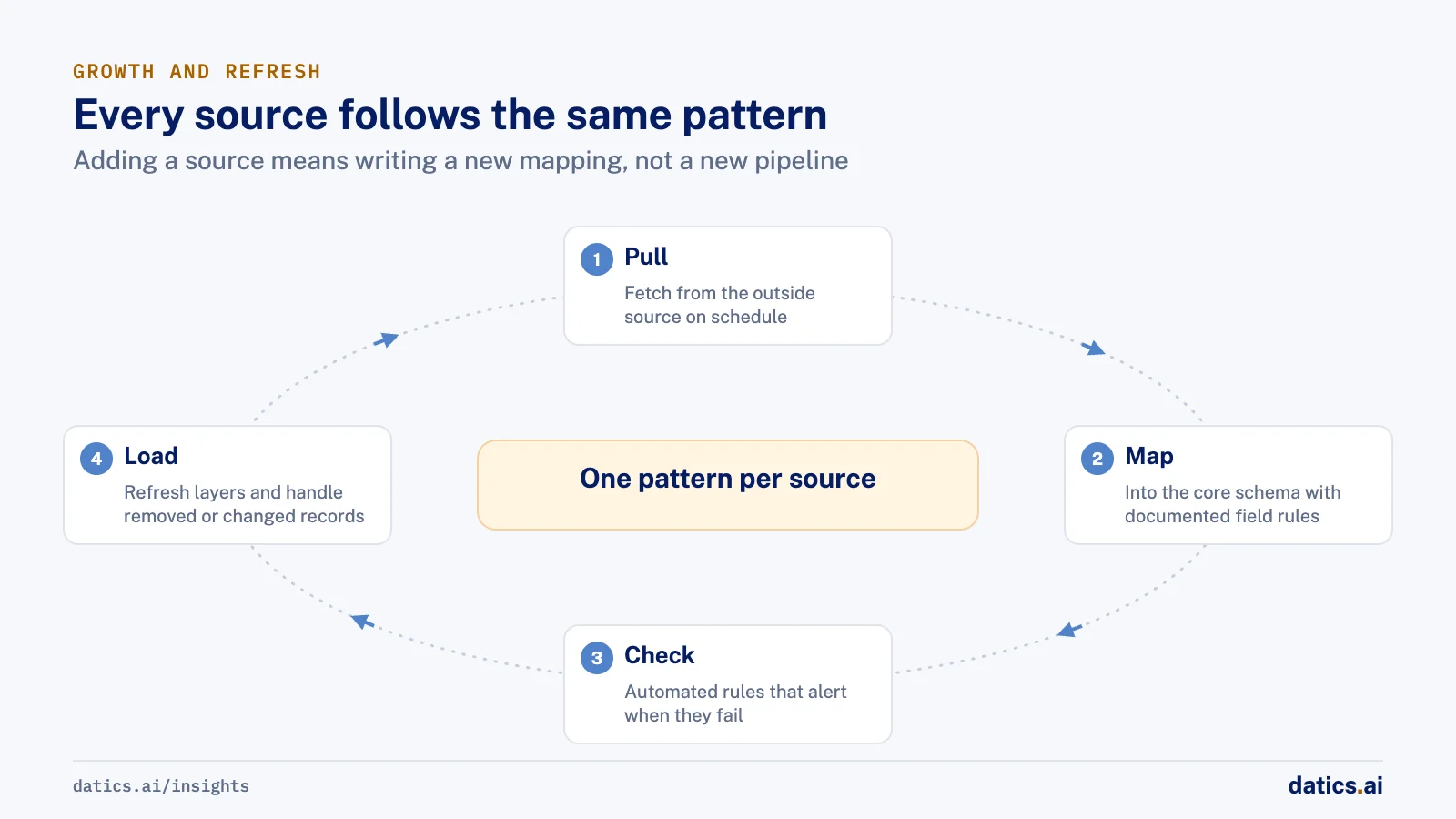
First, make every source a module that follows the same pattern: pull, map, check, load. Adding a source should mean writing a new mapping, not changing the pipeline.
Second, plan the refresh from the start. Outside data goes stale. Decide how often each layer is refreshed, how removed records are handled and how a changed record is detected. A product that shows last quarter's listings as current loses trust quickly, and an AI feature built on stale data repeats the mistake at scale.
06When AI comes in
Only once the core layer is trusted should AI features read from it: search in plain language, summaries of long records, matching between users and listings, or classification of free text. The model reads clean, linked records with known sources, and its answers can point back to them. For a wider view of how AI fits into an existing product, see adding AI agents to an existing SaaS product without rebuilding it.
07What we see in production
For an affordable rental housing venture, we started with data before any software. We collected property listing data from several large property management websites and delivered it as CSV files. We then extended it to deeper property detail pages, then to public housing authority contacts for all states, and then to a rental listings feed format the client could push to a third-party listing portal. The data scope grew with each delivery round, from one metro area to a far larger listing set, and the staged order meant each round built on data the client had already reviewed.
The data also shaped the schema: some properties had several bedroom, bathroom and square foot combinations, so in the affordable housing listings work we delivered unit models as data rather than one flat table per property, and when the scope grew to a far larger listing set, the full records followed within two weeks.
The listings website followed the same shape. Its data model has properties, units and media tables, with test data mapped into the database before the screens were finished. We built it in milestones: project setup and property management first, then search, discovery and communication, then a round of client revisions, with a full QA cycle before the client demo. There was no AI in the delivered scope. The data foundation is what any later AI feature, such as matching renters to units, would depend on.
Frequently asked questions
Should we copy every field from every source?
No. Copying everything feels safe, but it creates a mess the product cannot use: different names for the same thing, the same name for different things, and prices stored in different formats. Decide what the product needs first. Keep the core schema small, with only the fields the product will show, filter or compute on.
In what order should outside data be delivered?
Summary fields first, then detail, then media, then reference data, with delivery formats for partners built last from the checked core. Pull a small sample from each source and review it with the client against the live source before going to full scale. Each layer is reviewed before the next is added.
How do you keep an ingestion pipeline reliable after launch?
Automate the checks. Turn every manual check into a rule that runs on each refresh and alerts when it fails, such as counts within a range, required fields present, keys unique and prices positive. Make every source a module that follows the same pattern, and plan how often each layer is refreshed.
When should AI features read from the data?
Only once the core layer is trusted. Then AI can search in plain language, summarize long records, match users to listings or classify free text. The model reads clean, linked records with known sources, so its answers can point back to them. An AI feature built on stale data repeats the mistake at scale.
How Datics helps
Datics specializes in brownfield AI: bringing production AI into the product you already operate, without forcing a rebuild.
Related work
Case studies from our projects on the same subject.
RentSpire
Real Estate & Hospitality · Affordable housing listings platform
Renters search affordable housing listings built on property data we structured first
A listings site with no listings is no use to renters; we structured the property data first, then built search and an owner dashboard on it.
Where Do You Nom
Healthcare & Wellness · Food search and recommendations
Restaurant dishes linked to their recipes, so nutrition comes from ingredient data
Branded dish names linked to nothing, so no dish showed nutrition. Now each menu item reaches its recipe and ingredients.
Coast Technology
Automotive & Dealerships · Competitive inventory intelligence engine
Dealers see rival stock, prices and sales daily, captured from many changing websites
Dealers checked rival lots by hand, site by site. Now one engine captures competitor stock daily and the portal compares prices and sends alerts.
More on Brownfield AI
Brownfield AI
AI integration for SaaS: add AI without a rebuild
AI integration for an existing SaaS product: keep your core as the system of record, reuse your APIs and auth, and ship one AI workflow without a rebuild.
 Umair MajeedRead
Brownfield AI
Is vibe coding enough for mature SaaS?
Vibe coding in SaaS is fast for prototypes. Mature products need server-side permissions, regression tests, evaluation and review before AI code ships.
Umair MajeedReadBrownfield AI
Entity matching: how do you map supplier data to a catalog?
Entity matching for product data works when you agree on mapping rules first, normalize before you compare, and route uncertain matches to people.
Rana Umar MajeedReadBrownfield AI
AI data integration: connect AI without a new platform
AI data integration without a migration: leave customer data where it lives, give AI governed paths to it, and index only what retrieval really needs.
Umair MajeedReadBrownfield AI
Brownfield vs greenfield: retrofit AI or start fresh?
Brownfield vs greenfield for AI: what a mature SaaS platform has that an AI startup lacks, where legacy code slows it down, and how to move just as fast.
Umair MajeedReadBrownfield AI
AI product strategy: embed AI or launch a separate product?
An AI product strategy for an established SaaS: when to build AI into the product you have, when a separate AI product makes sense, and how to decide.
Umair MajeedReadYour customers already expect AI from your product.
Let us make it real without rebuilding what already works.