
Fintech and investment platforms
AI in fintech: what should it do, and what should it not?
In fintech, the AI can do the reading. The yes or no on money belongs to a person, every time.
 Umair MajeedCo-founder and CEO, Datics AI5 min read
Short answer
AI in fintech earns its place when it prepares the work and a person makes the call. For investing, wealth, private markets and lending software, the strongest features read documents into fields, answer research questions with their sources and draft orders or deals that an investor or an analyst confirms. The regulated decision always stays with a person.
On this page
01Where AI in fintech creates value today
Fintech products are full of slow, careful reading. Analysts read pitch decks and subscription documents into deal records. Diligence teams chase missing forms. Investors ask research questions that someone answers by searching filings and news. Each of these is work AI can prepare well, as long as the product shows where every number came from.
Five uses pay off first:
- Deal drafting from issuer files. Pitch decks and offering documents become a drafted deal record, with each field linked to the page it came from and the issuer approving every field before publishing.
- Due diligence pre-fill. Onboarding and diligence questionnaires filled from the documents already uploaded, with missing items flagged instead of guessed.
- Investor matching. Deals recommended to investors from their stated criteria, with the reasons shown, while the investor decides.
- Cited research answers. Questions answered from filings, news and market data, each figure cited to its source and forecasts declined.
- Orders an investor confirms. Agents that research and prepare an order, then wait for the investor to confirm it.
02The rules that shape AI in fintech
Regulators have been clear that existing rules apply to AI the same way they apply to any other technology. FINRA's Regulatory Notice 24-09 reminds member firms that its rules, including those on supervision and communications with the public, apply when firms use generative AI. For lenders, Regulation B (12 CFR 1002.9) requires a creditor that takes adverse action to give the applicant a statement of specific reasons, and nothing in the rule exempts decisions made with AI or complex models. The CFPB withdrew its 2023 circular on adverse action notices in May 2025, but the regulation itself still applies, so confirm the details with your own counsel.
Those two points shape the design of any AI feature in a financial product:
| What the rules expect | What it means for the AI feature | How to build it |
|---|---|---|
| Supervision of communications | Anything the AI writes to a customer can be reviewed | Drafts go to a person; every message is logged |
| Specific, accurate reasons | The system must explain its outputs | Every value and recommendation carries its source or reason |
| No advice by accident | Forecasts and recommendations are sensitive | Decline price predictions; present facts with sources |
| Data separation | One client must never see another's data | Filter by firm, plan and user before retrieval |
| Decisions stay human | Orders, deals and KYC need accountable people | AI prepares; a named person confirms each one |
None of this is a compliance claim on its own. Compliance depends on the whole product, its policies and how it is supervised. A well designed AI layer makes those reviews easier, because every output can be traced and every decision has an owner.
03How to add AI to a fintech platform without touching the core
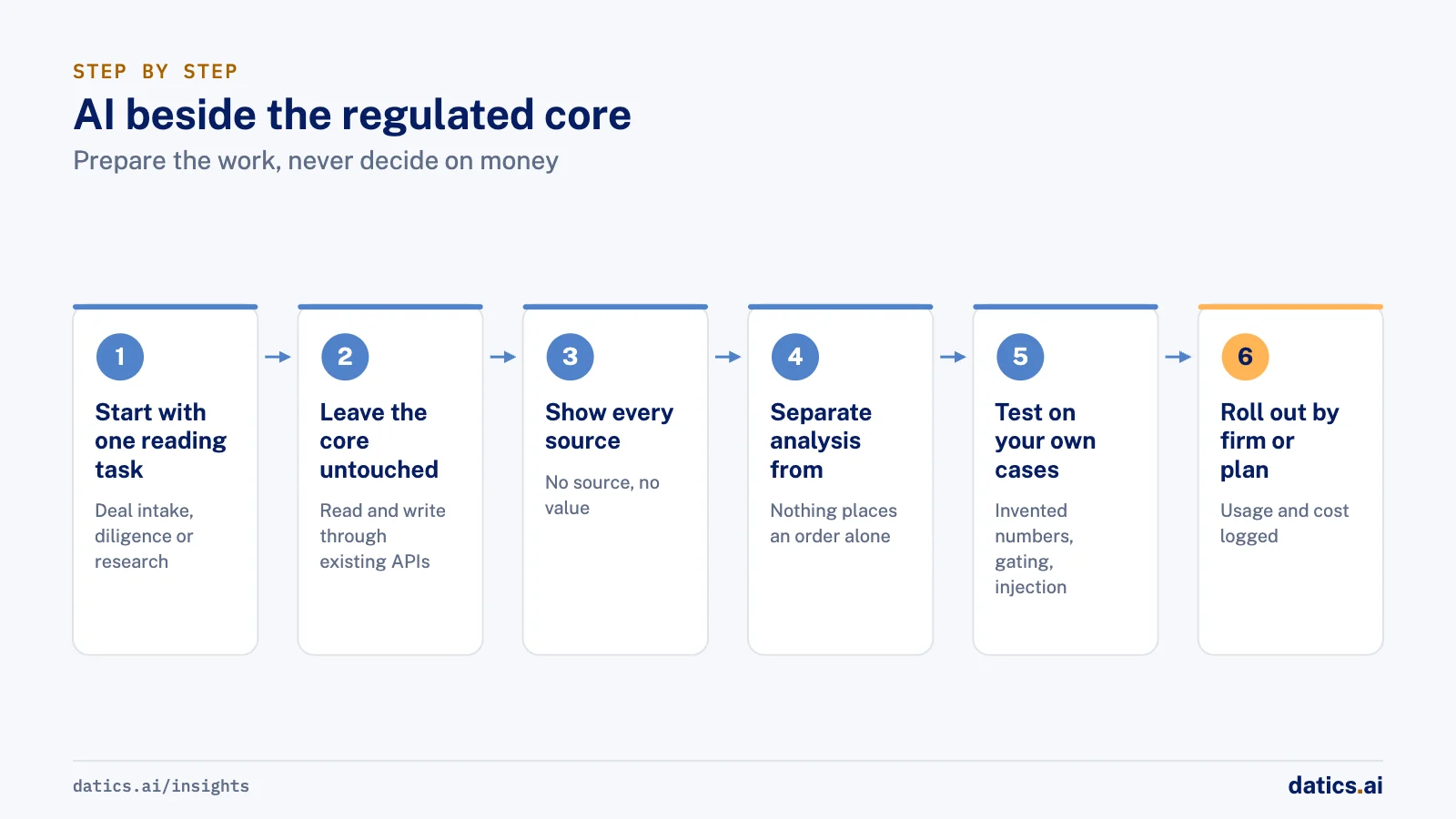
Most established fintech products have a regulated core system that nobody wants to rewrite. The safest path keeps AI beside it.
- 01
Start with one reading task.
Deal intake, diligence pre-fill or research answers are good first choices, because they save analyst time without making a regulated decision.
- 02
Keep the core untouched.
The AI reads through the platform's existing APIs and writes drafts through the same actions a person would use.
- 03
Show the source of every value.
If a figure has no source, the field stays blank and flagged.
- 04
Separate analysis from execution.
The part that researches and drafts never places an order or approves a record on its own.
- 05
Test on your own cases.
Measure invented numbers, wrong sources, plan gating and prompt injection from uploaded documents before release.
- 06
Roll out by firm or plan.
Turn the feature on per customer, with usage and cost logged.
Our fintech section shows each of these as a module on a fictional firm. For why retrieval must follow user permissions, see how RAG security scopes retrieval to user permissions.
04How to measure AI in fintech before it ships
A fintech AI feature is ready when its numbers can be defended, not when the demo looks good. Agree the measures with your product and compliance leads before the build, so nobody argues about them afterwards.
- Source coverage. The share of figures in answers and drafts that carry a source a reviewer can open. Anything below near total coverage means the feature is still guessing.
- Invented values. How often a draft contains a number or a name that does not appear in the documents. The bar here is zero on your test set.
- Plan and client separation. Attempts from one account to reach another firm's deals or a paid plan's data, run on every release. The result should never change.
- Reviewer time. Minutes an analyst spends checking and correcting a drafted deal or diligence record, compared with doing it by hand. This is the number that sells the feature internally.
- Cost per user. Model and retrieval cost at your real volume, so you can decide whether to include the feature in every plan or sell it as a tier.
Keep the test cases. Run them again after every model or prompt change, because a feature that passed last quarter can quietly drift.
05What we see in production
We added production AI around a regulated investment platform without replacing its core system. Pitch decks became drafted deals, and issuers approved each field before anything was published. The core kept doing what it already did well; the AI sat beside it and prepared work.
We built research assistants that answer from filings, news and posts, with the source shown for every claim, and investing agents that take a person from research to a prepared order that the investor confirms. The hardest problems were never the model. They were freshness of data, plan gating on the server and declining to forecast prices even when asked.
The common thread: fintech buyers accept AI quickly when it removes reading work and leaves every money decision with a person who can see the evidence.
Frequently asked questions
Can AI in fintech make investment or credit decisions?
It should not make them alone. AI can prepare a recommendation, draft an order or summarize an application, with sources. A licensed or accountable person decides, and for credit decisions the reasons given to the customer must be specific and accurate.
How do you stop the AI from inventing numbers?
Answer numbers only from retrieved sources, cite the page, and leave a field blank when there is no source. Then test it on your own cases before every release.
How Datics helps
Building Fintech or investment software? See the AI modules we build for private markets, wealth, trading and market data platforms.
Related work
Case studies from our projects on the same subject.
Regulated investment platform
Fintech · Private investment marketplace
Pitch decks become drafted deals, and issuers approve each field before publishing
Issuers retyped decks and financials into long deal forms. Now AI suggests each field, and the issuer applies, edits or rejects it.
Cosmic AI
Fintech · Multi-agent investing assistant
Retail investors go from research to a confirmed order in one conversation
Investors juggled data, news and a separate broker. Now agents research and prepare each trade in chat, and nothing is placed until they confirm.
Related answers
Brownfield AI
What makes good AI user experience for non-technical users?
Good AI user experience for non-technical users means recommendations instead of automatic actions, AI work beside their own, and confirmation before saving.
 Bilal HassanRead
AI agents
How much autonomy should AI agent guardrails allow?
AI agent guardrails that work: agents read and draft freely, but need consent and an editable confirmation before moving money, changing records or messaging.
Umair MajeedReadEdTech
AI in admissions: what enrollment platforms should build
AI in admissions works inside the enrollment platform: answers from each catalog, booked advisor calls, documents pre-filled for staff, and people deciding.
Umair MajeedReadYour customers already expect AI from your product.
Let us make it real inside the product you run today.