
Property management and field operations
AI property management software: a feature checklist
In property software, the AI feature worth buying is the one that can show you its mistakes before your residents find them.
 Umair MajeedCo-founder and CEO, Datics AI7 min read
In brief
AI property management software should do six jobs well: triage maintenance requests, draft owner and resident messages, answer leasing questions from approved facts, find gaps in turnover schedules, pull fields from invoices and keep listing data clean. Each feature should prove itself on your own requests, run under the signed-in person's role, and stop for a person before anything touches money, an applicant decision or a legal notice.
On this page
01What each AI feature should do, and what it should prove
Every vendor demo looks good on a clean sample. The useful question is what the feature does on a messy Tuesday, with a vague text from a resident, a half-filled work order and a cleaner who has not checked in. Here is what we expect each feature to do, and the evidence we would ask for.
- Maintenance triage. It should read the request, ask one or two follow-up questions, set category and urgency, attach photos to the right unit and route it by your rules. Proof: accuracy on a few hundred of your past tickets, with emergencies such as gas, water and no heat counted separately, because a missed emergency matters more than ten misfiled drips.
- Owner and resident messaging. It should draft replies from live records, such as the work order status or the next scheduled visit, not from memory of the conversation. Proof: every factual sentence traces to a record, and messages that change a commitment go to a person first.
- Leasing questions. It should answer availability, pricing, pet and amenity questions only from facts the property has published, and hand off anything else. Proof: a test set that includes the questions people should not answer, such as "is this a good building for families" or "who lives on this floor".
- Turnover scheduling. It should spot gaps between check-out and check-in, unassigned cleanings and booking overlaps, in the property's own time zone. Proof: tests on real calendars with time zone edges and same-day turnovers.
- Invoice and document processing. It should pull vendor, amount, unit, dates and line items into fields a person can check, with each value linked to where it came from on the page. Proof: field-level accuracy on your vendors' actual invoices, including scans and handwritten notes. Our guide to AI document extraction covers how to measure this.
- Listings data. It should normalize units, floor plans, amenities and media into one schema that feeds your site and outside portals. Proof: a sample feed that the destination accepts, and a count of records rejected or corrected.
What residents expect sets the bar. The 2024 NMHC and Grace Hill Renter Preferences Survey, drawn from 172,703 verified renters, found that renters overwhelmingly preferred email, even for setting up tours and non-emergency maintenance requests. That is a reminder to build AI into the channels residents already use, and to treat the written reply as the product.
02Demo feature vs production feature
The gap between a demo and a production feature is rarely the model. It is the data, the permissions and the plan for when the answer is wrong.
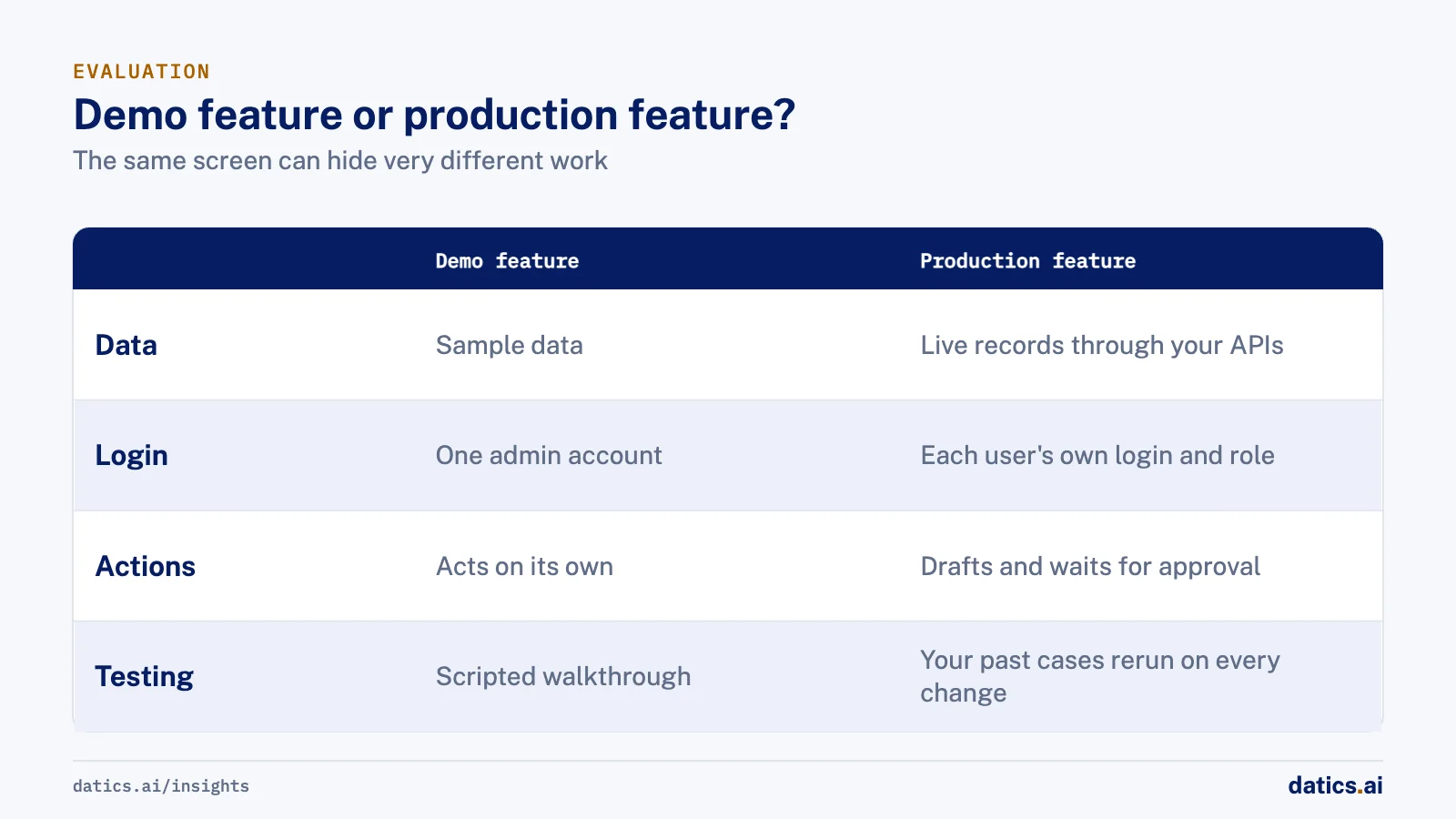
| Area | Demo feature | Production feature |
|---|---|---|
| Data | A sample property and a few clean tickets | Your live records, read through your existing APIs at the moment of the question |
| Identity | One admin account for everything | Every action runs under the signed-in user's own login and role |
| Actions | Sends, books and assigns on its own | Drafts and suggests; outward actions wait for approval where a mistake is costly |
| Shared channels | Replies to every message | Decides whether a message is meant for it, and stays quiet otherwise |
| Testing | A scripted walkthrough | A test set of your own past cases, rerun on every change |
| Records | A chat transcript | Results written back as work orders, notes and job updates, with a log of who did what |
| Cost | Not discussed | A stated cost per conversation, per document or per door |
| When wrong | Not discussed | A clear owner, a correction path and the failed case added to the tests |
If a vendor fills the left column with confidence and the right column with promises, you are looking at a prototype. Our article on AI evaluation explains how to build the test set that separates the two.
03What AI should never do alone
Some property work carries legal, financial or safety weight. AI can prepare it. A person should decide it.
Applicant decisions and fair housing. The Fair Housing Act bars housing discrimination based on race or color, religion, sex, national origin, familial status and disability, and the Department of Justice names steering homeseekers to certain areas as one form it takes. The rule is not only about screening. HUD's regulation on discriminatory notices, statements and advertisements, 24 CFR 100.75, covers written and oral statements by anyone engaged in renting a dwelling. A leasing assistant that answers "would this unit suit a family with kids" or describes who lives nearby is making statements. Keep it to published facts, log every answer, and test it with exactly those questions. Teams should confirm their own obligations with counsel.
Money. Approving invoices, issuing refunds, waiving fees and changing rent should go through a person, with the AI preparing the record and the evidence.
Legal notices and lease terms. Notices to quit, lease changes and anything with a deadline should be drafted, reviewed and sent by a person.
Emergencies. AI can flag a gas leak or a flood fast. It should page a human on call, not decide it can wait.
Approval steps work only if they are quick to act on. Our piece on human in the loop AI covers how to place them without slowing every request.
04Questions to ask about any AI property management software
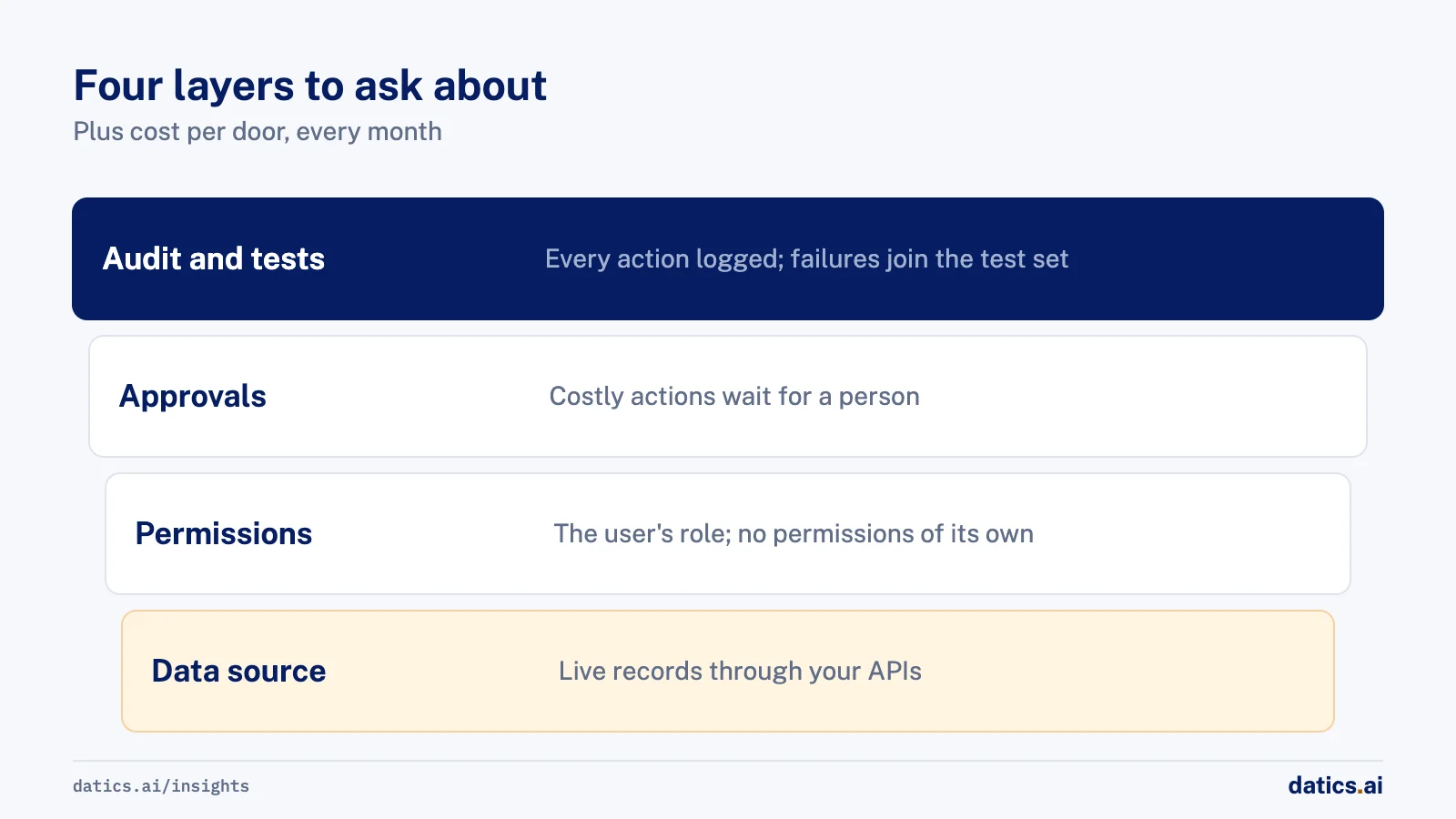
We use the same seven questions whether we are reviewing a vendor's AI or planning a feature for a property platform.
- 01
Where does the data come from?
Live records through your APIs, a nightly copy, or documents someone uploaded? Stale data produces confident wrong answers about schedules and balances.
- 02
Who can see and do what?
Can a cleaner reach another cleaner's jobs? Can an owner assign staff when your product does not allow it? The AI should have no permissions of its own, only the user's.
- 03
What needs approval, and who gives it?
Name the actions that wait for a person, and check that the approval lives in the product, not in a chat log.
- 04
What is logged?
You should be able to see which user, which tool, which record and which answer, for every action.
- 05
How is it tested on our cases?
Ask for results on a sample of your own tickets, messages and invoices, not on the vendor's benchmark. Our guide to AI model testing covers what a fair test looks like.
- 06
What does it cost per unit of work?
Get a price per conversation, per document or per door, and the model costs behind it. The NAA's 2025 rent dollar study, based on 13,471 communities, puts same-store operating costs at $8,213 per unit a year, up 4.6 percent, against revenue that grew 2.7 percent. Any AI line item has to earn its place inside that budget. Our article on AI token cost shows how to estimate it before you ship.
- 07
What happens when it is wrong?
Who sees the error, how is it corrected, and does the failed case join the test set so it cannot come back quietly?
A vendor that answers all seven with specifics is worth a pilot. A roadmap item that cannot answer them is not ready to build.
05What we see in production
On CleanHaus, a turnover operations platform for short-term rentals, we extended the AI assistant already running in the live product. Every action passes through the platform's existing APIs under the user's own login, so the assistant has no separate permissions. Each channel and role gets its own tool allowlist, a cleaner's session has no owner tools, and in shared property channels a decision step checks whether a message is meant for the assistant before it replies. Booking tools handle overlaps and guest check-in conflicts in the client's time zone. Contractor bids wait in an inbox for the owner's approval unless the owner sets that job to auto. Testing runs in three tiers: unit tests on every push, routing evals against a mocked backend, and model-graded evals that later supported a model comparison.
When cleaners needed to reach the assistant from the field, text, picture messages, Slack and voice calls all sign in to the same account the app uses, and the role is checked on every call and in every channel. A texted photo and a few words become a note on the right job, and replies come in each user's language. The client tested phone-only sign-in before it replaced the original code flow, and texts now run on a production short code.
Listings work shows the data side. For RentSpire, a Los Angeles area rental and affordable housing venture, we structured property data once and reused it for both the site and an outside portal's XML rental feed, with a schema that separates properties, units and media and allows several floor plans per property. When RentSpire asked to grow from one metro area to a much larger listing set, the full records followed within two weeks.
06Where to start
Pick one feature from the list, collect fifty real cases for it, and write down what a correct answer looks like before anyone writes a prompt. Our property management page shows how we approach this kind of platform. If AI is already in your product, our AI Scorecard tests it on 50 of your own cases in two weeks for $5,000 and ranks what to fix. If you are building the first feature, a three-week Build Sprint for $10,000 builds one outcome on your platform.
Frequently asked questions
What should AI property management software do first?
Start with work that repeats all day and has a clear right answer, such as maintenance triage, turnover gap detection or invoice field extraction. These are easy to test on past records and cheap to correct. Leave applicant decisions, money movement and legal notices with people.
How do we test an AI feature before residents see it?
Collect a few hundred of your own past cases, label the correct outcome, and run the feature against them on every change. Count the costly errors, such as a missed emergency or a wrong date, separately from minor ones. Add each real failure to the set so it stays fixed.
Is per-door pricing a good way to buy AI features?
It is easy to budget, but ask what sits underneath it. A per-door price hides how many conversations or documents each door generates, so request usage figures from a comparable portfolio and the model costs per unit of work. That tells you whether the price will hold as volume grows.
How Datics helps
Building Property Management, rental or field service software? See the AI modules we build for crews, schedules and listings.
Related work
Case studies from our projects on the same subject.
CleanHaus
Property Management · Turnover operations SaaS
Hosts and cleaners manage rental turnovers in chat, within each person's permissions
Owners, managers and cleaners all talk in one property chat. Now an AI there acts for each of them, only within that person's role.
RentSpire
Property Management · Affordable housing listings platform
Renters search affordable housing listings built on property data we structured first
A listings site with no listings is no use to renters; we structured the property data first, then built search and an owner dashboard on it.
Related answers
Property management and field operations
AI for property management: where it pays off first
AI for property management pays off first in maintenance triage, turnover scheduling and tenant messages. Keep screening, payments and notices with people.
Umair MajeedReadProperty management and field operations
AI agents for real estate: what to build into your software
AI agents for real estate answer listing questions, book showings and draft follow-ups from live data. Offers, money and legal notices stay with people.
Umair MajeedReadFintech and investment platforms
AI in lending: where it pays off and where people decide
AI in lending pays off in document intake, completeness checks, credit memo drafts and servicing answers. Credit decisions and pricing stay with people.
Umair MajeedReadYour customers already expect AI from your product.
Let us make it real inside the product you run today.