
Brownfield AI
AI strategy consulting: what to get before you build
An AI strategy is finished when someone is willing to put a fixed price on the first step.
 Umair MajeedCo-founder and CEO, Datics AI8 min read
In brief
AI strategy consulting for a software company should end with a decision you can fund, not a deck you file away. A good engagement hands you a ranked list of AI capabilities tied to what your buyers value, what each one depends on, a readiness check, a cost per use, and a fixed quote for the first capability. If nobody who will build it opened your data or priced a model call, you bought an opinion.
On this page
- 01What AI strategy consulting should deliver before anything is built
- 02Why slide-deck AI strategy fails
- 03Check readiness and price each use before you rank
- 04How to evaluate an AI strategy consulting firm
- 05What a short, fixed-scope engagement looks like
- 06What we see in production
- Frequently asked questions
01What AI strategy consulting should deliver before anything is built
For a software product with paying customers, the strategy is a short set of working documents your engineering and product leads can start from on Monday. We expect six outputs.
- 01
A ranked capability list.
Each item names a specific capability, such as "draft a reply to a billing ticket from the account's invoice history," the buyer it serves, and the value to that buyer: hours saved per week, a reason to renew, or a feature a higher plan can charge for. The rank weighs buyer value and feasibility together, so the top item is the one that is both wanted and buildable.
- 02
A dependency map for each capability.
Which data it reads and where that data lives, which APIs it calls, which APIs are missing, and which permissions apply by tenant and role.
- 03
A readiness check.
Is the data complete and reachable? Can the team write down what a correct answer looks like for a set of real cases? What security review and product changes will the capability need before customers see it?
- 04
A cost per use.
What one run of the capability costs in model calls, retrieval and hosting, and how that number moves at your real volume.
- 05
A first capability with a fixed quote.
A scoped brief with acceptance tests, so the first build is a commitment with a price, not an open-ended experiment.
- 06
A definition of success.
A quality bar measured on real cases before launch, and a product or business measure after launch, agreed before anyone writes code.
This order is not our invention. The NIST AI Risk Management Framework, released in January 2023 and intended for voluntary use, organizes AI risk work into Govern, Map, Measure and Manage. In its description of the core functions, the Map function establishes the context to frame risks related to an AI system, and outcomes in Map are the basis for Measure and Manage. In plain terms: understand where the capability sits and what it touches before you decide how to test and run it. Our pillar on AI integration in established software covers the build side of that same sequence.
02Why slide-deck AI strategy fails
Most AI strategy decks we are shown share the same three gaps.
No one who builds was in the room. Workshops collect ideas from executives and package them into themes. Nobody checks whether the billing API exposes the fields the idea needs, or whether the tenant model allows one customer's data to be searched at all. Engineering discovers all of that later, usually after the budget is set.
No cost model. A capability that costs pennies in a demo can cost real money at production volume, and a capability with heavy context on every call can erase the margin on a lower plan. If the strategy does not price one use of each capability, it cannot rank them honestly. Our guide to what production AI costs in SaaS walks through the full cost picture.
No data check. Ideas are ranked on how exciting they sound, not on whether the records they need exist, are clean and can be reached under the right permissions.
The research points the same way. BCG reported in October 2024 that 74 percent of companies have yet to show tangible value from their use of AI, and that leaders put 10 percent of their resources into algorithms, 20 percent into technology and data, and 70 percent into people and processes. The same release says leaders invest in a few high-priority opportunities rather than spreading effort thin. A ranked list with a cost and a dependency map is how you pick those few.
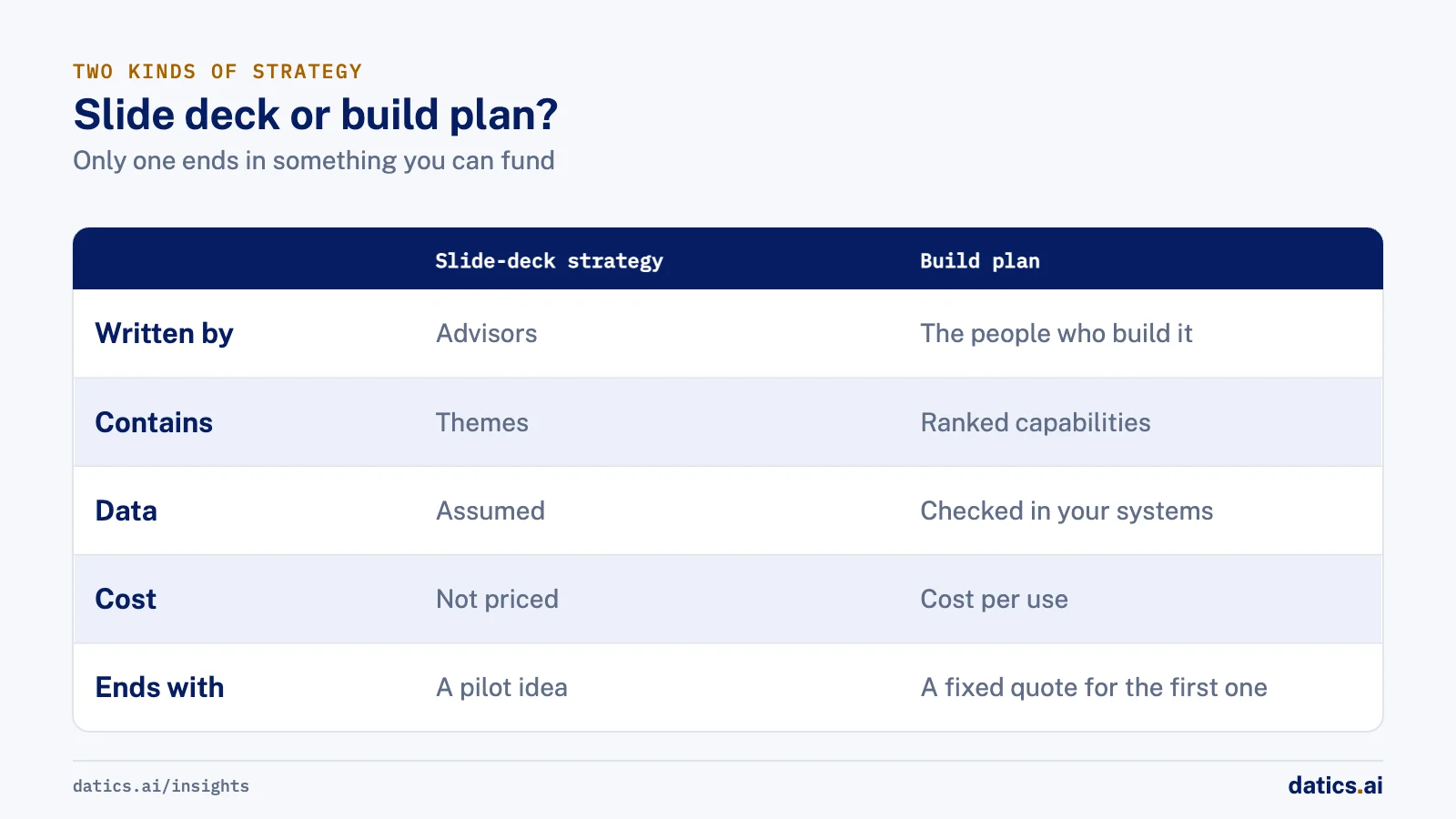
| Slide-deck strategy | Strategy that ends in a build plan | |
|---|---|---|
| Who writes it | Advisors who will not build it | The engineers who will build the first capability |
| Ideas | Themes and use case categories | Specific capabilities ranked by buyer value and feasibility |
| Data | Assumed to be available | Opened, sampled and checked for access and quality |
| Cost | Not priced, or a total program budget | Cost per use for each capability at real volume |
| First step | A recommendation to start a pilot | A scoped brief with a fixed quote |
| Success | Adoption and transformation goals | A quality bar on real cases, then a product measure |
03Check readiness and price each use before you rank
The readiness check is practical, not a maturity survey. For each top capability we look at four things: the data it needs and whether it can be reached under the signed-in user's permissions, the APIs it needs and which are missing, how quality will be judged on real cases, and what product changes the capability forces, such as a review screen or an audit record. Our AI readiness assessment article lists the checks in detail.
Cost per use is simple arithmetic once someone has looked at the real payloads. Model providers publish prices per million tokens. At the time of writing, Anthropic's pricing page lists Claude Sonnet 5.5 at $2 per million input tokens and $10 per million output tokens, prices a prompt cache hit at a small fraction of the standard input price, and gives a 50 percent discount on both input and output tokens through its Batch API. Here is an illustration with those list prices: a capability that reads 6,000 tokens of ticket history and writes a 500-token reply costs about $0.017 per model call. If the capability makes four calls per task, that is roughly $0.07 per task, and at 200,000 tasks a month it is about $13,600 a month before caching or batching. The numbers themselves will change. The point is that a strategy without this line cannot tell you which capability fits which plan.
04How to evaluate an AI strategy consulting firm
When you interview firms, ask questions whose answers you can check. These are the ones we would ask in your seat:
- Who will be in the working sessions, and will those same people build the first capability?
- Will you open our data, API documentation and permission model during the engagement, or work only from interviews?
- Will every ranked capability come with a cost per use at our real volume?
- What does the engagement end with: a fixed quote for a first build, or a proposal for more discovery?
- How will you define success for the first capability, and on which real cases will you test it before launch?
- Have you shipped AI into a live product with paying customers, existing logins and tenant permissions?
- What happens if your answer is "do not build this yet"?
Watch for three warning signs. A fee that scales with the number of workshops rather than with the decisions delivered. Deliverables described as frameworks, maturity scores or roadmaps with no prices in them. And a team that will hand the plan to someone else to build. If the planners and builders are different people, every assumption in the plan becomes a renegotiation later. Our article on AI product strategy covers how the ranked list connects to your wider product roadmap.
05What a short, fixed-scope engagement looks like
A strategy engagement for one product does not need months. Two weeks is enough when the scope is fixed and the people doing it can read code and data.
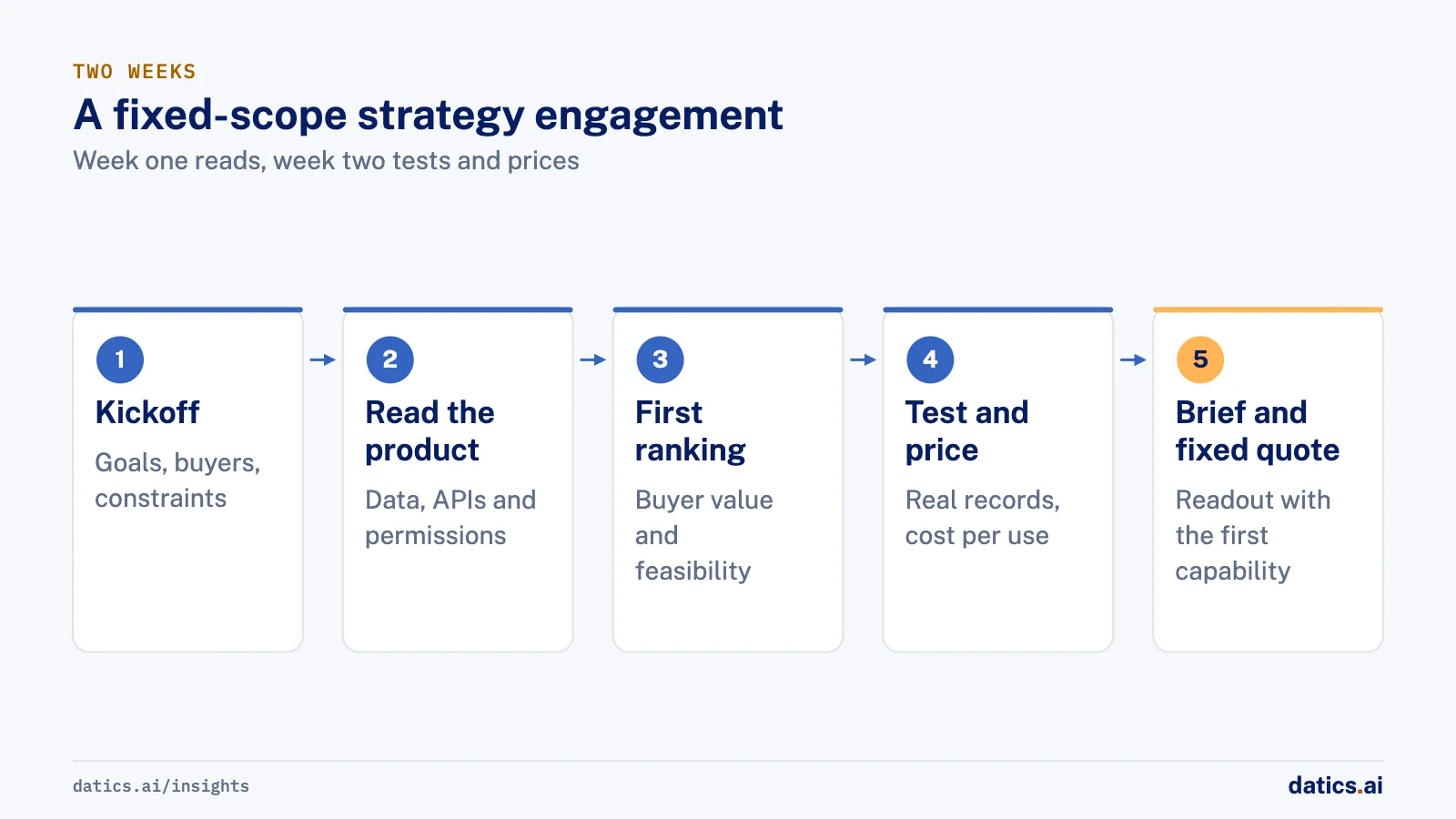
Week one: understand and rank. A kickoff with your product owner and technical lead. We collect the AI ideas already in circulation, from the board, customers and your own team, then read the product: its architecture, data stores, APIs and permission model. By the end of the week there is a first ranking and a list of what each top idea depends on.
Week two: check, price and quote. We test the top candidates against real records, write the dependency map, run the cost per use, and draft the brief for the first capability with its acceptance tests and a fixed quote. The engagement ends with a readout where your team can push back on the ranking before anything is signed.
A fixed scope forces choices, and you know what you will get and when. Our comparison of fixed price and time and materials explains when each model fits the build that follows.
06What we see in production
For OCCI, a U.S. industrial contractor with a mature Microsoft reporting stack, the question was whether a Copilot Studio agent already published over its job cost data could be trusted. Before building anything new, we reviewed the existing agent, knowledge base, SQL tools and Power BI, limited the agent's data tool to approved, read-only queries on ten views under a least-privilege login, wrote a data dictionary, and built a layered test set of 20 questions, each with a verifying SQL query. The testing showed that totals computed by the model drifted between runs, so we recommended moving heavy calculations into SQL views and stored procedures. The deliverables included a results report and a phased pilot plan, and OCCI chose to stay on Copilot and pilot its weekly labor report first, validated against the current report. A good strategy can conclude that the tool you already own is the right one, once it has been tested on your own numbers.
Coast Technology, which sells a customer intelligence and engagement portal to RV, auto, powersports and marine dealers, wanted one multi-role platform it could also resell under other brands, while dealers kept using the live portal every day. We began by supporting the original portal and learning its parsers, visitor data and product while it ran. Discovery then produced user stories for every role and a gap analysis, and our business analyst ran backlog grooming with Coast's product lead each sprint. The same team that planned the work built it: the portal grew into a CRM and engagement platform with a chat assistant inside it, with all servers and data kept in Coast's own accounts.
If you have a live product, several AI ideas and no agreed order, our AI consulting starts with a Planning Sprint: two weeks for $5,000, run by the engineers who build it. You get a ranked capability list, a product and dependency map, a readiness plan and a fixed quote for the first capability, and the fee counts toward production.
Frequently asked questions
What does an AI strategy consultant actually do?
For a software company, a useful AI strategy consultant turns a pile of AI ideas into a ranked, priced plan. That means reading your product, data and APIs, checking which ideas are feasible under your permissions, estimating cost per use, and scoping the first capability with acceptance tests.
How long should an AI strategy engagement take?
For one established product, two to four weeks is usually enough when the scope is fixed and the team can work directly with your code and data. Engagements that run for months tend to produce broader roadmaps that age before anything ships. If a firm proposes a long discovery phase, ask what decision you will be able to make at the end of each week.
Should we hire AI strategy consultants or let our own engineers plan it?
Your own engineers know the product best and should be in every session. Outside help is worth paying for when your team has not yet shipped AI to production, when the ideas outnumber the people available to assess them, or when the board wants an independent, priced plan.
How Datics helps
Datics specializes in Brownfield AI: production AI inside software people already rely on. A Build Sprint puts one outcome working in your product's staging in three weeks, for $10,000, and the fee counts toward production. Not sure what to build first? The Planning Sprint ranks it in two weeks, for $5,000.
Related work
Case studies from our projects on the same subject.
OCCI
Other software · Enterprise data assistant evaluation
OCCI kept Copilot once its live job cost answers were checked against SQL
Leaders wanted plain language answers from their own job cost data. We tested their Copilot agent in their tenant and checked each answer against SQL.
Coast Technology
Automotive · Dealership customer intelligence SaaS
Coast ships new dealer features every sprint, with our engineers in its team
Coast needed a product team that could keep a live dealer portal growing. Our engineers work inside its process, accounts and weekly calls.
Regulated investment platform
Fintech · Private investment marketplace
Pitch decks become drafted deals, and issuers approve each field before publishing
Issuers retyped decks and financials into long deal forms. Now AI suggests each field, and the issuer applies, edits or rejects it.
Related answers
Brownfield AI
AI integration for SaaS: build AI into your live product
AI integration for an existing SaaS product: keep your core as the system of record, reuse your APIs and auth, and ship one AI workflow at a time.
Umair MajeedReadBrownfield AI
AI product strategy: embed AI or launch a separate product?
An AI product strategy for an established SaaS: when to build AI into the product you have, when a separate AI product makes sense, and how to decide.
Umair MajeedReadAI-native
Which workflow should you make AI-native first?
A simple five-factor score (value, frequency, data readiness, risk and effort) for choosing the first workflow to make AI native in an established product.
Umair MajeedReadBrownfield AI
AI implementation challenges: lessons from 60+ AI projects
The AI implementation challenges behind 60+ AI projects: integration, data, permissions, approvals and testing, and what to settle first.
Umair MajeedReadBrownfield AI
How do you build an AI data pipeline from outside sources?
An AI data pipeline for outside sources needs a reviewed data model and ETL that links records to real entities. Learn how to plan sources and mappings.
 Rana Umar MajeedRead
Brownfield AI
AI for field service and compliance software
AI for field service and compliance software drafts inspection reports, checks records against rules and prepares follow-ups, while a named person approves.
Umair MajeedReadYour customers already expect AI from your product.
Let us make it real inside the product you run today.