
Forward deployed engineers
Fixed price vs time and materials: which fits AI work?
Fix the boundary first. The price model follows from it.
 Umair MajeedCo-founder and CEO, Datics AI6 min read
Short answer
Choose fixed price vs time and materials by how firm the boundary is, not by habit. A first AI feature that is one service plugged into an extension point your product already has can be scoped, reviewed and priced as fixed. Work where requirements will move as users react, such as a new operational system built from scratch, belongs on time and materials or a change request model.
On this page
01Fixed price vs time and materials: what each model buys you
The contract type is a decision about who carries scope risk. It is not a statement about trust or quality. This is part of our larger guide, What is forward deployed engineering?.
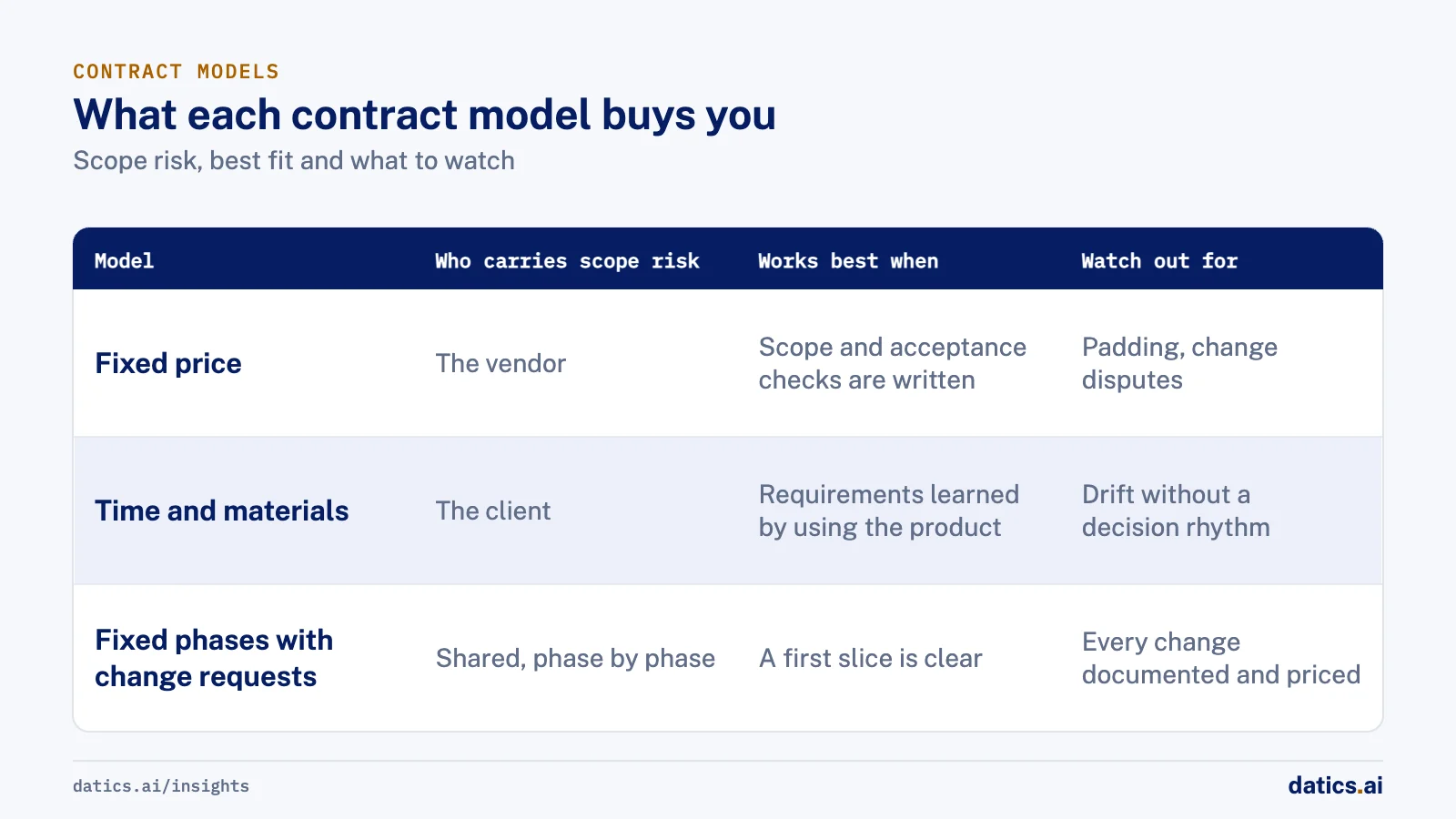
| Model | Who carries scope risk | Works best when | Watch out for |
|---|---|---|---|
| Fixed price | The vendor | Scope, interfaces and acceptance checks are written down | Padding, change disputes, pressure to cut testing |
| Time and materials | The client | Requirements will be learned by using the product | Drift without a regular decision rhythm |
| Fixed phases with change requests | Shared, phase by phase | A first slice is clear and later work is not | Every change must be documented and priced openly |
The Agile Manifesto values customer collaboration over contract negotiation and responding to change over following a plan. That is sometimes read as an argument against fixed price. It is not. It is an argument against pretending that unknown scope is known. When scope genuinely is known, a fixed price is the most honest contract there is, because both sides can see exactly what done means.
02Why AI makes the choice harder
AI features carry uncertainty that ordinary features do not. Answer quality depends on data nobody has looked at closely yet. Model behavior varies between runs. Success criteria are often vague at the start, such as an assistant that answers customer questions well. Teams respond in one of two ways: they refuse fixed price for anything involving AI, or they fix a price on a vague promise. Both go wrong.
The fix is to separate the parts. Integration work, meaning APIs, connectors and a hook into the user interface, is ordinary engineering and can be fixed. Quality work, meaning how good the answers are, needs either a measurable target on a defined test set or a separate, time-boxed phase. Mixing the two in one fixed price is where most disputes start. Cost is a separate question again: see how much production AI costs in SaaS.
03How to shrink a first AI feature until it fits a fixed price
The most reliable way to make a first AI feature fixable is to make it small and to fence it off from everything that already works. We use six steps:
- 01
Find the extension point. Most mature products already have one
a plugin model, a webhook, a filter pipeline, an API gateway, an embed slot. Build behind it.
- 02
Put the platform off limits. Write down that the host application will not be modified. This one sentence removes the largest source of surprise in the whole project.
- 03
Make the AI a separate service with a narrow contract
one request shape, one response shape, versioned so either side can change without breaking the other.
- 04
Define failure behavior. Decide what happens when the AI service is slow or down. Failing safe, so the product keeps working without the AI, should be the default.
- 05
Write acceptance checks a reviewer can run, for example
given these documents and these questions, every answer shows its sources, and when the answer is not in the documents the assistant says so.
- 06
List what is out of scope, in writing, including the things everyone quietly assumes will come next.
Anthropic's guidance on building with language models recommends starting with the simplest solution that works and adding complexity only when it is needed. That advice is technical, but it is also commercial. The simplest version is the one you can price.
04Buy certainty before you buy the build
When a feature is larger than one service, a short paid scoping phase is often the cheapest way to make a fixed price possible. The output is not a slide deck. It is the material a fixed quote needs: a feature breakdown, wireframes for every role, user stories and a system flow. It also includes a written answer to the hardest integration question, such as how the AI will reach the production database. Once both sides have signed off on that, the build can be fixed with a straight face.
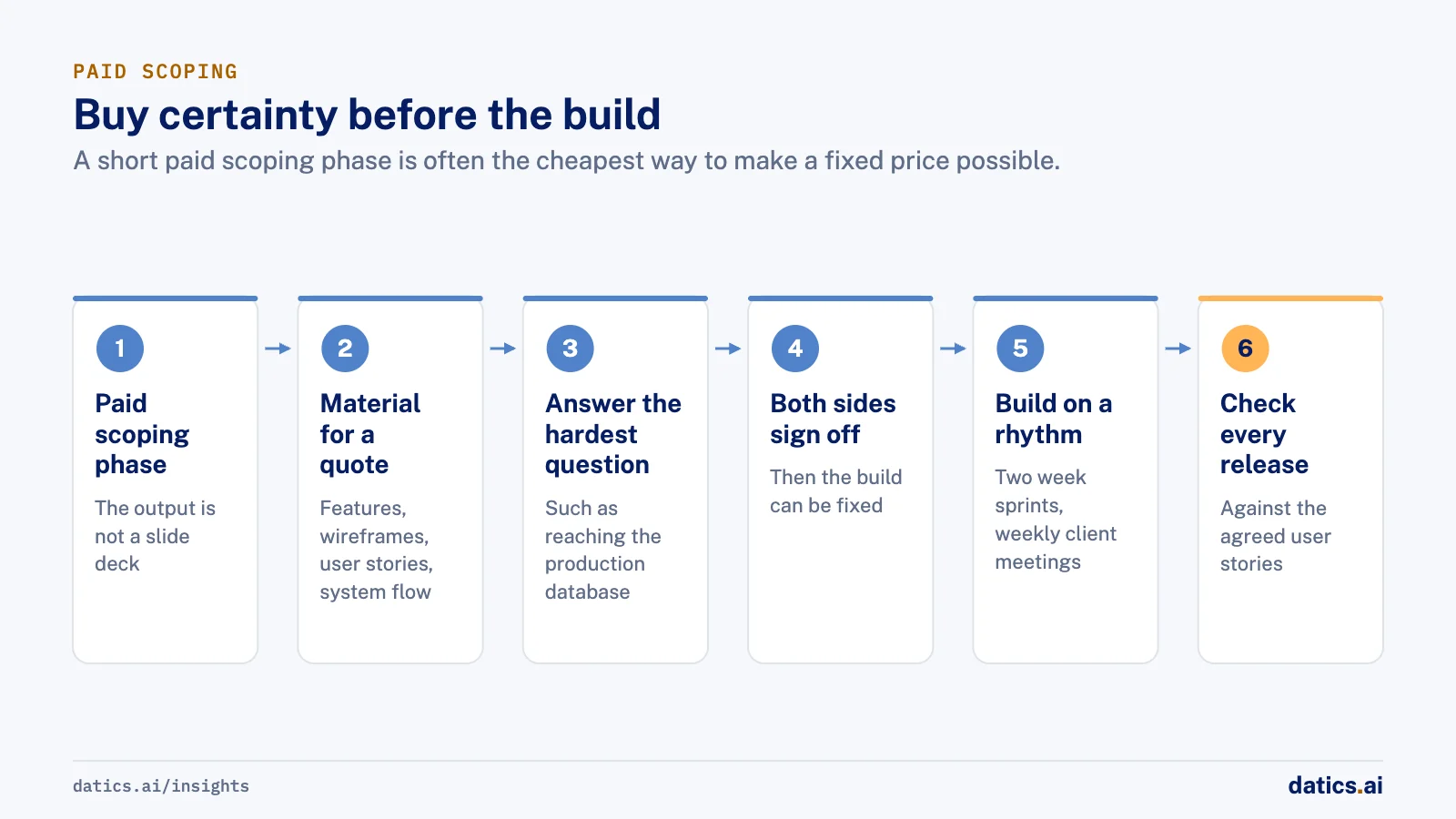
The build itself then runs on a short, visible rhythm: two-week sprints, weekly client meetings, and an internal check of every release against the agreed user stories before the client sees it. That rhythm is what keeps a fixed price fair to both sides, because gaps are found early, while they are still small.
05When fixed price stops being honest
Some projects outgrow their contract, and pretending otherwise hurts both sides. The signs are easy to spot once you look for them. Requirements arrive as users see working builds, approval flows need repeated rework, dashboards go through several iterations, and imported data turns out to be incomplete. None of this is failure. It is what happens when people start using a real system.
The right response is to keep delivering on a regular rhythm and to say what is happening, in writing. Compare the original milestone plan with the change requests, show both side by side, and propose a model that fits the work as it now is. Usually that means time and materials, or fixed phases with priced change requests.
06What we see in production
For a software services firm, we added document search to a self-hosted chat interface on a fixed price scope. The boundary was explicit: one retrieval service built on LlamaIndex, and one thin filter inside the chat platform's existing pipeline model, with the platform itself off limits. The filter takes the user's latest question, fetches the top five chunks, injects them just before the question and shows each source with a relevance score. It accepts both the new and the legacy response format, so the service could change without breaking the interface, and it fails safe: if the service errors, the chat simply continues without context. The contract completed, and the client described our team as persistent and focused.
That fixed boundary came out of scoping calls before any work began, including the client's request to leave the platform's built in retrieval unused. Our technical lead still sent the service back for revisions before the filter reached version 2.2. The contract closed with a 5 star review.
For a retail sales services company, we ran a paid scoping and UI/UX phase before a fixed price build of a multi-tenant AI sales assistant. The phase covered a proposal and feature breakdown, wireframes for all four roles walked through with the client, designs, user stories, a system flow chart and a dedicated session on database connectivity. The build then ran in two-week sprints with weekly meetings, our business analyst evaluated every deployment against the user stories, and every item in the MVP scope was delivered.
For a self-serve ad builder for vehicle dealers, built for a U.S. dealership marketing agency, we started with a narrow fixed price proof that ads could be created from a client-facing site and pushed through the ad platform's API. We then built the interface on a second contract and continued the product on an hourly basis once the shape of the work was clear.
For a large public security organization, we built an on-premise operations system where requirements changed heavily as staff used it, with ten major change requests across approvals, linkage between modules, dashboards and reports. We kept showing working builds on a regular rhythm. We documented the growth openly in progress presentations that compared the original milestones with the change requests, and recommended moving to time and materials or change requests.
Frequently asked questions
Can AI work be priced as a fixed price at all?
Yes, when the parts are separated. Integration work, meaning APIs, connectors and a hook into the user interface, is ordinary engineering and can be fixed. Quality work needs either a measurable target on a defined test set or a separate, time-boxed phase. Mixing the two in one fixed price is where most disputes start.
What does a paid scoping phase produce?
It produces the material a fixed quote needs: a feature breakdown, wireframes for every role, user stories and a system flow. It also answers the hardest integration question in writing, such as how the AI will reach the production database. Once both sides have signed off on that, the build can be fixed.
When should a fixed price project move to time and materials?
When requirements arrive as users see working builds, approval flows need repeated rework, dashboards go through several iterations or imported data turns out to be incomplete. Keep delivering on a regular rhythm, compare the original milestone plan with the change requests side by side, and propose time and materials or fixed phases with priced change requests.
How Datics helps
Datics specializes in brownfield AI: bringing production AI into the product you already operate, without forcing a rebuild.
Related work
Case studies from our projects on the same subject.
WikiTeq
B2B Software · RAG API for a chat
WikiTeq's self hosted AI chat now answers from its documents, citing every source
The chat could not answer from the firm's own documents. Now a separate retrieval service feeds it passages and shows the source of each answer.
Large public security organization
Government, Legal & Defense · Geospatial situational awareness platform
Security leaders trace each alert to its outcome, seeing only approved records
Alert, incident and response records sat apart across many teams. Now they are linked on one map and appear only after approval.
More on Forward deployed engineers
Forward deployed engineers
What is forward deployed engineering?
Forward deployed engineering places engineers inside a customer's own team, repositories and code review, so AI ships inside the product customers already use.
Umair MajeedReadForward deployed engineers
How do you run an AI POC with real data?
An AI POC with real data succeeds when the data, security review, a separate staging path and the release plan are settled before anyone tunes a prompt.
Umair MajeedReadForward deployed engineers
What should an AI readiness assessment cover?
An AI readiness assessment compares how your product works today with the workflow you need, flow by flow, and ends in a pilot scope and a do not break list.
Umair MajeedReadForward deployed engineers
How do you scope an AI proof of concept that ships in weeks?
How to scope an AI proof of concept that ships in weeks: test one workflow inside the live product, start with the simplest input and defer the hard formats.
Umair MajeedReadForward deployed engineers
AI MVP development: how do you scope the core journeys?
Good AI MVP development starts with the few journeys that let a customer sign up, pay and get value alone. Here is how we rank features and scope the rest.
 Bilal HassanRead
Your customers already expect AI from your product.
Let us make it real without rebuilding what already works.