
Forward deployed engineers
How do you run an AI POC with real data?
When users test AI on real data, the data request, the staging path and the release timing matter as much as prompt quality.
 Umair MajeedCo-founder and CEO, Datics AI7 min read
Short answer
You run an AI POC with real data by settling four things before anyone tunes a prompt. They are the data the pilot needs and who owns it, the security review that unlocks that data, a staging path kept apart from production, and a release plan that limits who sees it first. An AI POC that skips these usually proves the model works and little else.
On this page
01Decide what the pilot must prove
A pilot with real data is expensive in attention. Real users give their time, real data needs approvals, and a bad result sticks in people's memory. So the first step is to write down the one question the pilot must answer, and the evidence that would answer it. This is part of our larger guide, What is forward deployed engineering?.
Good pilot questions are narrow and observable. Can the assistant answer a runner's questions about an uploaded route and find similar routes nearby? Can the extraction step fill these twelve fields from our own documents as well as a person does? Weak questions are broad: will users like AI, or is the model good enough.
We also separate a demo from a pilot. A demo shows a capability on data you control. A pilot shows the capability on the client's data, with the client's users, under the client's constraints. Both are useful, but they answer different questions, and confusing them leads to pilots that are really demos with more risk.
When an early-stage AI startup for runners asked us to help convince a global sportswear brand to build an AI experience on its running app data, we kept the first demo deliberately plain. It skipped a polished interface and showed the capability itself: upload a GPX route file and get a summary of the route in a chat. Then ask for similar routes nearby and receive at least three matches based on distance and elevation. That answered the first question, whether the idea worked at all, in days rather than weeks.
02List the data before you estimate
The next step is a written data request. After that demo, the brand asked for a proof of concept on its own data. Before estimating anything, we listed exactly what the pilot would need. It needed course details for one target city, GPX files as a fallback, performance data from many runners on the same courses, and access to the running app's partner interface. Personal training advice depends on many runners' results on the same course, so without that data the second use case could not be proven, however good the model.
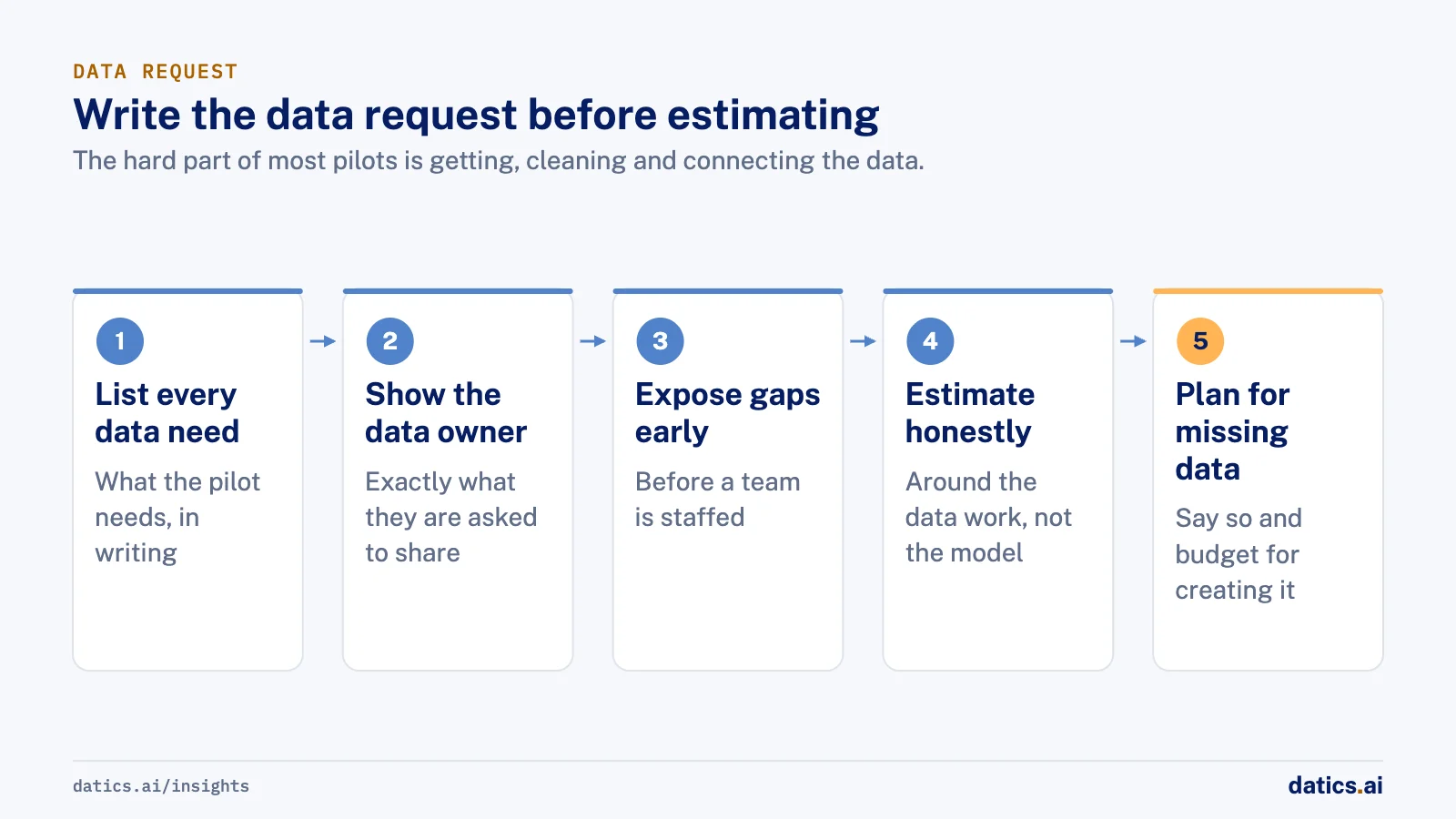
Writing the request first does three things. It shows the data owner precisely what they are being asked to share. It exposes gaps early, before a team is staffed. And it makes the estimate honest, because the hard part of most pilots is getting, cleaning and connecting the data, not calling a model.
Sometimes the data does not exist at all. Years ago, our team worked with a hardware innovation platform on an engine that turned a plain request, such as a wish to build a wireless video doorbell, into a circuit board design, firmware and an enclosure. No public training data existed for requests about electronic components. Public text corpora gave poor results, so the team generated domain training examples, filtered them, and compared several language tools before choosing one. When the real data is missing, say so in the plan and budget for creating it.
03Get through the security review early
Real data comes with a review. In the running project, the brand's apps team required a privacy and security vendor assessment before sharing any data, and the startup did not own that data. We filled in the vendor questionnaire. We also recommended that the startup remain the vendor to the brand, with Datics as its technology partner, so the brand would not hesitate to share data with a party it already knew.
For established B2B products, the equivalent is the customer's security review, data processing terms and sometimes a request to keep everything in their own cloud account. Start it in the first week, not after the build. If the data you need cannot be shared in time, consider whether synthetic or de-identified data can answer the pilot question first. Our article on AI for K-12 software without touching student data shows that approach in a sensitive domain.
04Keep a separate staging path
Users who test AI on real documents will find failures you never saw, and they will often find them while you are changing something else. A pilot needs a path where fixes can be made and checked without touching what other users rely on.
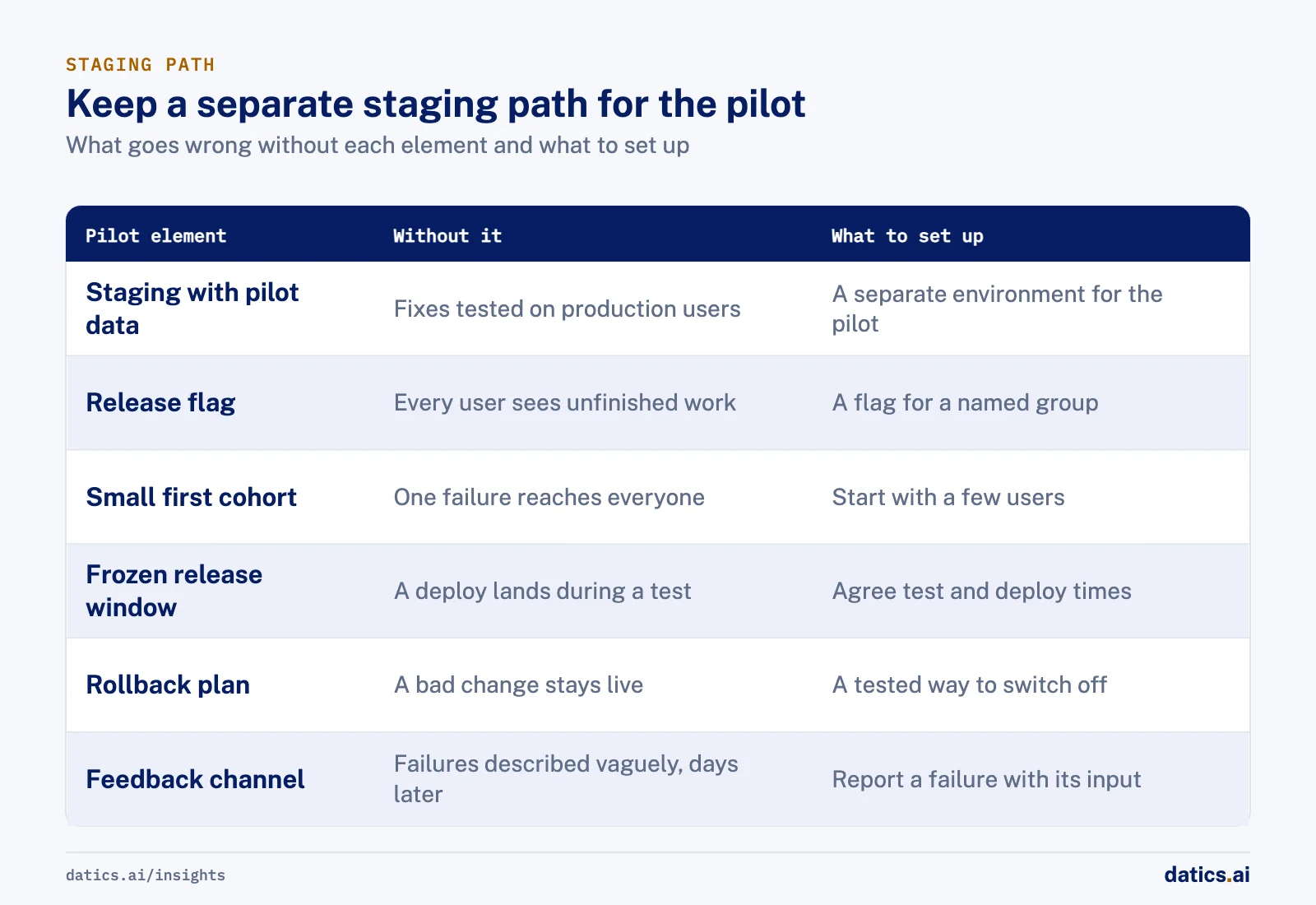
| Pilot element | What goes wrong without it | What to set up |
|---|---|---|
| Staging environment with pilot data | Fixes are tested on production users | A separate environment and address for the pilot |
| Release flag | Every user sees an unfinished feature | A flag that turns the feature on for a named group |
| Small first cohort | One failure reaches everyone | Start with a few users, compare with the rest |
| Frozen release window | A deployment lands during a user test | Agree when users test and when the team deploys |
| Rollback plan | A bad change stays live while you debug | A tested way to switch the feature off or roll back |
| Feedback channel | Failures are described vaguely, days later | A simple way to report a failure with the input attached |
Feature flags are the standard tool here. Pete Hodgson's article on feature toggles, published on Martin Fowler's site, separates release toggles, which hide unfinished work, from permission toggles, which give a feature to a chosen group of users. It also describes canary releases, where a small cohort gets a feature first and its metrics are compared with everyone else's. Google's SRE workbook describes canarying the same way: a partial, time-limited deployment, evaluated against a control group, with a clear path to roll back.
05Run the AI POC in a fixed order
This is the order we follow on most pilots:
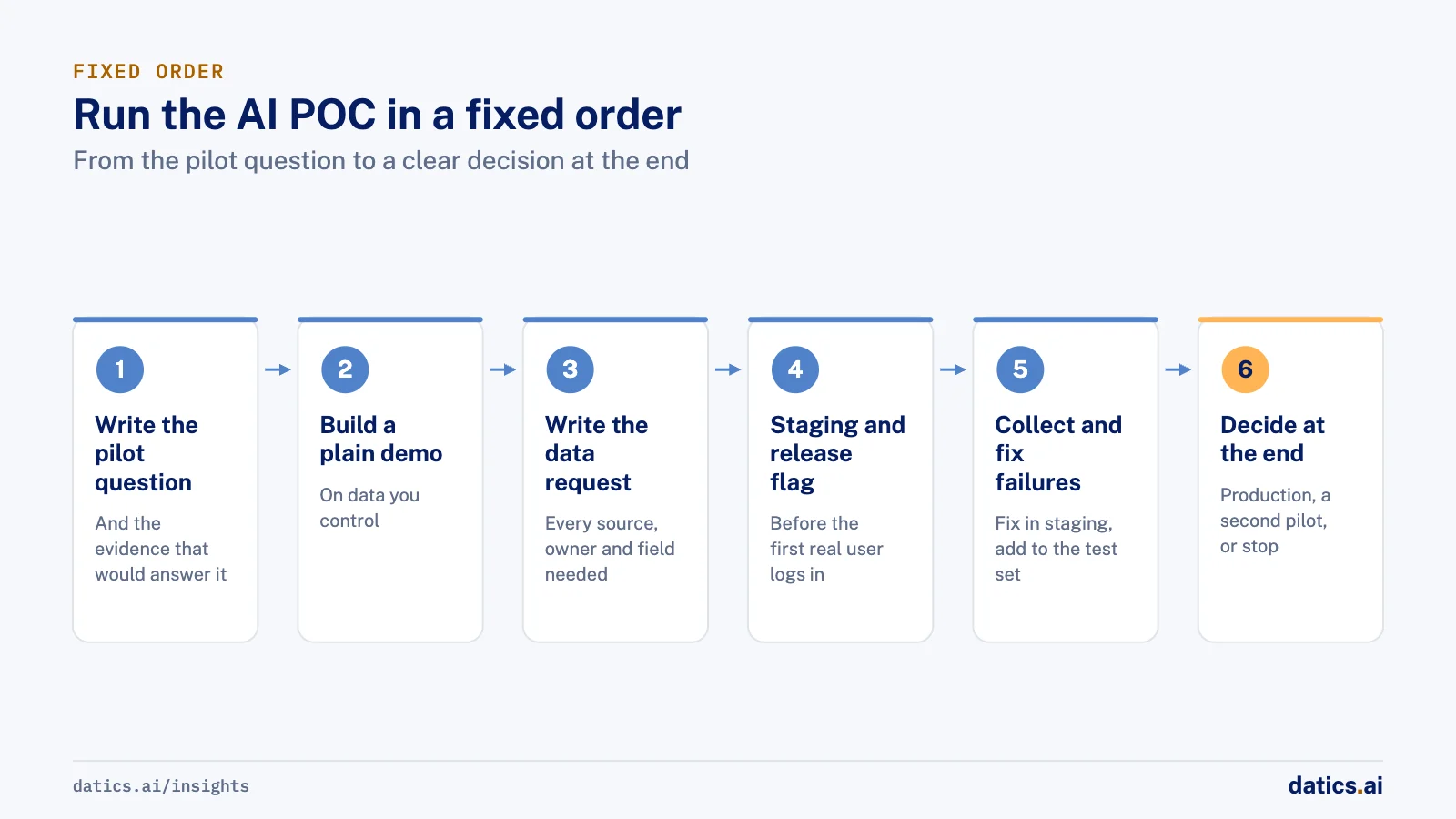
- 01
Write the pilot question and the evidence that would answer it.
- 02
Build a plain demo on data you control to prove the idea works at all.
- 03
Write the data request, listing every source, owner and field the pilot needs.
- 04
Start the security and privacy review in parallel with the data request.
- 05
Set up a staging environment and a release flag before the first real user logs in.
- 06
Agree the testing windows with the client, so deployments do not land during a user session.
- 07
Collect each failure with its input, fix it in staging, and add it to the test set.
- 08
Decide at the end
move to production, run a second pilot, or stop and keep what you learned.
06What we see in production
On the running assistant, built for an early-stage startup in sports and fitness, the demo was delivered and praised by the founder, and the data request turned out to be the real gate. The proof of concept depended on data owned by a third party and on that party's vendor review. We see this often: the pilot plan is written around the model, while the schedule is decided by data access.
On the hardware design engine, built with a platform for product creators, the team split the problem into separate modules, each with its own technique, so each could be tested on its own. Language AI only read the request and pulled out components and parameters. Electrical checks, part placement and routing were rule-based and search-based, so every output was validated before manufacturing files were produced. Splitting a pilot this way lets you show real progress on the parts that work while the hardest part is still in research.
Data was a gate there too. No public data covered requests about electronic components, and general corpora and pretrained word vectors extracted components poorly. We generated our own domain examples, filtered out the noisy ones and tagged every entity and value before choosing the extraction model.
Across pilots, the pattern is consistent. The prompt is rarely what decides success. The data request, the review, the staging path and the release timing do. For the cost side of moving a pilot to production, see how much production AI costs in SaaS.
Frequently asked questions
How long does an AI POC take?
The first plain demo can show whether the idea works at all in days rather than weeks. The full pilot depends on data access more than on the model. The schedule is usually decided by the data request and the security review, so start the review in the first week, in parallel with the data request.
What if the data we need is not ready to share?
Check whether synthetic or de-identified data can answer the pilot question first. If the real data does not exist at all, say so in the plan and budget for creating it. On one hardware design engine, the team generated its own domain training examples, filtered them and compared several language tools before choosing one.
What is the difference between a demo and a pilot?
A demo shows a capability on data you control. A pilot shows the capability on the client's data, with the client's users, under the client's constraints. Both are useful, but they answer different questions. Confusing them leads to pilots that are really demos with more risk.
What happens at the end of a pilot?
You make a decision: move to production, run a second pilot, or stop and keep what you learned. The evidence comes from the pilot question written at the start, and from each failure collected with its input, fixed in staging and added to the test set.
How Datics helps
Datics specializes in brownfield AI: bringing production AI into the product you already operate, without forcing a rebuild.
Related work
Case studies from our projects on the same subject.
IDEEZA
B2B Software · Generative hardware design engine
Inventors describe a device in plain words and get a buildable board design
Hardware ideas needed electrical engineers to become boards; now a plain request becomes a checked circuit design, manufacturing files and an app.
More on Forward deployed engineers
Forward deployed engineers
What is forward deployed engineering?
Forward deployed engineering places engineers inside a customer's own team, repositories and code review, so AI ships inside the product customers already use.
Umair MajeedReadForward deployed engineers
Fixed price vs time and materials: which fits AI work?
Fixed price vs time and materials for AI work depends on how firm the boundary is. Learn when a first AI feature can be priced as fixed and when it cannot.
Umair MajeedReadForward deployed engineers
What should an AI readiness assessment cover?
An AI readiness assessment compares how your product works today with the workflow you need, flow by flow, and ends in a pilot scope and a do not break list.
Umair MajeedReadForward deployed engineers
How do you scope an AI proof of concept that ships in weeks?
How to scope an AI proof of concept that ships in weeks: test one workflow inside the live product, start with the simplest input and defer the hard formats.
Umair MajeedReadForward deployed engineers
AI MVP development: how do you scope the core journeys?
Good AI MVP development starts with the few journeys that let a customer sign up, pay and get value alone. Here is how we rank features and scope the rest.
 Bilal HassanRead
Your customers already expect AI from your product.
Let us make it real without rebuilding what already works.