
Brownfield AI
AI strategy for a mature product: build, buy or partner?
Buy what your customers will never notice. Own what they pay you for.
 Umair MajeedCo-founder and CEO, Datics AI6 min read
Short answer
For a mature product, the core AI strategy question is not whether to use AI but who should build each feature. Buy a tool when the need is generic and the tool can reach your data safely. Build in house when the feature is core to your product and your team has the skills and the time. Bring in a partner when the feature is core but your team lacks the AI experience or the capacity, and make sure the partner works inside your code so the capability stays with you.
On this page
01What makes this decision different for a mature product
A startup choosing AI tools risks a few months. A product with paying customers risks more. Your AI feature has to work with permissions that took years to get right, data that has grown messy across versions, integrations customers depend on, and contracts that say where their data may go. Every path has to respect all of that.
Three things change the math for an established company:
- Your data is the advantage. A vendor can sell the same model to your competitors. It cannot sell your workflows, your customer records or your domain rules. Features that depend on those are the ones worth owning.
- Your customers will ask hard questions. Where does our data go, who trains on it, what happens if the AI is wrong. Whatever you choose, you must answer for it.
- Your roadmap is already full. The team that knows the product best is usually busy keeping it running. Pulling them onto AI work has a cost that rarely appears in the plan.
That is why I prefer to make this choice feature by feature, not once for the whole company. Our AI integration guide covers how those features fit into the product itself.
02When building in house fits
Building in house fits when the AI feature is part of what customers buy from you, and your team can carry it from prototype to production. Signs that it fits:
- The feature depends deeply on your domain logic, data model and permissions.
- You have, or can hire, engineers who have shipped AI to production before, not only built demos.
- The roadmap can absorb the work without stalling the features customers are waiting for.
- You plan to keep improving the feature for years, so the learning needs to live inside your team.
The trap is underestimating the gap between a working prototype and a feature customers rely on. Evaluation, monitoring, cost control and failure handling take more time than the first version. Our view on why vibe coding falls short in mature SaaS explains why a fast prototype is a starting point, not a plan.
03When buying a tool fits
Buying fits when the need is common across many companies and is not where you compete. Internal search over your own documents, meeting summaries and coding assistants are typical. Microsoft's guidance on planning AI agents starts from one question: does a ready-made agent meet your functional requirements? If it does, adopt it. If not, build. It also notes that ready-made agents offer limited customization.
For customer-facing features in a mature product, buying has extra risks:
- Data reach. The tool needs your data, and getting it there safely may cost as much as building the feature.
- Terms that change. The OWASP entry on supply chain risks for LLM applications warns that if a model operator's terms or privacy policy are unclear or change, your application data may end up used for training. It recommends vetting suppliers and reviewing their terms regularly.
- Fit with your interface. A bought widget often looks and behaves like someone else's product inside yours.
- Lock-in. Prompts, workflows and evaluation data built inside a vendor's tool may not move with you.
Buying is still the right answer more often than engineering teams like to admit. The rule is to test the tool on your own data before you commit, not on the vendor's demo.
04When a partner fits
A partner fits when the feature is core to your product, but your team lacks the AI production experience or the capacity to deliver it in the time the market allows. The point of a partner is speed and experience without giving up ownership.
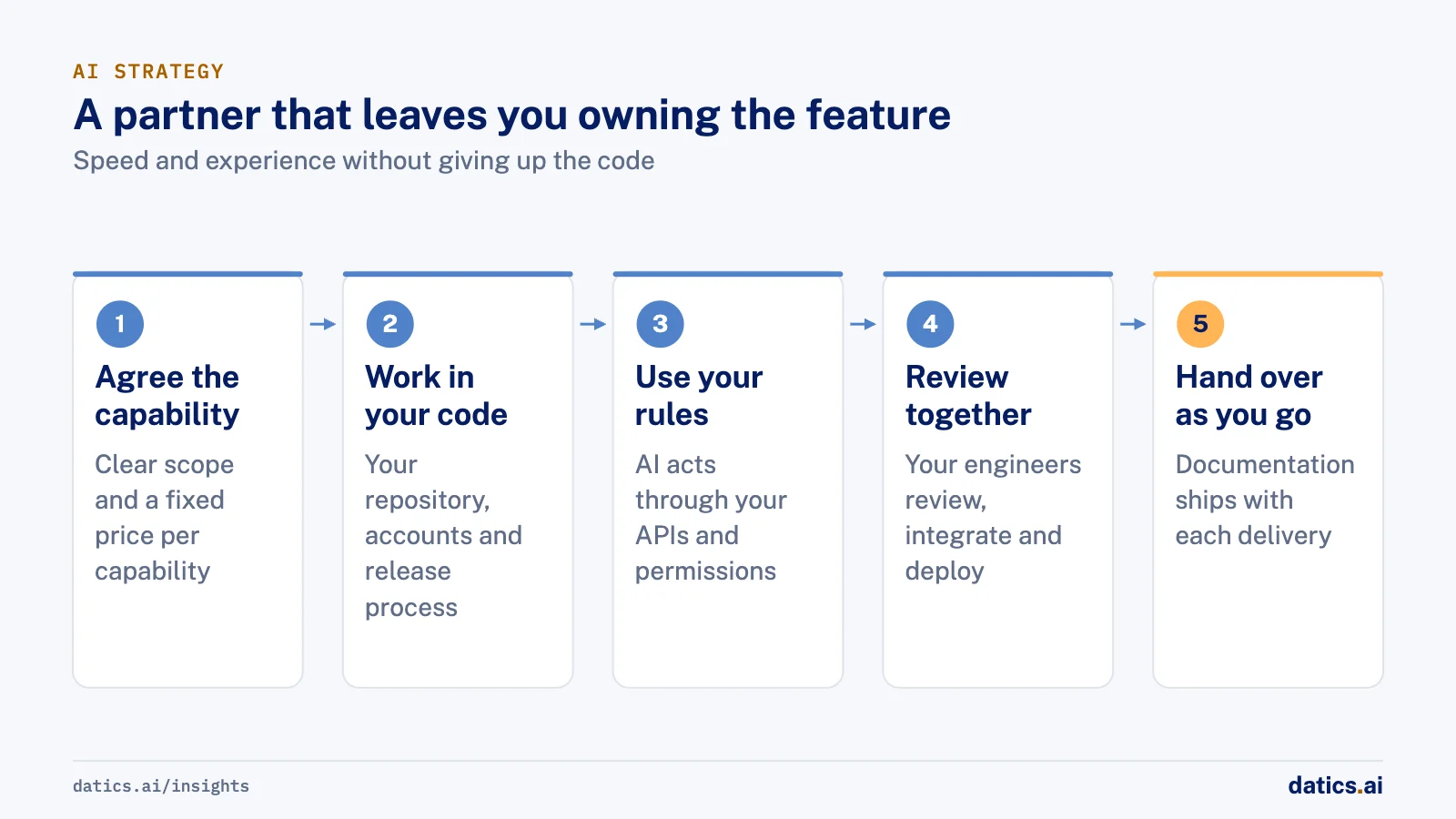
What makes a partner model work for a mature product:
- They work in your repository, your accounts and your release process. The code is yours from the first commit, not handed over at the end.
- They use your permissions and APIs. The AI acts through the rules your product already enforces.
- Your team stays in the loop. Your engineers review, integrate and learn, so they can carry the feature later.
- Scope and price are clear per capability. You know what you are paying for and what done looks like. Our comparison of fixed price and time and materials covers how to structure this.
A partner who builds a separate product beside yours, on their own infrastructure, recreates the risks of buying with fewer of the benefits. Our article on forward deployed engineering describes the inside-your-team model in more detail.
05The questions that decide it
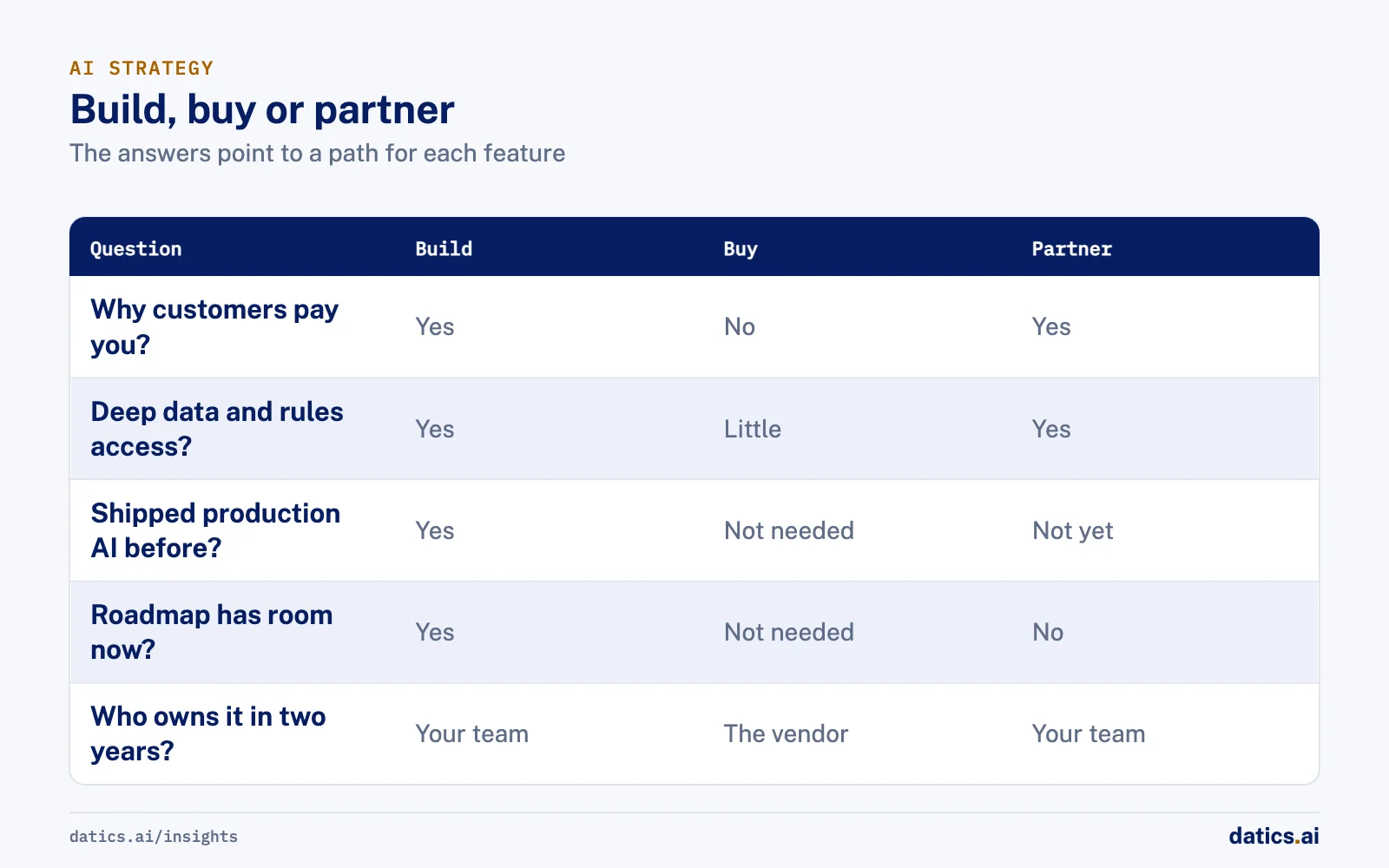
| Question | Points to build | Points to buy | Points to partner |
|---|---|---|---|
| Is this feature part of why customers pay you? | Yes | No | Yes |
| Does it need deep access to your data and rules? | Yes | Little | Yes |
| Has your team shipped production AI before? | Yes | Not needed | Not yet |
| Can the roadmap absorb the work now? | Yes | Not needed | No |
| Does a ready-made tool meet the requirement on your data? | No | Yes | No |
| Who must own the code and the learning in two years? | Your team | The vendor | Your team |
When the answers split, I ask one more: what would hurt more, being six months late or being dependent on a vendor for something customers see? The answer usually settles it. For the cost side of the same decision, see our breakdown of what production AI costs in SaaS.
Microsoft's guidance also recommends short, time-boxed experiments of one to two weeks per option before scaling, with findings documented for stakeholders. I agree with the spirit. A decision made on a slide is weaker than one made on your own data.
06What we see in production
A construction company had already bought into Microsoft Copilot and built an agent over its reporting database. Rather than replace it, we tested that agent on live job cost data, inside the client's own Microsoft tenant, and checked every answer against our own SQL. The agent was reliable on direct questions over approved reporting views, and we showed where the database, not the model, has to do the math. That is the buy path done properly: test the tool on your own figures, and keep calculations in deterministic code.
Insurance Sales Lab trains insurance agents on its own learning platform. Our engineers already worked in its repository on platform features, directed through its daily syncs. When it wanted AI voice roleplay, we built the trainer inside its existing platform, using its sign in and organizations, with admins in charge of the scripts and the scoring standard. That is the partner path: core to the product, built in the client's code, owned by the client.
On a regulated private investment marketplace, we built AI agents as backend APIs beside the client's .NET core, while the client's own .NET developers owned the screens and the integration. The client's team kept control of the product, and integration ran through its own branch. Partnering and building in house are not opposites. The best setups mix them on purpose.
If you are weighing these paths for a specific feature, our AI integration services start with a Planning Sprint: two weeks, $5,000, ending in a plan and a fixed quote, with the fee counted toward the build. It answers the questions above on your own product before anyone commits to a path.
07Signs you picked the wrong path
- You bought a tool, and half the project is now moving data into it.
- You built in house, and the AI feature has been "almost ready" for two quarters.
- Your partner's code lives in their repository, and your team has never deployed it.
- Nobody on your side can explain how the feature is evaluated.
- A vendor's terms changed and you found out from a customer.
Frequently asked questions
Should we build AI features ourselves or buy them?
Buy where the need is common and not where you compete, after testing the tool on your own data. Build where the feature is part of why customers pay you and your team has production AI experience. Where the feature is core but the experience or capacity is missing, a partner working inside your code is usually the fastest safe route.
How do we avoid lock-in with an AI partner?
Insist that the work happens in your repository and your cloud accounts from the start, under your release process. Have your engineers review and deploy the code, and make documentation part of each delivery. Then the partner can leave and the feature stays.
How long should the build, buy or partner decision take?
Weeks, not quarters. A short, time-boxed test of the leading option on your own data usually settles it. If the decision drags on, the missing input is normally a real test, not more opinions.
How Datics helps
Datics specializes in Brownfield AI: production AI inside software people already rely on. A Build Sprint puts one outcome working in your product's staging in three weeks, for $10,000, and the fee counts toward production. Not sure what to build first? The Planning Sprint ranks it in two weeks, for $5,000.
Related work
Case studies from our projects on the same subject.
OCCI
Other software · Enterprise data assistant evaluation
OCCI kept Copilot once its live job cost answers were checked against SQL
Leaders wanted plain language answers from their own job cost data. We tested their Copilot agent in their tenant and checked each answer against SQL.
Insurance Sales Lab
EdTech · AI voice roleplay trainer
Insurance agents practice calls with an AI prospect, scored on the company's script
Practice used to wait for a human coach, and feedback varied. Now agents call an AI prospect any time and get the same checklist score.
Regulated investment platform
Fintech · Private investment marketplace
Pitch decks become drafted deals, and issuers approve each field before publishing
Issuers retyped decks and financials into long deal forms. Now AI suggests each field, and the issuer applies, edits or rejects it.
More on Brownfield AI
Brownfield AI
AI integration for SaaS: build AI into your live product
AI integration for an existing SaaS product: keep your core as the system of record, reuse your APIs and auth, and ship one AI workflow at a time.
Umair MajeedReadBrownfield AI
Is vibe coding enough for mature SaaS?
Vibe coding in SaaS is fast for prototypes. Mature products need server-side permissions, regression tests, evaluation and review before AI code ships.
Umair MajeedReadBrownfield AI
AI strategy consulting: what to get before you build
AI strategy consulting should end with ranked AI capabilities, a data and cost check per capability, and a fixed quote for the first one, not a slide deck.
Umair MajeedReadBrownfield AI
Brownfield vs greenfield: retrofit AI or start fresh?
Brownfield vs greenfield for AI: what a mature SaaS platform has that an AI startup lacks, where legacy code slows it down, and how to move just as fast.
Umair MajeedReadBrownfield AI
AI product strategy: embed AI or launch a separate product?
An AI product strategy for an established SaaS: when to build AI into the product you have, when a separate AI product makes sense, and how to decide.
Umair MajeedReadBrownfield AI
AI implementation challenges: lessons from 60+ AI projects
The AI implementation challenges behind 60+ AI projects: integration, data, permissions, approvals and testing, and what to settle first.
Umair MajeedReadYour customers already expect AI from your product.
Let us make it real inside the product you run today.