
Automotive and dealerships
AI agents for car dealerships: what should they do?
A dealership agent earns trust the day it refuses to quote a unit that already sold.
 Umair MajeedCo-founder and CEO, Datics AI4 min read
Short answer
AI agents for car dealerships work when they answer shoppers from the dealer's live inventory, compute payments and towing with tools instead of guessing, and hand every qualified lead to a salesperson with the conversation attached. For companies that build dealer software, the agent belongs inside the website, CRM or inventory platform dealers already use, not in a separate chat tool.
On this page
01What AI agents for car dealerships should actually do
Shoppers now do much of their buying online. Cox Automotive's 2025 Car Buyer Journey study found that buyers who complete more of the deal online report higher satisfaction with their time at the dealership. That makes the questions a shopper asks online, at any hour, part of the sale.
Useful dealership agents do five jobs:
- Answer from live stock. Which units are available, with prices and features from today's feed, and sold units removed.
- Work out what the shopper needs. Towing capacity, payload or payment estimates computed by tools, with the inputs shown.
- Book the next step. Test drives, water tests or appraisal visits, offered from real availability.
- Follow up on leads. Draft follow-up messages for leads the CRM shows as untouched, for a salesperson to send.
- Hand off cleanly. Every qualified lead reaches the CRM with the full conversation, so the salesperson does not start from zero.
02Why most dealership chat fails
Many dealer website chats disappoint for the same reasons: they guess. They offer a unit that sold last week, quote a payment the model made up, or capture a name without the conversation that explains what the shopper wants.
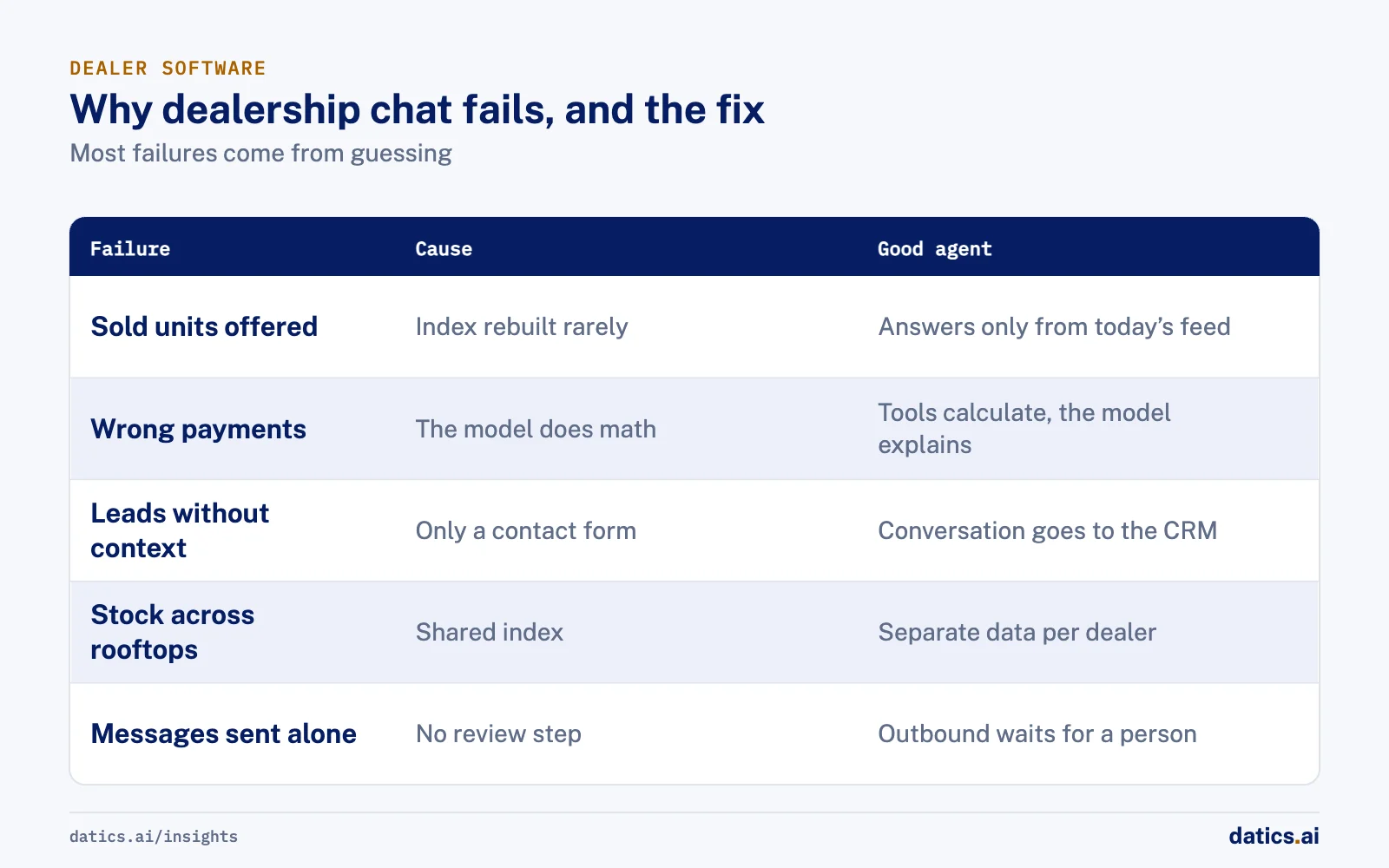
| Common failure | Why it happens | How a good agent avoids it |
|---|---|---|
| Sold units offered | The index is rebuilt rarely | Re-index changed units often, and answer only from today's feed |
| Wrong payments or towing | The model does the math | Calculations run in tools; the model only explains them |
| Leads without context | The chat stores a contact form | The conversation travels with the lead into the CRM |
| One dealer's stock on another site | Shared indexes across rooftops | Separate data per dealer and per brand, tested on every release |
| Messages sent without review | The agent acts alone | Outbound texts and emails wait for a person |
Dealers also handle customer financial information, so their vendors work under the FTC Safeguards Rule. The FTC's FAQ for automobile dealers explains what the rule expects, including oversight of service providers. An agent that keeps each dealer's data separate and logs what it does makes a dealer's own review easier; compliance still depends on the whole product and how it is run.
03How to add an agent to dealer software, step by step
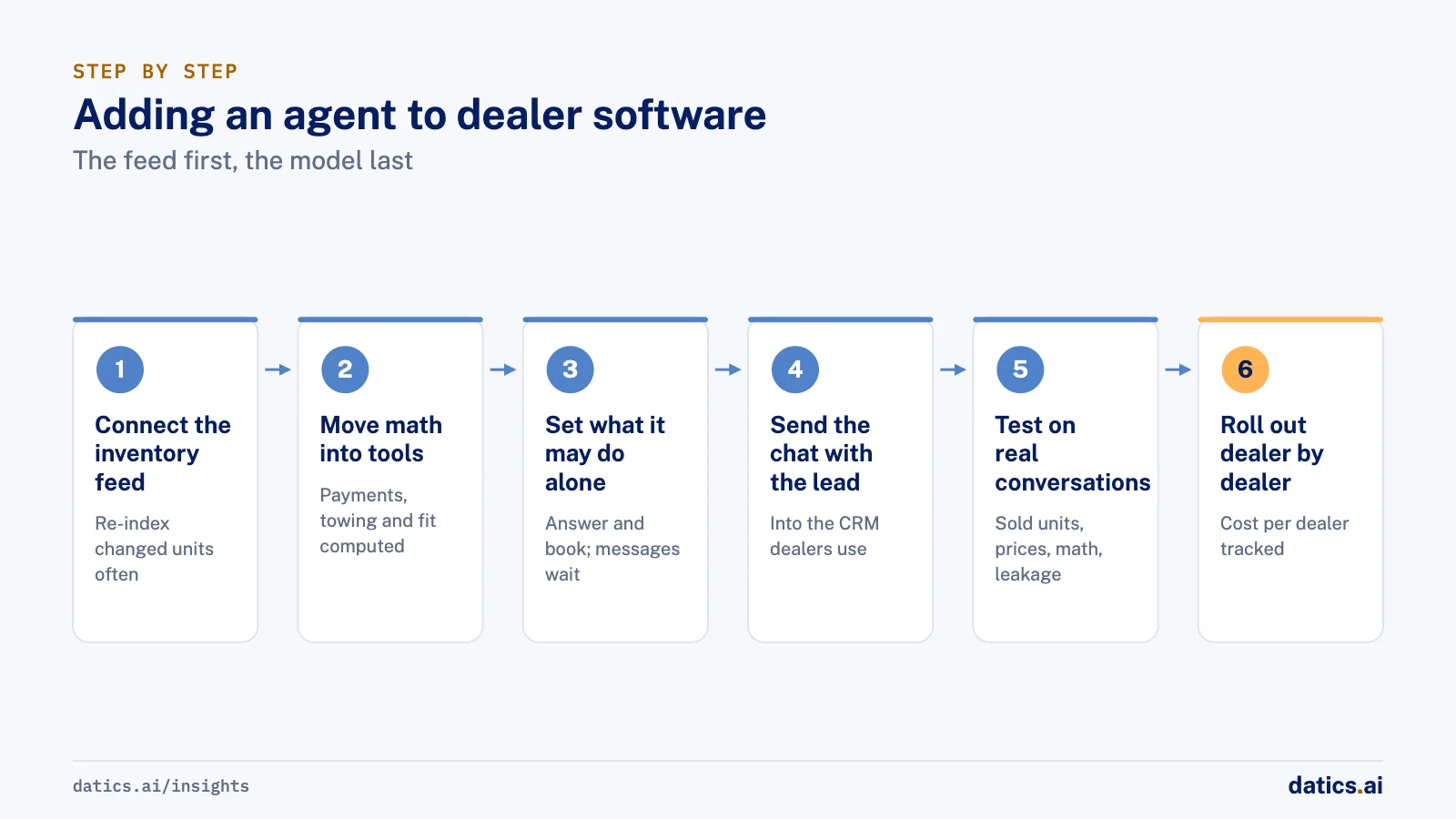
- 01
Connect to the inventory feed first.
The agent is only as good as the feed. Decide how often changed units are re-indexed.
- 02
Move every calculation into a tool.
Payments, towing and fit are computed, not generated.
- 03
Define what the agent may do alone.
Answering and booking from availability are usually fine; outbound messages wait for approval.
- 04
Send the conversation with the lead.
Map the hand-off into the CRM fields your dealers already use.
- 05
Test on real shopper conversations.
Measure sold units offered, wrong prices, wrong math and leakage between dealers.
- 06
Roll out dealer by dealer.
Each dealer or brand turns the agent on when ready, with cost per dealer tracked.
Our automotive section shows a dealer website assistant, lead follow-up and other modules working on a fictional dealership. For the broader picture, read our guide to AI for car dealerships.
04How to measure a dealership agent
Dealers judge an agent by leads and appointments, so measure those, and measure the mistakes that cost trust.
- Accuracy on stock and price. How often the agent offered a sold unit or quoted a price that did not match the feed, on a set of real shopper conversations.
- Math done by tools. The share of payment, towing and fit answers that came from a calculation rather than from the model, with the inputs shown.
- Qualified hand-offs. Conversations that reached the CRM as a lead with the full conversation attached, and how many became appointments.
- Response at any hour. Shoppers answered outside showroom hours who later booked a visit.
- Dealer separation and cost. Attempts on one dealer's site to reach another dealer's stock, with zero as the bar, and model cost per dealer at real volume.
Run the same test conversations after every change to prompts, models or the inventory pipeline. Dealers notice a sold unit offered once far more than a hundred correct answers.
05What we see in production
We built a white-label sales assistant for RV dealers that recommends units from live stock, with towing fit computed rather than guessed, and turns conversations into qualified leads and appointments. The towing math was the turning point: once it ran in a tool, salespeople stopped correcting the agent.
We have also modernized dealer CRM and operations platforms module by module while dealers kept using them daily, and built daily market data from many changing dealer websites. In every case, the data plumbing decided the quality of the AI: fresh inventory, clean lead records and clear separation between dealers.
The agents dealers keep are the ones that make salespeople faster, not the ones that try to replace them.
Frequently asked questions
Can an AI agent close a car sale on its own?
It should not. An agent can answer, qualify and book, and it can draft follow-ups. The deal, the price negotiation and any financing conversation stay with the dealership's people.
How does an agent avoid offering sold units?
It answers only from the current inventory feed and re-indexes changed units often, so sold units drop out quickly. Testing on real conversations before release shows how often it still happens.
Does the agent need its own CRM?
No. It should write leads, conversations and appointments into the CRM the dealer already uses, through that system's own APIs or lead formats, so salespeople keep working where they work today and managers see every lead in one place.
How Datics helps
Building dealer software? See the AI modules we build for dealer CRMs, websites and inventory platforms.
Related work
Case studies from our projects on the same subject.
Coast Technology
Automotive · AI sales assistant for dealers
RV shoppers get units from live stock, with towing fit computed, not guessed
Dealer sites offered static forms and filters. Now shoppers ask in plain words and get real units from the hourly feed, with the reason each one fits.
Coast Technology
Automotive · Dealership customer intelligence SaaS
Dealers kept using their portal daily while we rebuilt it module by module
Dealers relied on a portal run on per dealer scripts. We rebuilt it module by module while they worked, and grew it into a CRM and more.
Coast Technology
Automotive · Competitive inventory intelligence engine
Dealers see rival stock, prices and sales daily, captured from many changing websites
Dealers checked rival lots by hand, site by site. Now one engine captures competitor stock daily and the portal compares prices and sends alerts.
Related answers
Automotive and dealerships
AI for car dealerships: where it pays in dealer software
AI for car dealerships pays in sales, BDC follow-up and service booking first, grounded in live inventory and wired into each dealer's CRM and DMS.
Umair MajeedReadRAG and AI assistants
How do you make AI product search match how buyers shop?
AI product search works when it learns how buyers decide, such as a monthly payment budget, and turns that into precise filters over live inventory.
 Applied AI TeamRead
Property management and field operations
AI agents for real estate: what to build into your software
AI agents for real estate answer listing questions, book showings and draft follow-ups from live data. Offers, money and legal notices stay with people.
Umair MajeedReadYour customers already expect AI from your product.
Let us make it real inside the product you run today.