
AI security and compliance
What enterprise AI security questions do buyers ask?
An AI feature is only as trustworthy as the production access around it.
 Umair MajeedCo-founder and CEO, Datics AI6 min read
Short answer
In enterprise AI security reviews, buyers ask where their data goes, which model provider processes it and in which region, whether it is used for training, who can reach production, what the AI may do without a person, and how every action is logged. Enterprise AI security reviews start with the plain controls first: access, monitoring, secrets and environments. An AI feature inherits whatever access hygiene the product already has.
On this page
01The questions arrive in a predictable order
Security questionnaires for AI features look new, but most of the questions are old ones asked again with a model in the middle. In our experience they arrive in roughly this order:
- 01
Where does our data live, and does any of it leave our region or our cloud account?
- 02
Which model provider processes it, under what terms, and is it retained or used for training?
- 03
Who on your side can access production, from where, and how is that logged?
- 04
Where are secrets and API keys stored, and who can read them?
- 05
What can the AI do on its own, and what needs a person to approve?
- 06
How do you log prompts, outputs and actions, and how long are logs kept?
- 07
How do you prevent one customer's data from reaching another customer's answers?
- 08
What happens if the model or a provider fails, and can we switch the feature off?
The first four are about your platform, not about AI. If those answers are weak, a strong AI story will not save the review.
02Fix the plain controls before the AI controls
Teams often prepare long answers about prompt injection and model safety while production access is still loose. Reviewers notice. The basics carry the most weight, because they limit the damage of any failure, AI or otherwise.
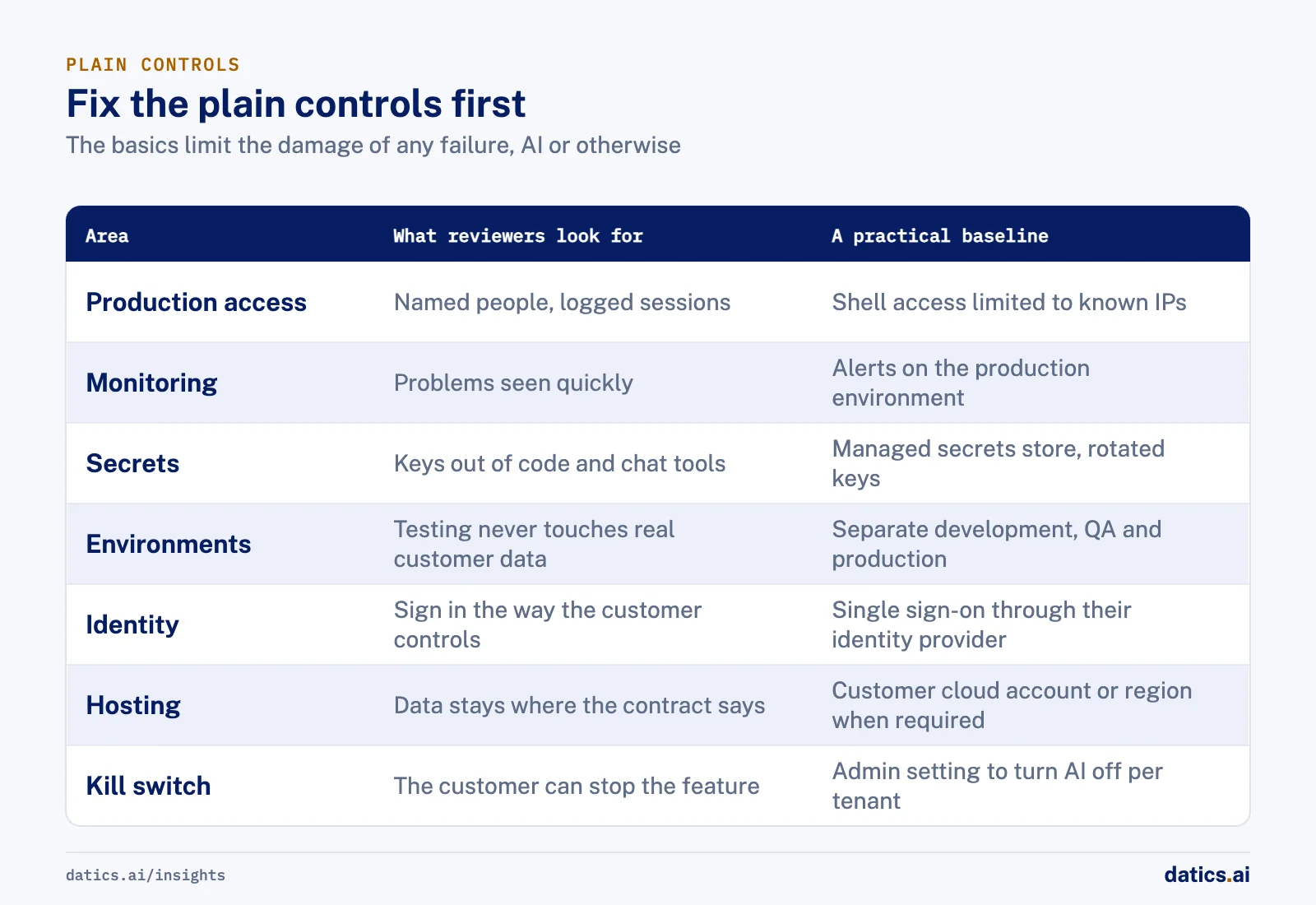
| Area | What reviewers look for | A practical baseline |
|---|---|---|
| Production access | Named people, limited network paths, logged sessions | Shell access limited to known IP addresses, no shared accounts |
| Monitoring | Evidence that problems are seen quickly | Infrastructure monitoring and alerts on the production environment |
| Secrets | Keys out of code and out of chat tools | A managed secrets store, rotated keys, least privilege access |
| Environments | Testing never touches real customer data | Separate development, QA and production, with synthetic or de-identified test data |
| Identity | Customer users sign in the way the customer already controls | Single sign-on through the customer's identity provider |
| Hosting | Data stays where the contract says | Deployment in the customer's own cloud account or region when required |
| Kill switch | The customer can stop the feature quickly | An admin setting that turns the AI feature off per tenant |
None of this is specific to language models, which is exactly the point. The NIST Generative AI Profile, a companion to the NIST AI Risk Management Framework, treats generative AI risk as part of an organization's wider risk management, not as a separate island.
03Then answer the AI specific questions
Once the platform basics are in place, the AI specific questions become easier to answer honestly. The OWASP Top 10 for LLM Applications is a useful map of what reviewers worry about: prompt injection, sensitive information disclosure, excessive agency, system prompt leakage and unbounded consumption among them. For each one, describe the control in plain terms:
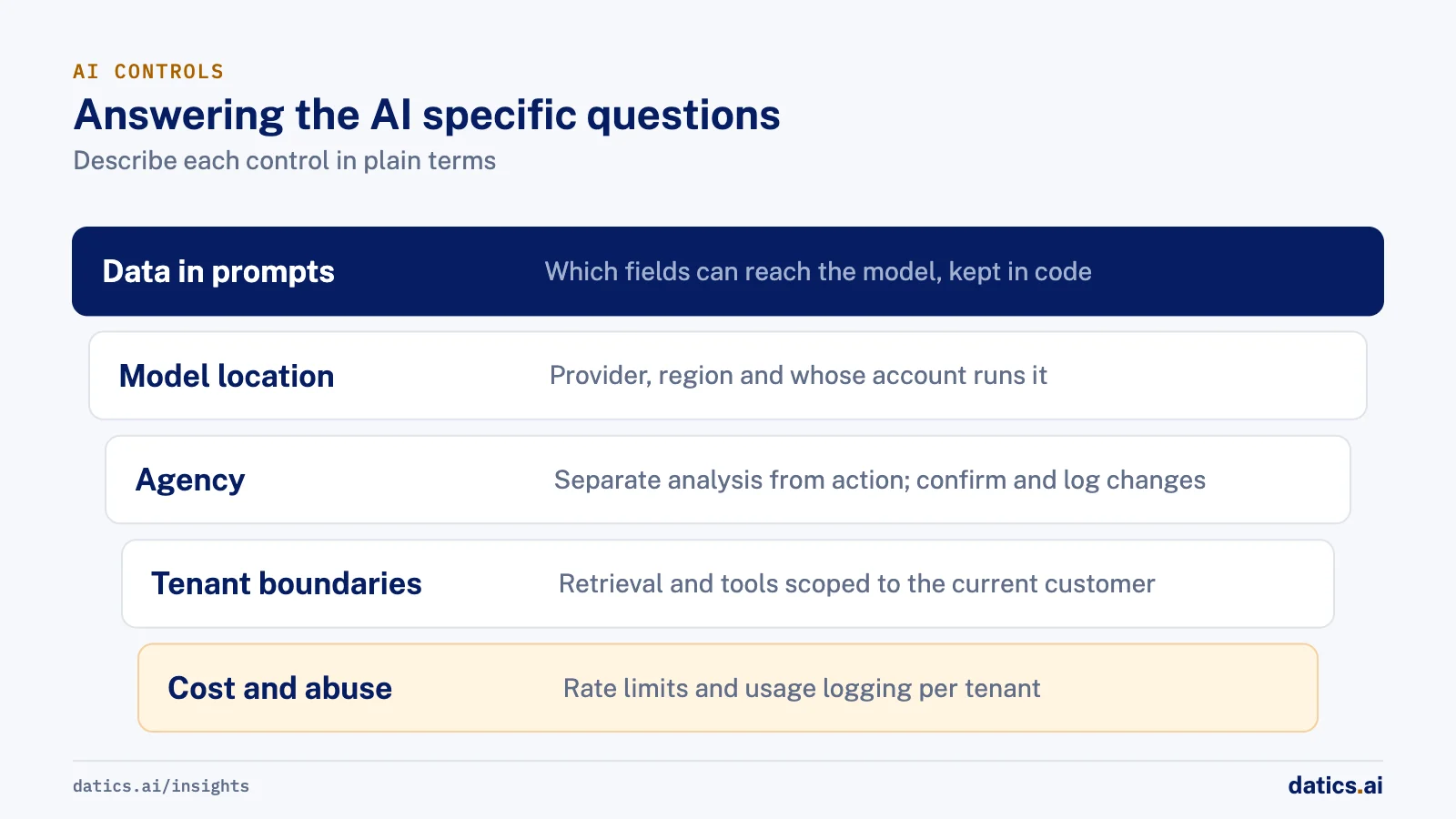
- Data in prompts. List which fields can reach the model and which never can. Keep the list in the codebase, not in a slide.
- Model location. State the provider, the region and whether the model runs in your account, the customer's account or the provider's service.
- Agency. Separate analysis from action. If the AI can change records, send messages or place orders, require an explicit user confirmation and log it.
- Tenant boundaries. Show that retrieval and tools are scoped to the current customer before the model sees anything.
- Cost and abuse. Show rate limits and usage logging per tenant and per conversation.
Where possible, offer deployment options rather than one answer. Some buyers accept a hosted service with clear terms. Others need the AI to run inside their own cloud subscription, on a model endpoint they already approved. We compare cloud options in Bedrock vs Azure AI vs Vertex AI for existing SaaS.
04Prepare the evidence, not just the answers
A review goes faster when every answer points to something the buyer can check. Keep a short evidence pack:
- An architecture diagram showing where data flows, including the model call.
- A list of production access holders and how access is granted and removed.
- Sample audit log entries for an AI action, with sensitive values removed.
- The data field list for prompts.
- The steps to switch the feature off for one customer.
Be precise about what you do not have. If you hold no certification, say so plainly and describe the controls you do run. Reviewers trust a clear "not yet" more than a vague claim.
05Common mistakes in enterprise AI security reviews
The same mistakes slow down many reviews, and most of them are avoidable:
- Answering for the model provider instead of for your product. Buyers want to know what your platform does with their data, not only the provider's general terms.
- Describing controls that are planned as if they were live. Reviewers ask for evidence, and a gap found late damages trust in every other answer.
- Using production data in testing. Even one screenshot of real customer data in a demo environment can stop a review.
- Leaving agent permissions broad. An assistant that can call any internal endpoint is hard to defend. Give it a short, explicit tool list scoped to the user it acts for.
- Forgetting offboarding. Buyers increasingly ask how their data, logs and any indexes are deleted when the contract ends.
A useful habit is to run your own review first. Take a recent questionnaire, answer it internally for the AI feature, and fix the weak answers before a customer sees them.
06What we see in production
On a promotional campaign portal we built for a dealership marketing agency, the application ran on AWS in the client's own account alongside its other apps. Before any AI was ever discussed, it got infrastructure monitoring, and production shell access was limited to known office IP addresses. Later, its resources moved with the client's other applications to a new AWS account. These are the plain controls a security review checks first, and any AI work inside a product like this inherits them.
On an AI market intelligence app for retail investors, AI analysis was kept separate from real trades. Orders through the connected brokerage required explicit consent to connect and a mandatory user confirmation. Licensed options data was held to the QA environment only. When the client explored a business version for investment firms, our proposal set out deployment inside the prospect's own Azure subscription, with a managed key vault for all secrets, single sign-on through the prospect's identity provider, monitoring, infrastructure as code, an admin kill switch and human in the loop settings, with the agents exposed only through an authenticated API.
On a governed AI content platform, a fresh install of the second version carries no client documents, data or keys by design, which makes it simpler to stand up a clean environment for a new customer.
Across our work, engineering runs with no standing access to client production data, and we work in the client's cloud and on the client's model by default.
Frequently asked questions
Do we need a security certification before selling an AI feature to enterprises?
Not necessarily, but be precise about what you have. If you hold no certification, say so plainly and describe the controls you do run. Reviewers trust a clear "not yet" more than a vague claim, and describing planned controls as if they were live damages trust in every other answer.
Can the AI run inside the customer's own cloud account?
It can, and some buyers require it. Offer deployment options rather than one answer. Some buyers accept a hosted service with clear terms, while others need the AI to run inside their own cloud subscription, on a model endpoint they already approved. Either way, state the provider, the region and where the model runs.
What evidence should we prepare for an AI security review?
Prepare a short evidence pack the buyer can check. It holds an architecture diagram showing where data flows, including the model call, and a list of production access holders. Add sample audit log entries for an AI action with sensitive values removed, the data field list for prompts, and the steps to switch the feature off for one customer.
How Datics helps
Datics specializes in brownfield AI: bringing production AI into the product you already operate, without forcing a rebuild.
Related work
Case studies from our projects on the same subject.
Cosmic AI
Financial Services · Multi-agent investing assistant
Retail investors go from research to a confirmed order in one conversation
Investors juggled data, news and a separate broker. Now agents research and prepare each trade in chat, and nothing is placed until they confirm.
SovrenAI
B2B Software · GCE, a grounded AI chat and document IDE
Every claim in an AI answer shows its confidence and its source
AI answers look equally sure when they guess; in SovrenAI's chat every claim carries a tier, confidence and source, and we ship each version live.
More on AI security and compliance
AI security and compliance
AI security for SaaS: protect data and pass security reviews
A practical map of AI security for established SaaS: threats, data governance, permissions, audit trails and how to answer enterprise security reviews.
Umair MajeedReadAI security and compliance
Soft delete vs hard delete: which fits regulated software?
Soft delete vs hard delete in regulated software: when to suppress, when to purge, and how to keep the audit history that disputes depend on.
 Rana Umar MajeedRead
AI security and compliance
How do you stop AI data leakage through search metadata?
Stop AI data leakage in search by treating metadata as sensitive: classify records, automate high stakes rules, keep people on unclear cases, and audit.
Rana Umar MajeedReadAI security and compliance
LLM security: why treat model output as untrusted input?
A core LLM security rule: treat every model response like input from an unknown user. Parse it, validate it against business rules, then let it through.
Rana Umar MajeedReadAI security and compliance
Which AI disclaimers does a product need?
An AI disclaimer works when it is designed into the feature: say it is AI, that it can be wrong, what happens to data, and where its numbers come from.
Umair MajeedReadAI security and compliance
How do you enforce tenant isolation beyond database rows?
Tenant isolation beyond database rows means boundaries per field and per role, in caches, files, payments and jobs, so no tenant sees what another owns.
Rana Umar MajeedReadYour customers already expect AI from your product.
Let us make it real without rebuilding what already works.