
AI security and compliance
How do you stop AI data leakage through search metadata?
The document is not the only secret. The index card can be one too.
 Rana Umar MajeedCo-founder and CTO, Datics AI6 min read
Short answer
To prevent AI data leakage through search, treat extracted metadata as sensitive data in its own right. Names, captions and dates can reveal as much as the document behind them. Classify each record by confidentiality level, apply rules automatically where the stakes are highest, keep a person in control of uncertain cases, and prefer suppression with an audit trail over deletion.
On this page
01Why metadata causes AI data leakage
AI extraction makes it cheap to pull structured fields out of documents: parties, witnesses, dates, case numbers, amounts. Search makes those fields discoverable. Put the two together and a product can expose more through its index than it ever would through its documents, because the index is built to be found. This is part of our larger guide, AI security for SaaS: protect data and pass security reviews.
In legal software, a witness name next to a case caption can disclose a private matter even if the transcript stays locked. In healthcare, an appointment type and a date can say enough about a patient. In financial software, a deal name and a list of counterparties can move a market. Even the identity of who holds a record can be confidential.
NIST's guide to protecting personally identifiable information takes a context-based approach: the same data element needs different protection depending on where it appears and what it can be combined with. That is the right frame for metadata. A field is not safe or unsafe on its own. It is safe or unsafe in a given search result, for a given user.
OWASP lists sensitive information disclosure among the top risks for LLM applications. Its guidance points to least privilege access and restricting data sources, and it warns that restrictions written only into a system prompt can be bypassed. For search products, that means the protection has to live in the data and the access layer, not in model instructions.
02Classify before you index
Every record should carry a confidentiality level before it reaches the search index. The level decides what is shown, to whom, and who must approve anything more.
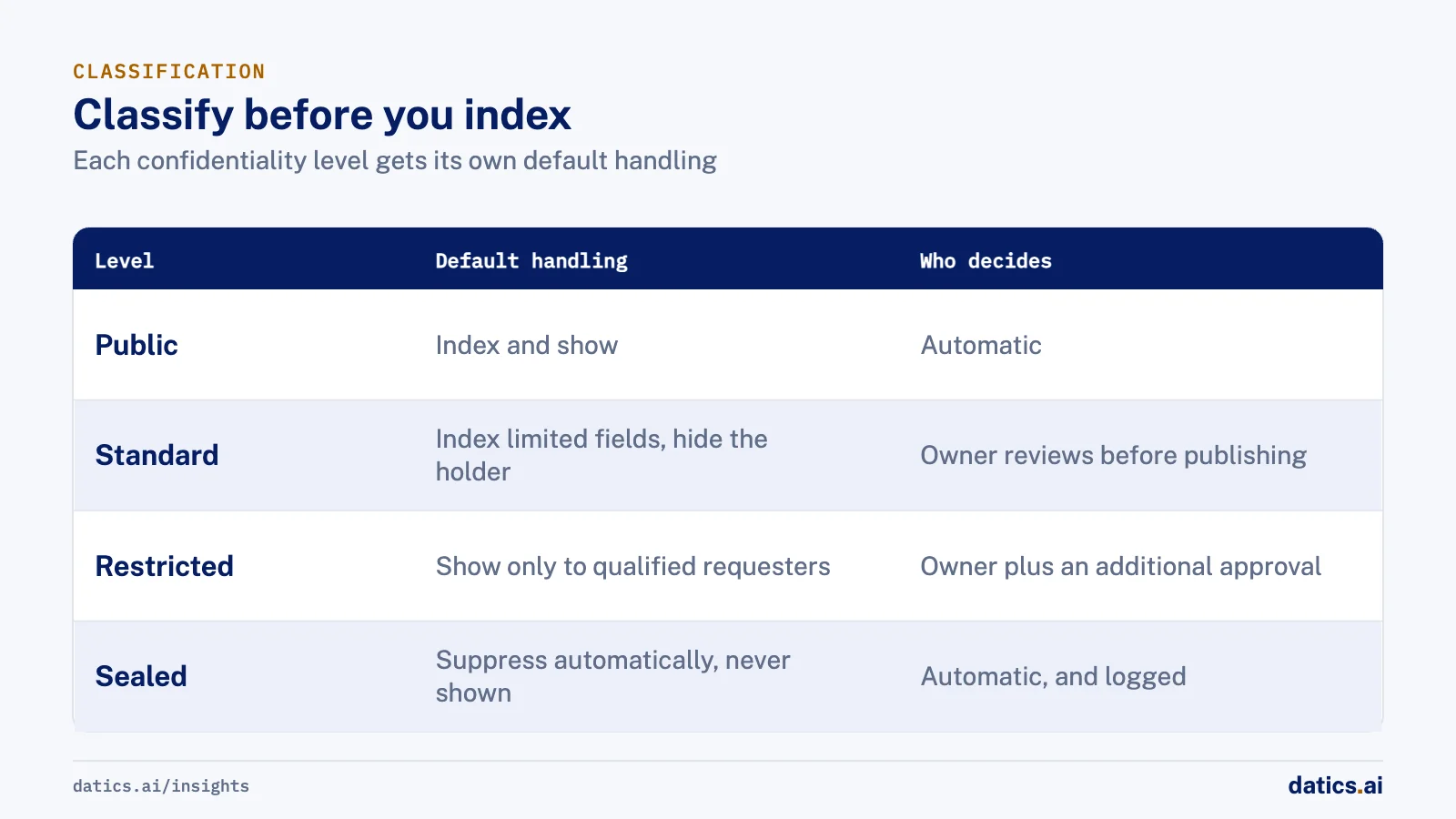
| Confidentiality level | Example | Default handling | Who decides |
|---|---|---|---|
| Public | Published opinions, public filings | Index and show | Automatic |
| Standard | Routine records with ordinary metadata | Index limited fields, hide the holder's identity | Owner reviews before publishing |
| Restricted | Records under a protective order | Show only to qualified requesters, extra authorization before release | Owner plus an additional approval |
| Sealed | Records sealed by a court or by regulation | Suppress automatically, never shown in search | Automatic, and logged |
Automate the extremes and keep people in the middle. A sealed flag should suppress a record without any human step, because the cost of a mistake is too high. A routine record with a low-confidence extracted field should wait for the owner to review it.
03A practical control set
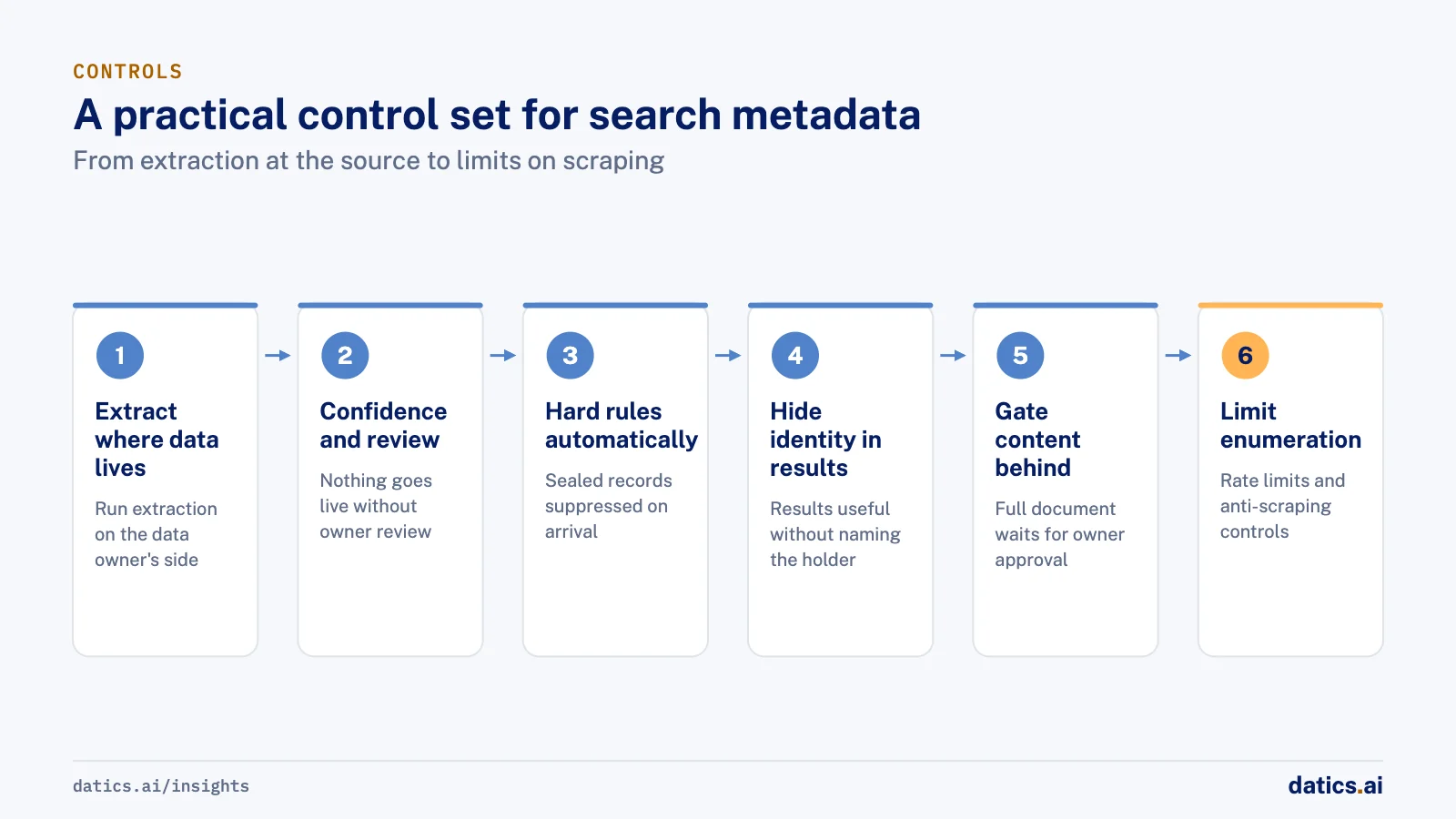
These are the controls we apply, roughly in the order the data moves:
- 01
Extract where the data lives. If possible, run extraction, including OCR, on the data owner's side, in their browser or their environment, and send only the approved fields. Your platform cannot leak
- 02
Show confidence and require review. Each extracted field carries a confidence score, and the owner reviews, edits and publishes. Nothing goes live just because a model extracted it.
- 03
Apply hard rules automatically at the top of the scale, such as sealed records suppressed on arrival.
- 04
Hide identity in results. Search results can be useful without naming the record holder, which also protects the holder's commercial position.
- 05
Gate content behind approval. The full document stays unavailable until the owner approves a specific request, and where possible it is encrypted with keys the platform itself cannot use.
- 06
Suppress, do not delete, and log every state change against one request or record ID.
- 07
Limit enumeration. Metadata search can be scraped one query at a time, so add rate limits, anti-scraping controls and request-level security.
04Suppress, do not delete
Deletion feels safer, but it usually is not. A deleted record loses its history, so you can no longer show who saw it, when it was hidden and why. A later re-import can quietly bring it back, because nothing remembers that it was removed on purpose. And deletion cannot be reversed when the decision was wrong.
Suppression keeps the record out of search and out of every response, while keeping the event history. An authorized role can reverse it, and every change is on the audit trail. For regulated customers, that trail is often the evidence they need to answer their own auditors.
05Choose the narrowest discovery model
Open keyword search is the widest possible exposure. Before shipping it, ask whether the people who need a record can be matched to it in a narrower way. A party to a case can be matched to records from that case. A clinician can see records for patients under their care. A requester can submit a private request that the owner decides on, instead of browsing everything. The same thinking applies to education data: see AI for K-12 software without touching student data.
The narrower the discovery model, the less any single mistake in classification can expose. It also makes your audit trail more meaningful, because every view of a record is tied to a reason the person had to see it, not just to a search that happened to return it.
06What we see in production
For a national legal transcript marketplace that connects court reporting agencies with attorneys, we moved the product to a metadata-only workflow. We started with a limited first-phase pilot that reused the existing payment and delivery flows and tied the whole lifecycle to one request ID. In the second phase we moved extraction into the agency's browser, so agencies select files rather than upload them, with OCR and a confidence score per field, and only approved metadata reaches the platform. Transcripts are encrypted with a per-document key that only the agency, and then the paying attorney, can unlock with a PIN, and decryption happens only in the attorney's browser. The platform cannot read a transcript at any point.
Confidentiality rules follow the table above: sealed records are suppressed automatically, protective-order records need extra authorization, and records are suppressed instead of deleted, with audit events and in-request messaging. Search results show no agency identity, and anti-scraping and request-level security sit on top. Automatic extraction of confidentiality flags is on hold, and agencies review every record before it is published. When pilot feedback raised privacy concerns about open search, we proposed replacing it with counsel-of-record matching and private requests that the agency decides on. Every item on the client's own checklist for that phase was completed, the platform moved into a controlled pilot with agencies and attorneys, and the client wrote that metadata extraction accuracy had improved significantly.
In a governed internal app builder for structured company data, the same principle applies in a different shape: AI suggestions are built from catalog metadata that excludes personal data, and a scanner blocks publishing when an app would expose personal data columns, leaked secrets or unsafe SQL.
Frequently asked questions
Why is metadata a leakage risk if the documents stay locked?
Names, captions and dates can reveal as much as the document behind them, and search is built to make them discoverable. A witness name next to a case caption can disclose a private matter even if the transcript stays locked. A field is not safe or unsafe on its own. It depends on the search result and the user.
Can a system prompt stop an AI search feature from leaking data?
No. OWASP warns that restrictions written only into a system prompt can be bypassed, and its guidance points to least privilege access and restricting data sources. For search products, the protection has to live in the data and the access layer: confidentiality levels on every record, hidden identities in results and approval before content is released.
Should sensitive records be deleted or suppressed?
Suppressed. A deleted record loses its history, a later re-import can quietly bring it back, and deletion cannot be reversed when the decision was wrong. Suppression keeps the record out of search and out of every response while keeping the event history. An authorized role can reverse it, and every change is on the audit trail.
What is the safest way to let people discover records?
Choose the narrowest discovery model that works. Open keyword search is the widest possible exposure. A party to a case can be matched to records from that case, or a requester can submit a private request that the owner decides on. The narrower the discovery model, the less any single mistake in classification can expose.
How Datics helps
Datics specializes in brownfield AI: bringing production AI into the product you already operate, without forcing a rebuild.
Related work
Case studies from our projects on the same subject.
Transcripts U.S.
Government, Legal & Defense · Legal transcript marketplace
Court reporting agencies publish transcript metadata without the file ever leaving their browser
Agencies once uploaded full transcripts to the marketplace; now title page details are read in their own browser, and they confirm what is published.
Regulated investment platform
Financial Services · Private investment marketplace
Pitch decks become drafted deals, and issuers approve each field before publishing
Issuers retyped decks and financials into long deal forms. Now AI suggests each field, and the issuer applies, edits or rejects it.
TrailBlaze Innovations
Healthcare & Wellness · AI meal planning chat
Dieters get meal plans with every calorie computed from food data, not guessed
Chat assistants make up nutrition numbers. Here code computes every calorie from food data, and the model only phrases the plan.
More on AI security and compliance
AI security and compliance
AI security for SaaS: protect data and pass security reviews
A practical map of AI security for established SaaS: threats, data governance, permissions, audit trails and how to answer enterprise security reviews.
 Umair MajeedRead
AI security and compliance
LLM security: why treat model output as untrusted input?
A core LLM security rule: treat every model response like input from an unknown user. Parse it, validate it against business rules, then let it through.
Rana Umar MajeedReadAI security and compliance
Which AI disclaimers does a product need?
An AI disclaimer works when it is designed into the feature: say it is AI, that it can be wrong, what happens to data, and where its numbers come from.
Umair MajeedReadAI security and compliance
What enterprise AI security questions do buyers ask?
Enterprise AI security reviews ask where data and models run, who reaches production, what the AI may do alone and how it is logged. Here is how to prepare.
Umair MajeedReadAI security and compliance
How do you enforce tenant isolation beyond database rows?
Tenant isolation beyond database rows means boundaries per field and per role, in caches, files, payments and jobs, so no tenant sees what another owns.
Rana Umar MajeedReadAI security and compliance
What does HIPAA AI compliance mean for software vendors?
HIPAA AI for software vendors: what the product company owns, what the engineering team builds, and how to keep patient identifiers away from models.
Umair MajeedReadYour customers already expect AI from your product.
Let us make it real without rebuilding what already works.