
AI security and compliance
Which AI disclaimers does a product need?
Trust statements belong in the feature specification, because they change how users read every answer.
 Umair MajeedCo-founder and CEO, Datics AI7 min read
Short answer
Most AI products need four disclaimers: that the user is dealing with AI, that it can make mistakes, what happens to the user's data, and what the feature is not. For example, it is not medical, legal or financial advice. Each AI disclaimer belongs in the interface at the moment it matters, written into the feature specification, and backed by design that keeps the risky parts out of the model's hands.
On this page
01Why disclaimers are a product decision
Many teams treat AI disclaimers as legal text: a paragraph in the terms of service, added late and read by no one. That misses what a disclaimer actually does. A short message near the answer changes how the user reads the answer. A user who has just been told the assistant can make mistakes checks the number before acting on it. A user who knows their data is not stored speaks more freely. Those are product effects, so the wording, placement and timing are product decisions. This is part of our larger guide, AI security for SaaS: protect data and pass security reviews.
We saw this on an AI nutrition and meal planning assistant we built for a founder. After reviewing the first build, the client asked for two additions in the interface itself. One was a visible message that the app can make mistakes, and the other a note that it does not store user data. The model selector was removed in the same round. None of these changed the model. All of them changed what a user would understand about each meal plan they received.
The lesson for a product team is to write the trust statements into the specification next to the feature, with the same care as the feature's inputs and outputs. If you wait until legal review, they end up in the wrong place.
This article is practical product guidance, not legal advice. Your counsel decides what the law requires in your markets. The product team decides how that requirement reaches users in a way they will actually notice.
02The AI disclaimers most features need
The right set depends on the domain and the users, but these are the ones we consider for every feature.
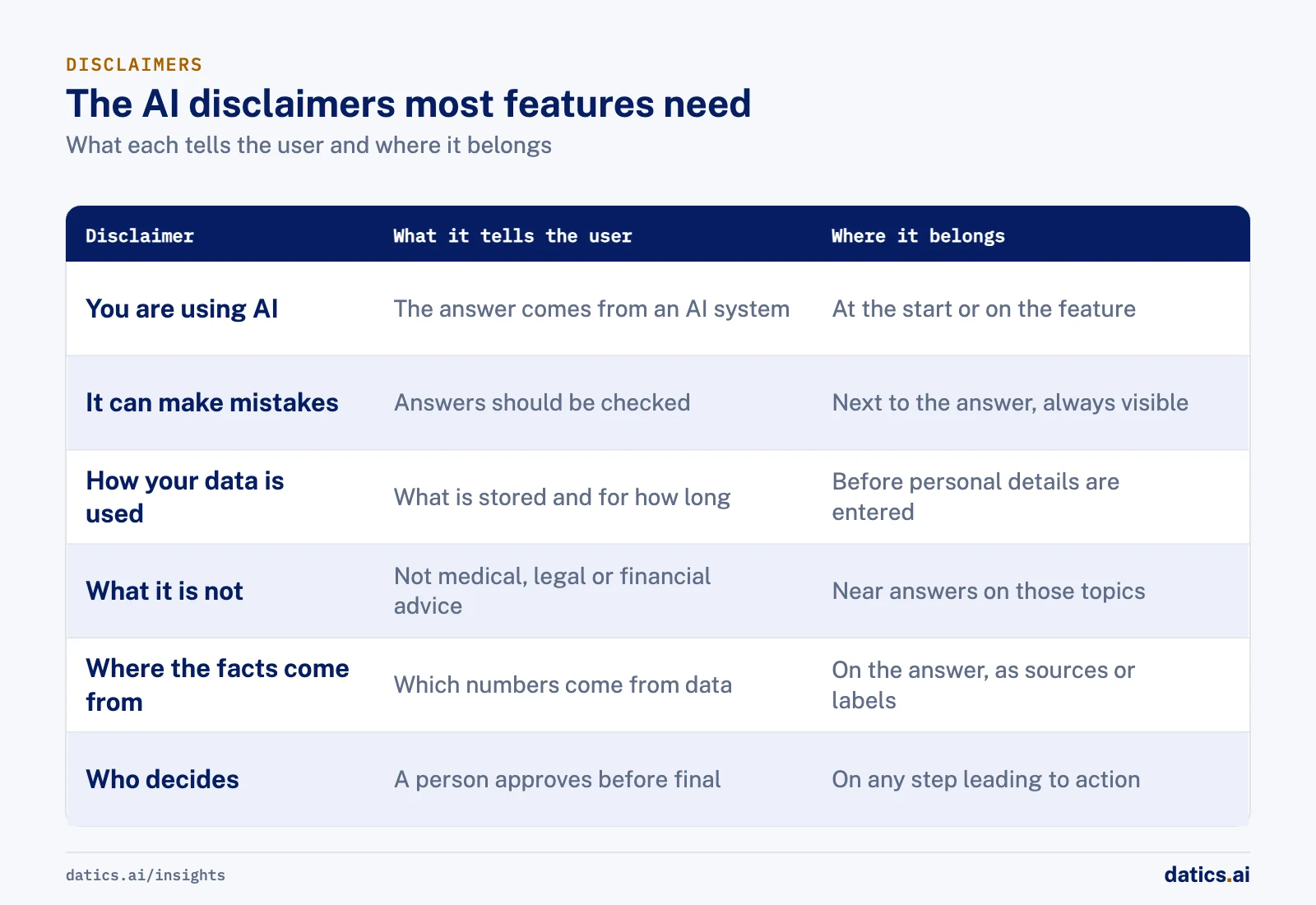
| Disclaimer | What it tells the user | Where it belongs |
|---|---|---|
| You are using AI | The answer comes from an AI system, not a person | At the start of the conversation or on the feature itself |
| It can make mistakes | Answers may be wrong and should be checked | Next to the answer area, always visible |
| How your data is used | What is stored, for how long, and whether it trains anything | Before the user enters personal details |
| What it is not | Not medical, legal, financial or professional advice | Near answers on those topics |
| Where the facts come from | Which numbers come from data and which are written by the model | On the answer, as sources or labels |
| Who decides | A person reviews or approves before anything is final | On any step that leads to an action |
Regulation is moving the first row from good practice toward obligation. Article 50 of the EU AI Act requires providers of AI systems that interact directly with people to design them so that people are told they are interacting with an AI system. The exception is when that is already obvious from the context. The information must be clear and given no later than the first interaction, and the article applies from August 2, 2026. If you sell into Europe, check this with counsel now.
03How to write them so people read them
A disclaimer that users skip does nothing. A few rules make them work.
- 01
Keep each statement to one short sentence in the user's own language. For example: This assistant can make mistakes. Check important details.
- 02
Show it where the risk is, not in a footer. The mistakes message sits next to the answer, and the data note sits next to the input.
- 03
Show it at the right moment. Tell users about AI before the first answer, and about data before they type personal details.
- 04
Make it specific to the feature. A general statement about AI is ignored. A statement about this feature and this kind of answer is read.
- 05
Keep it consistent. The same statement in the same place every time becomes part of how users read the product.
- 06
Test it with real users. If users cannot repeat what the statement means after a session, rewrite it.
Google's People and AI Research guidebook gives the same advice from a design point of view. It advises teams to communicate the product's capabilities and limitations clearly and early, explain what data is used, and tell users when missing information means they need to rely on their own judgment.
04A disclaimer is not a substitute for design
The weakest use of a disclaimer is to cover for a design that lets the model do something it should not. A mistakes message does not make a wrong calorie count acceptable in a nutrition app. It only shifts blame.
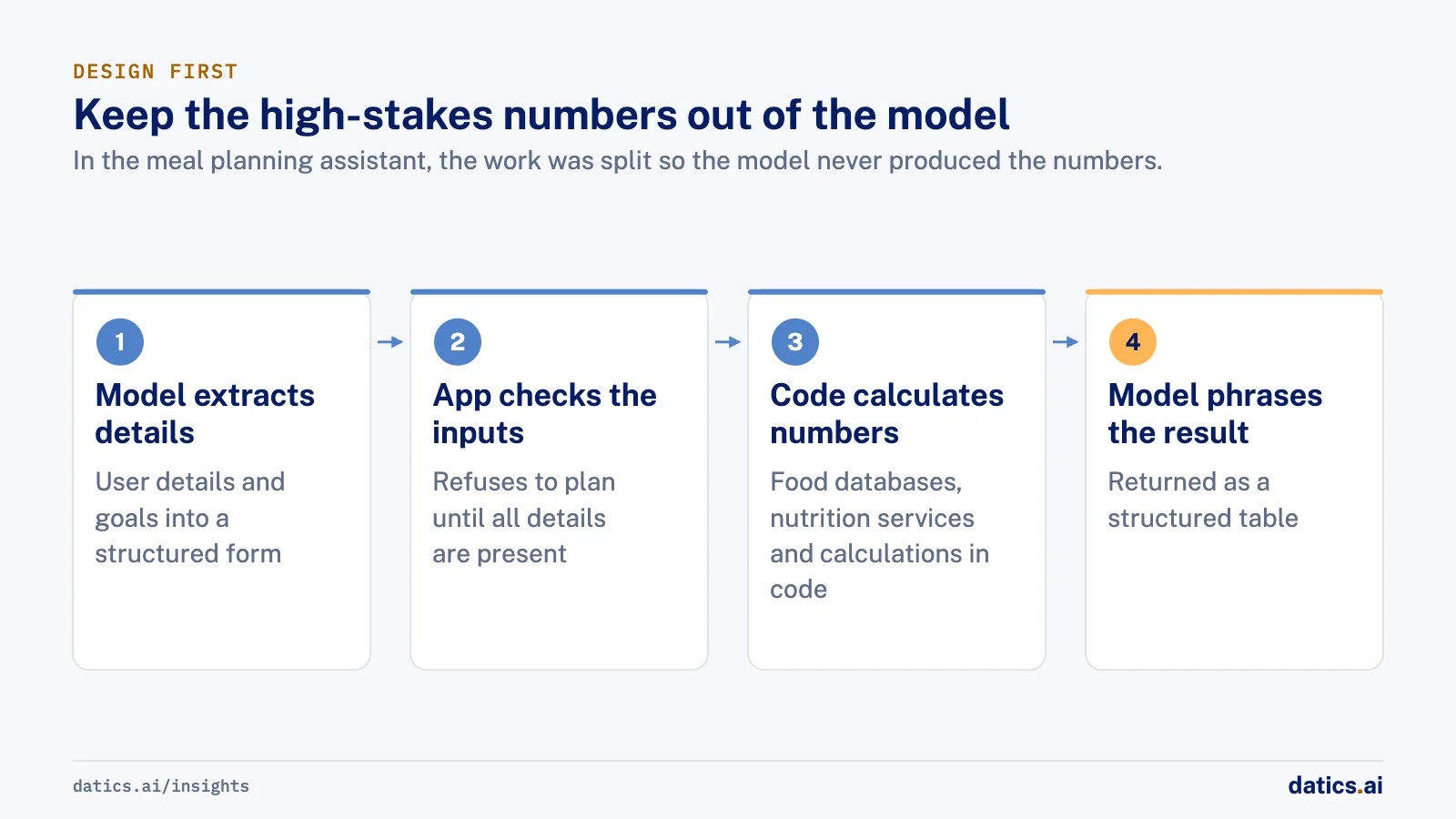
In the meal planning assistant, the model never produced the numbers. We split the work into steps. The model extracted the user's details and goals into a structured form. The app then checked that height, weight, age, gender and diet preference were all present, and refused to plan until they were. Food and nutrient data came from food databases and external nutrition services, and calories, ingredient weights and daily value percentages were calculated in code. Only then did the model phrase the result, returned as a structured table.
That design is what makes the disclaimer honest. The statement that the app can make mistakes is true, because the model can still misread a request or choose a poor phrasing. But the high-stakes numbers are not left to it. When you design an AI feature for a sensitive domain, ask which outputs a user is most likely to act on without checking, and move those out of the model first. Then write the disclaimer for what remains.
The same applies in regulated B2B products. If an AI step can approve, publish or send something, the strongest trust statement is a visible human approval step, not a sentence saying the AI might be wrong. For K-12 and learning platforms, where student data raises the stakes further, see how K-12 software can add AI without touching student data.
05What we see in production
On the nutrition assistant, a short web product for a founder in health and wellness, the trust statements arrived through client review, not through a policy document. That is common. The product owner sees the first working version, imagines a real user reading a meal plan, and asks for the statements that user would need. We now raise them before the first build instead, so they are in the specification and the design from the start.
The mistakes note sits on top of a design that already limits what can be wrong. In that meal planning assistant, every calorie, ingredient weight and daily value is calculated in code from food data and nutrition APIs. The model only extracts the user's details and phrases the answer.
We also see that data statements must match the deployment. That assistant ran in the client's own cloud account, and the note that user data is not stored had to be true of the whole system, including logs, not only of the database. Before any data statement goes into the interface, we check every place a request passes through.
Removing the model selector in the same review is a smaller but useful lesson. Options that only engineers understand add doubt for ordinary users. Removing them is part of making the product trustworthy.
Finally, we see that disclaimers need owners. When the feature changes, for example when it starts storing conversation history or adds a new data source, the statement must change with it. We treat each trust statement as part of the feature's acceptance criteria, so a change that makes one untrue fails review.
06A short checklist
- Users are told they are using AI before or at the first answer.
- A visible mistakes message sits next to every AI answer.
- The data statement is true of the whole system, logs included.
- Advice boundaries are stated wherever the topic is medical, legal or financial.
- The numbers users act on come from data and code, not from the model.
- Each statement has an owner and is checked whenever the feature changes.
NIST's AI Risk Management Framework frames trustworthiness as something built into design, development, use and evaluation. Disclaimers are one visible part of that work. They are most credible when the design behind them already does the heavy lifting.
Frequently asked questions
Where should an AI disclaimer appear?
Where the risk is, not in a footer. The mistakes message sits next to the answer, the data note sits next to the input, and advice boundaries appear near answers on medical, legal or financial topics. Tell users about AI before the first answer, and about data before they type personal details.
Does the EU AI Act require an AI disclosure?
Article 50 requires providers of AI systems that interact directly with people to tell them they are interacting with an AI system, unless that is obvious from the context. The information must be clear and given no later than the first interaction, and the article applies from August 2, 2026. Check how it applies with counsel.
Can a disclaimer make up for a risky design?
No. A mistakes message does not make a wrong calorie count acceptable. It only shifts blame. Move the outputs users are most likely to act on without checking out of the model first, as we did by calculating nutrition figures in code, then write the disclaimer for what remains.
Who keeps AI disclaimers accurate?
Each trust statement needs an owner. When the feature changes, for example when it starts storing conversation history or adds a new data source, the statement must change with it. We treat each one as part of the feature's acceptance criteria, so a change that makes one untrue fails review.
How Datics helps
Datics specializes in brownfield AI: bringing production AI into the product you already operate, without forcing a rebuild.
Related work
Case studies from our projects on the same subject.
TrailBlaze Innovations
Healthcare & Wellness · AI meal planning chat
Dieters get meal plans with every calorie computed from food data, not guessed
Chat assistants make up nutrition numbers. Here code computes every calorie from food data, and the model only phrases the plan.
Transcripts U.S.
Government, Legal & Defense · Legal transcript marketplace
Court reporting agencies publish transcript metadata without the file ever leaving their browser
Agencies once uploaded full transcripts to the marketplace; now title page details are read in their own browser, and they confirm what is published.
Regulated investment platform
Financial Services · Private investment marketplace
Pitch decks become drafted deals, and issuers approve each field before publishing
Issuers retyped decks and financials into long deal forms. Now AI suggests each field, and the issuer applies, edits or rejects it.
More on AI security and compliance
AI security and compliance
AI security for SaaS: protect data and pass security reviews
A practical map of AI security for established SaaS: threats, data governance, permissions, audit trails and how to answer enterprise security reviews.
Umair MajeedReadAI security and compliance
How do you stop AI data leakage through search metadata?
Stop AI data leakage in search by treating metadata as sensitive: classify records, automate high stakes rules, keep people on unclear cases, and audit.
 Rana Umar MajeedRead
AI security and compliance
LLM security: why treat model output as untrusted input?
A core LLM security rule: treat every model response like input from an unknown user. Parse it, validate it against business rules, then let it through.
Rana Umar MajeedReadAI security and compliance
What enterprise AI security questions do buyers ask?
Enterprise AI security reviews ask where data and models run, who reaches production, what the AI may do alone and how it is logged. Here is how to prepare.
Umair MajeedReadAI security and compliance
How do you enforce tenant isolation beyond database rows?
Tenant isolation beyond database rows means boundaries per field and per role, in caches, files, payments and jobs, so no tenant sees what another owns.
Rana Umar MajeedReadAI security and compliance
What does HIPAA AI compliance mean for software vendors?
HIPAA AI for software vendors: what the product company owns, what the engineering team builds, and how to keep patient identifiers away from models.
Umair MajeedReadYour customers already expect AI from your product.
Let us make it real without rebuilding what already works.