
AI security and compliance
AI security for SaaS: protect data and pass security reviews
The model is not the risk you have to manage. The product around it is.
 Umair MajeedCo-founder and CEO, Datics AI9 min read
In brief
AI security in an established SaaS product is not a new security program. It is your existing one, extended to a component that reads untrusted text, holds context it should not leak and can call your own APIs. Treat the model as an untrusted user, give it no more access than the person it serves, log every step and keep customer data inside boundaries you already defend. That is what passes a security review.
On this page
- 01Why AI security is different in a product that already works
- 02The AI security threat model, in plain terms
- 03Data governance: what reaches the model and where it goes
- 04Permissions: the agent gets the user's permissions, never more
- 05Auditability: prove what the AI did and why
- 06Passing enterprise AI security reviews and audits
- 07What we see in production
- Frequently asked questions
01Why AI security is different in a product that already works
Most enterprise SaaS teams already have SSO, role-based access, tenant separation, encryption and a SOC 2 report or one on the way. AI adds a component that behaves unlike anything else in the stack.
A traditional service does what its code says. A language model does what its input persuades it to do, and its input now includes user messages, uploaded documents, tickets and records from your database. Any of that text can carry instructions. That single fact changes the threat model more than anything else.
The good news for a mature product is that the controls you need mostly exist already. The work is wiring the model into those controls instead of building around them. We cover the wider pattern in how to add AI agents to an existing SaaS product without rebuilding it.
02The AI security threat model, in plain terms
The OWASP Top 10 for LLM Applications is the most widely used starting list. Its 2025 edition puts prompt injection first and sensitive information disclosure second, and it also names improper output handling, excessive agency, system prompt leakage, vector and embedding weaknesses and unbounded consumption. For a B2B SaaS product, those collapse into four threats worth designing against.
| Threat | What it looks like in a SaaS product | The control that matters |
|---|---|---|
| Prompt injection | A customer document or ticket contains hidden text telling the assistant to ignore its rules or reveal data | Treat retrieved content as data, never as instructions; restrict what any instruction can unlock |
| Data leakage between tenants | Retrieval or caching returns another customer's records, or a shared index answers across accounts | Enforce tenant filters in the data layer, before the model sees anything |
| Insecure tool use | The agent can call an API with broader rights than the user who asked | Run every tool call as the requesting user, with server-side authorization |
| Model output as untrusted input | Generated text is rendered as HTML, run as a query or passed to another system unchecked | Validate, escape and constrain output exactly as you would user input |
Prompt injection deserves special attention because it cannot be patched away. It comes from how language models work: they cannot reliably tell the difference between your instructions and instructions hidden in content. So the defense is architectural. Assume that sooner or later the model will be persuaded to try something it should not. Make sure that when it does, the attempt fails at a permission check rather than succeeding because the model held the keys.
The same logic applies to output. Whatever the model produces is untrusted input to the next system in line: the browser, the database, the email service, the workflow engine. Our supporting piece on LLM security treats model output as untrusted input in depth, and the one on RAG security covers tenant isolation in retrieval, where most real leaks start.
03Data governance: what reaches the model and where it goes
Security reviewers ask three data questions before anything else. What customer data reaches the model? How long is it kept, and by whom? Where is it processed?
Answer the first one by design, not by policy. Send the model only the fields the task needs. Every field you leave out is a field you never have to defend. For development and testing, use synthetic or de-identified data so that real customer records stay in production, under production controls.
Retention is the second question and the one most often answered badly. A model call can leave copies in several places: your prompt logs, your trace store, your vector index, your cache and the model provider's own logs. Map each one, set a retention period for each and make sure deletion actually reaches all of them. Soft delete versus hard delete explains why a record marked deleted in your database can still live on in an embedding index. AI data leakage through search metadata shows how titles and snippets can expose what the content itself protects.
Data location is the third. Enterprise and public sector buyers increasingly want the model to run in a region and an account they can name. Running inference in your own cloud account, on a model you choose, answers that question cleanly and keeps the data inside contracts you already have. We compare the main platforms in AWS Bedrock vs Azure AI vs Vertex AI for existing SaaS. For production work with real customer data, our piece on AI data security with production data sets out the boundaries in detail.
04Permissions: the agent gets the user's permissions, never more
The most important rule in AI security is also the simplest. An AI feature acts on behalf of a user, so it gets that user's permissions and nothing more. No service account with admin rights. No shared key that can read every tenant. No tool that bypasses the checks your application already runs.
OWASP calls the failure mode excessive agency and traces it to three causes: too much functionality, too many permissions and too much autonomy. Its guidance matches what we see work in practice. Execute actions in the user's context with the minimum privileges needed, and require human approval for high-impact actions. Enforce authorization in the downstream system rather than trusting the model to decide what is allowed.
In practice that means a short checklist for every tool an agent can call:
- 01
Identity
the call carries the requesting user's identity and tenant, checked on the server.
- 02
Scope
the tool does one narrow job, with no open-ended query or shell access.
- 03
Authorization
the target system validates the request against its normal policy, every time.
- 04
Approval
anything that writes, sends, deletes or spends money waits for a person to confirm.
- 05
Limits
rate limits and spending caps stop a runaway loop before it becomes an incident.
Capability should rise only as control rises with it. Our CTO describes this as a ladder from reading to executing in why AI agents fail in production. The supporting article on AI agent security and permissions goes further into scoping tools for multi-step agents.
05Auditability: prove what the AI did and why
When something goes wrong, or when an auditor asks, you need to reconstruct a run. You need to know who asked, what context the model saw, which tools it called, what each call returned, what the model answered and who approved the action. If you cannot answer those questions from your logs, you do not yet have an auditable AI feature.
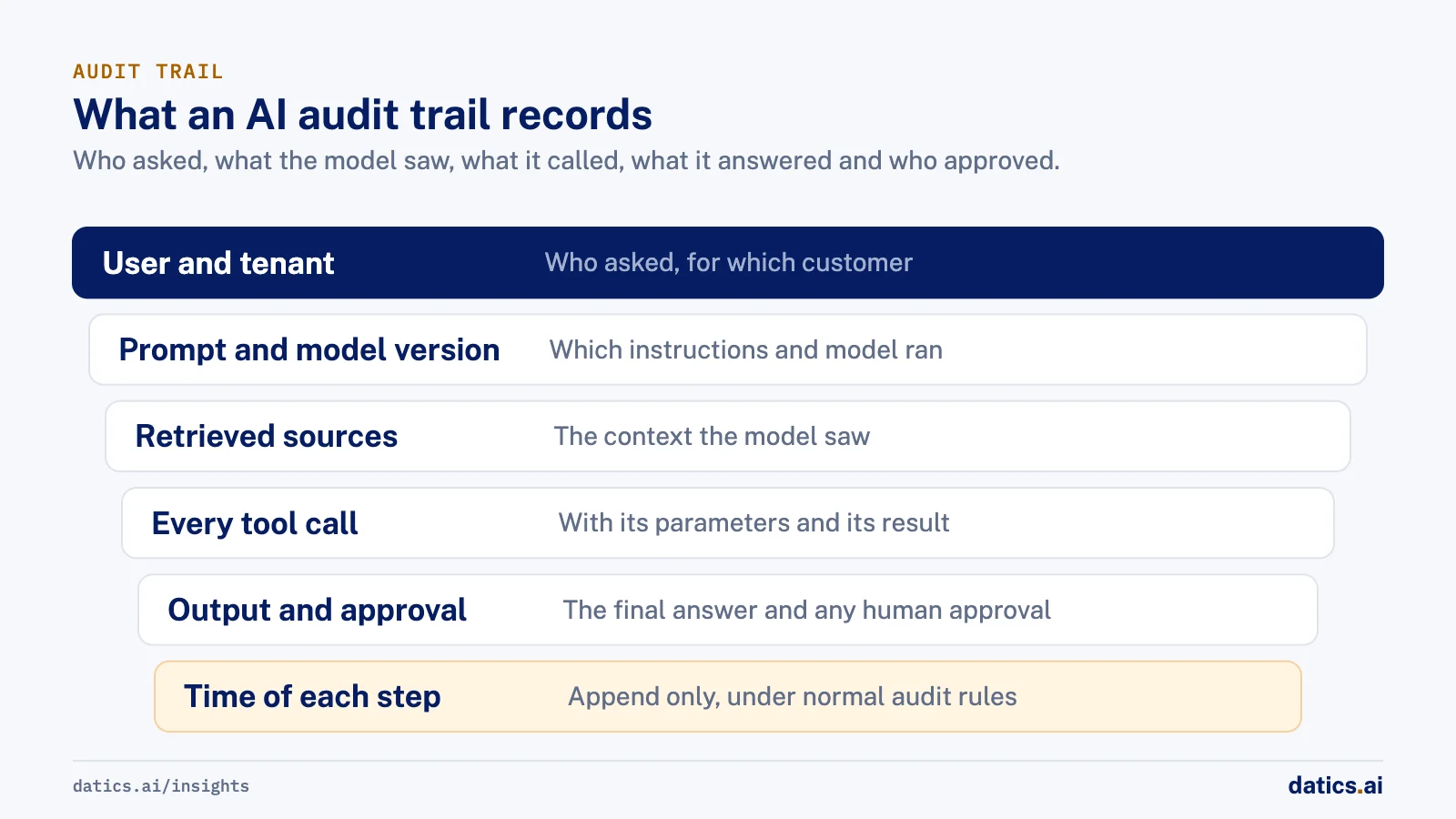
A good AI audit trail records the user and tenant, the prompt and model version, the retrieved sources, every tool call with its parameters and result, the final output, any human approval and the time of each step. It is append-only, it follows the same retention and access rules as your other audit logs, and it never becomes a new place where sensitive data piles up unprotected. Our supporting piece on AI audit trails covers the schema and the retention trade-offs, and the one on AI disclaimers covers what users should be told when content is generated.
06Passing enterprise AI security reviews and audits
Enterprise buyers now send AI-specific questionnaires alongside the standard ones. The questions are predictable: which models and providers you use, whether customer data trains any model, where processing happens, how tenants are separated and how prompt injection is handled. They also ask what humans approve, how AI behavior is tested and what is logged.
Map your answers to the frameworks buyers already recognize.
SOC 2 is the report most B2B buyers expect. It covers controls at a service organization across five trust services categories: security, availability, processing integrity, confidentiality and privacy. An AI feature does not need a separate report, but its controls need to sit inside the scope of the one you have. Auditors will want to see access control, change management and monitoring applied to prompts, models and retrieval pipelines just as they are to code.
HIPAA applies where your product handles protected health information. The practical questions are which vendors in the chain touch that data, including the model provider, and what agreements cover them. Our supporting article on HIPAA for AI vendors walks through the questions health care buyers ask.
The NIST AI Risk Management Framework is voluntary and organizes the work into four functions: Govern, Map, Measure and Manage. NIST added a Generative AI Profile in July 2024. Buyers do not certify against it, but structuring your AI risk documentation around those four functions gives reviewers a shape they already trust.
The EU AI Act matters if you sell into Europe. Obligations for general-purpose AI model providers applied from August 2, 2025, and the Article 50 transparency rules started to apply on August 2, 2026. Rules for stand-alone high-risk systems now apply from December 2, 2027, after the Digital Omnibus on AI moved the dates. Most SaaS features are not high-risk, but you should be able to say which category yours falls into and why.
The fastest way through a review is evidence, not assurances: a tested set of real cases, a data flow description, a permission diagram and a sample audit record. The enterprise AI security questions buyers ask lists the common questions with model answers.
07What we see in production
The pattern we see most often is not a dramatic attack. It is an AI feature built as a demo, with a broad service credential and a shared index, that works well until a security review asks how it separates tenants. At that point the feature stalls, sometimes for months, because the fix touches retrieval, permissions and logging at once.
The second pattern is retention drift. Prompt logs and traces are turned on for debugging, nobody sets an expiry, and a year later the trace store holds more sensitive text than the primary database.
The third is that teams underestimate how much their existing controls already solve. When the AI layer is wired through the permission model, tenant boundary and audit log instead of around them, security reviews get shorter, because the answers are ones the security team has given many times before.
That is how we approach AI security at Datics: we start from the product you already run. Our agent harness puts the model behind the same controls as the rest of your application: product context, trusted tools, permissions, tenant boundaries, business rules, human approvals, audit trails, observability and failure handling. Every request follows the same path: user intent, product context, allowed tools, permission check, approval, action, evaluation and audit.
By default the AI runs in your cloud, on your model. We build and test on synthetic or de-identified data, and our engineers have no standing access to client production data. When a product already has AI, we test it on 50 of the product's own cases, including misuse and prompt injection, rank the fixes and draft the answers your customers' security questionnaires ask for. We work within your SOC 2, HIPAA and contractual requirements, and we change only what the AI capability requires.
Frequently asked questions
Does sending customer data to a model provider break our SOC 2 scope?
Not by itself. The provider becomes another vendor that your controls must cover, just like your cloud host. Review its data use terms, confirm whether inputs are retained or used for training, choose a region you can name and document the data flow. Running the model inside your own cloud account usually makes this the simplest conversation with your auditor.
Can prompt injection be fully prevented?
No. Language models cannot reliably separate trusted instructions from instructions hidden in content, so filters reduce the risk but never remove it. The reliable defense is limiting what a successful injection can achieve: the model holds only the user's permissions, tools are narrow, authorization happens on the server and anything with real impact waits for human approval. Then an injection becomes a failed request, not a breach.
How do we stop one tenant's data from appearing in another tenant's answers?
Enforce the tenant boundary before the model sees anything. Retrieval queries must carry a tenant filter applied in the data layer, never inside the prompt. Indexes, caches and conversation memory need the same separation. Test it directly, with two test tenants and questions designed to cross the line, and rerun those tests on every release so a later change cannot quietly break the boundary.
What should an AI audit log contain?
It should record who asked and for which tenant, the model and prompt version, the sources retrieved, every tool call with its inputs and results, the final output, any human approval and timestamps for each step. Keep it append-only, apply your normal access controls and set a retention period. Without that record you cannot explain an incident or answer an auditor's question with evidence.
Do we need to comply with the EU AI Act if we are a U.S. company?
If you sell into Europe, treat it as relevant and ask your legal counsel to confirm the scope. Most SaaS features fall outside the high-risk categories, whose rules now apply from December 2027, but transparency rules started applying in August 2026 and may cover generated content. Classify each AI feature, write down the reasoning and keep it ready for buyer questions.
How Datics helps
Datics specializes in brownfield AI: bringing production AI into the product you already operate, without forcing a rebuild.
Related work
Case studies from our projects on the same subject.
Transcripts U.S.
Government, Legal & Defense · Legal transcript marketplace
Court reporting agencies publish transcript metadata without the file ever leaving their browser
Agencies once uploaded full transcripts to the marketplace; now title page details are read in their own browser, and they confirm what is published.
Regulated investment platform
Financial Services · Private investment marketplace
Pitch decks become drafted deals, and issuers approve each field before publishing
Issuers retyped decks and financials into long deal forms. Now AI suggests each field, and the issuer applies, edits or rejects it.
TrailBlaze Innovations
Healthcare & Wellness · AI meal planning chat
Dieters get meal plans with every calorie computed from food data, not guessed
Chat assistants make up nutrition numbers. Here code computes every calorie from food data, and the model only phrases the plan.
More on AI security and compliance
AI security and compliance
How do you stop AI data leakage through search metadata?
Stop AI data leakage in search by treating metadata as sensitive: classify records, automate high stakes rules, keep people on unclear cases, and audit.
 Rana Umar MajeedRead
AI security and compliance
LLM security: why treat model output as untrusted input?
A core LLM security rule: treat every model response like input from an unknown user. Parse it, validate it against business rules, then let it through.
Rana Umar MajeedReadAI security and compliance
Which AI disclaimers does a product need?
An AI disclaimer works when it is designed into the feature: say it is AI, that it can be wrong, what happens to data, and where its numbers come from.
Umair MajeedReadAI security and compliance
What enterprise AI security questions do buyers ask?
Enterprise AI security reviews ask where data and models run, who reaches production, what the AI may do alone and how it is logged. Here is how to prepare.
Umair MajeedReadAI security and compliance
How do you enforce tenant isolation beyond database rows?
Tenant isolation beyond database rows means boundaries per field and per role, in caches, files, payments and jobs, so no tenant sees what another owns.
Rana Umar MajeedReadAI security and compliance
What does HIPAA AI compliance mean for software vendors?
HIPAA AI for software vendors: what the product company owns, what the engineering team builds, and how to keep patient identifiers away from models.
Umair MajeedReadYour customers already expect AI from your product.
Let us make it real without rebuilding what already works.