
Forward deployed engineers
What does the FDE role involve in the first weeks?
The most expensive thing an outside engineer can build in week two is a clean new integration that does not match how your product already stores its data.
 Umair MajeedCo-founder and CEO, Datics AI8 min read
Short answer
In the first weeks, a forward deployed engineer learns how your product already works before building anything new. In the FDE role, that means mapping the data model, the pipelines and the existing integrations, testing assumptions against real behavior, and shipping a first small change through your own pull request review. The goal is a first contribution that fits the product, not a parallel system your team must later untangle.
On this page
- 01Why the first weeks decide the whole engagement
- 02What the FDE role looks like week by week
- 03What to expect from the engineer, and what they need from you
- 04How to tell whether the start is going well
- 05Trade-offs to decide up front
- 06What we see in production
- 07A short checklist for your first FDE conversation
- Frequently asked questions
01Why the first weeks decide the whole engagement
A forward deployed engineer, or FDE, joins your team and works inside your codebase, your repositories, your sprint rituals and your review process. That is the point of the model: the engineer carries outside experience but delivers under your rules. It is also the risk. An engineer who arrives with a plan already in mind will often build something that looks right in isolation and wrong inside the product.
In a mature SaaS product, nothing is isolated. A new call integration touches the way calls are stored. A new AI feature touches permissions, tenant boundaries and the API client that other services already consume. If the engineer does not understand those relationships first, the work gets rewritten, or worse, it ships and quietly creates a second version of the truth.
So we treat the first weeks as a discovery phase with a deliverable, not as ramp-up time. The engineer should end that phase with a written map of the parts of the system they will touch, a list of open questions with owners, and one small merged change that proves they can move work through your process.
For a broader view of why this matters for AI work in particular, see our piece on adding AI agents to existing SaaS without rebuilding.
02What the FDE role looks like week by week
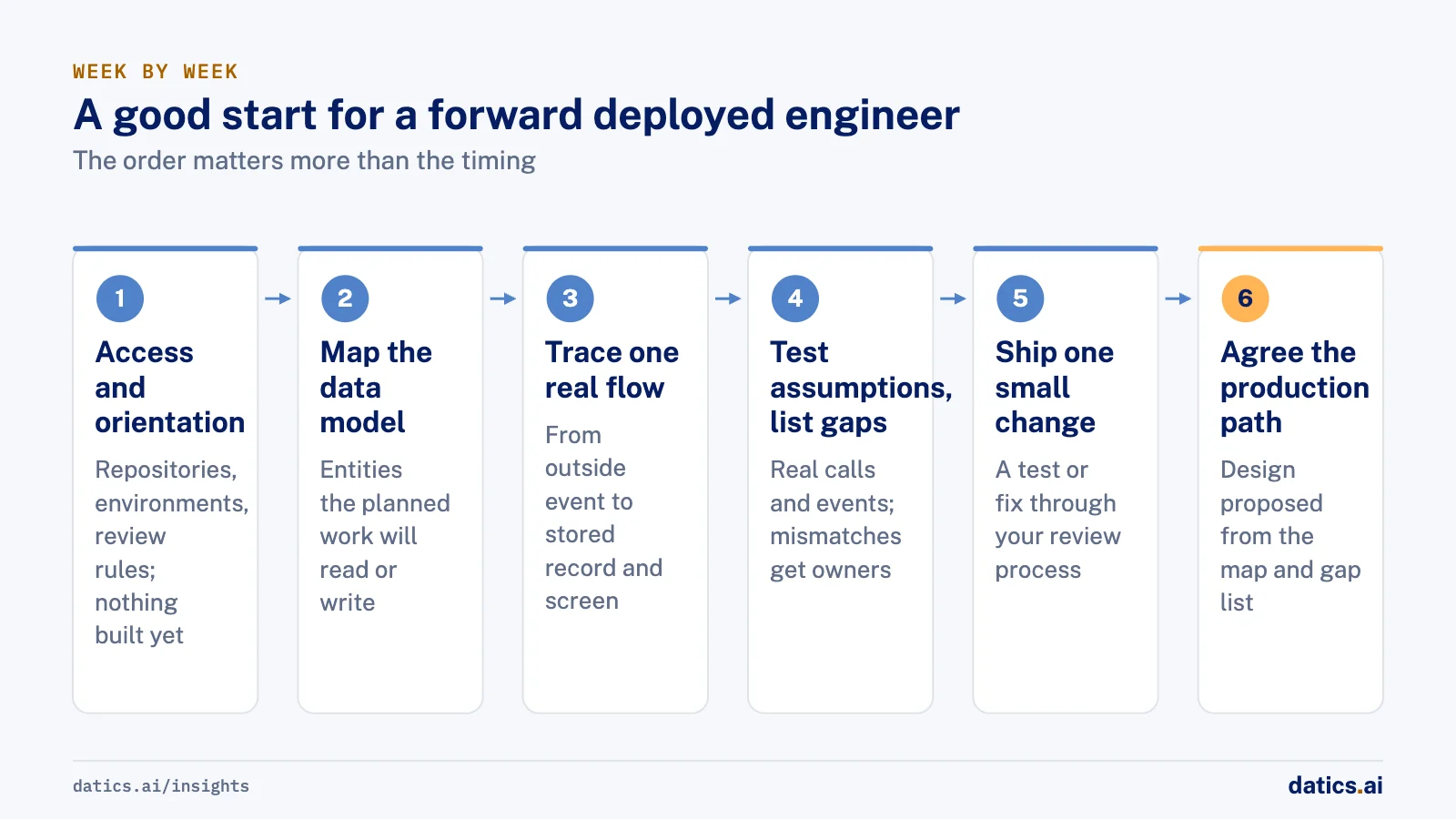
Every product is different, but the shape of a good start is consistent. This is the sequence we follow when our engineers join a client team.
- 01
Access and orientation.
Repositories, environments, the issue tracker, the team chat and the review rules. The engineer reads the contribution guide and asks who approves what. Nothing gets built yet.
- 02
Map the data model.
Which entities exist, how they relate, and which ones the planned work will read or write. For a communications product that means how a call, a call fragment, a recording and a practice relate to each other.
- 03
Trace one real flow end to end.
Pick the flow closest to the planned work and follow it from the outside event to the stored record and the screen that shows it. This is where hidden assumptions show up.
- 04
Test assumptions with real behavior.
Where third-party systems are involved, make real test calls, real API requests and real events. Compare what the documentation says with what actually arrives.
- 05
Write down the gaps.
Every mismatch between documentation, existing code and observed behavior goes into a short list with a proposed owner: the client team, the vendor, or the FDE.
- 06
Ship one small change through review.
A test, a validation fix or a small endpoint. The point is to learn the review process and earn trust, not to impress.
- 07
Agree the production path.
Only now does the engineer propose the design for the real work, using the map and the gap list as evidence.
The order matters more than the timing. Some teams move through steps one to five in a week. Others need longer because access approvals or vendor answers take time. What should never happen is step seven before steps two to four.
03What to expect from the engineer, and what they need from you
The FDE model works when both sides know what the first weeks are for. This table is the checklist we use to set expectations with a client's engineering lead.
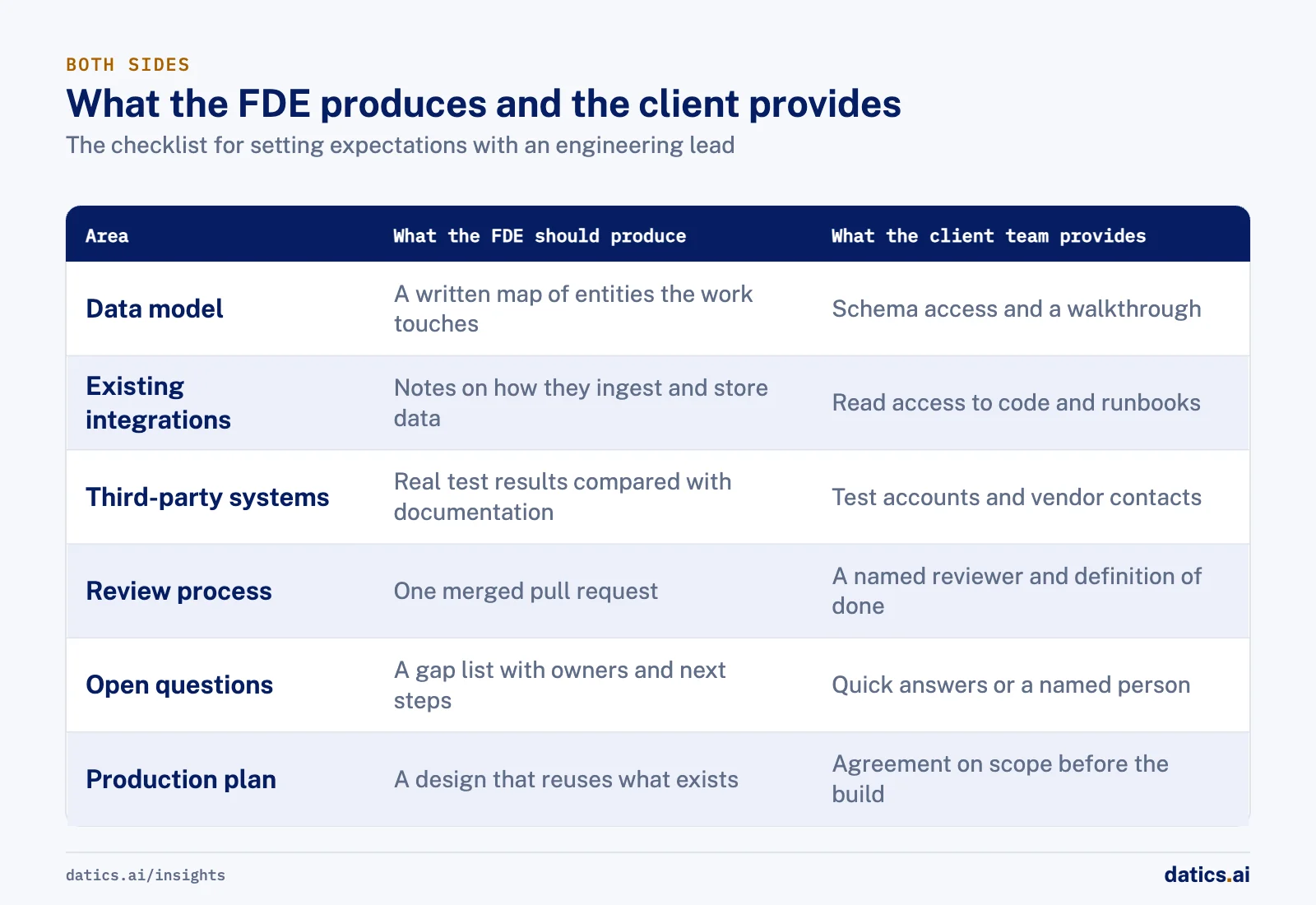
| Area | What the FDE should produce | What the client team provides |
|---|---|---|
| Data model | A short written map of the entities the work touches and how they relate | Access to schema, a walkthrough from the person who knows it best |
| Existing integrations | Notes on how current integrations ingest, transform and store data | Read access to the code and any runbooks |
| Third-party systems | Results from real test calls or requests, compared with the documentation | Test accounts, vendor contacts, permission to open support tickets |
| Review process | One merged pull request that follows house conventions | A named reviewer and a clear definition of done |
| Open questions | A gap list with owners and next steps | Quick answers or a named person who can give them |
| Production plan | A proposed design that reuses what already exists | Agreement on scope before the build starts |
If the client cannot provide something in the right column, that is useful information too. A missing reviewer or a missing test account is a delay you want to see in week one, not in week six.
04How to tell whether the start is going well
Engineering leaders often ask how to judge an embedded engineer early, before there is much code to look at. These are the signals we watch.
The questions get more specific. In the first days, questions are about access and conventions. By the end of the discovery phase, they should be about edge cases: what happens when an event arrives twice, which record wins when two sources disagree, which permission check applies to a new endpoint.
The engineer reuses before they build. A good FDE looks for the existing API client, the existing validation layer and the existing cloud function pattern, and extends them. A new framework or a new service in the first month is usually a warning sign.
Assumptions are tested, not trusted. Vendor documentation is a starting point. If the engineer reports what the documentation says without having seen real events, the work is not ready to build on.
Changes are small and reviewable. Early pull requests should be easy to read and easy to revert. Large first pull requests make review hard and hide misunderstandings.
The gap list shrinks. Open questions are normal. What matters is that each one has an owner and a next step, and that the list gets shorter.
05Trade-offs to decide up front
There is a real tension in the first weeks. Your team wants visible progress, and the FDE wants enough understanding to avoid rework. Three decisions help.
Decide what counts as progress. A data model map and a tested set of assumptions are progress, even with no feature shipped. Say that explicitly so nobody feels the engineer is idle.
Decide how much discovery is enough. For a narrow change, a few days may be enough. For a new integration with an external system whose behavior is uncertain, discovery can take longer because real events must be compared before anything is trusted. Agree on a time box and on what happens when it ends.
Decide who talks to vendors. When a third-party API does not behave as documented, someone needs to open a ticket and follow it. If the FDE can do this directly, problems close faster. If only your team can, plan for that delay.
06What we see in production
Our engineers have worked inside client teams in several industries, and the pattern of a good start is the same each time.
In one placement, our engineers joined the engineering team of an established call intelligence platform for dental and veterinary practices, working under the client's processes, repositories and pull request reviews. The client led the product; our engineers delivered inside it. The first scope was a telephony integration. Before writing production code, the team mapped the existing data model and audio pipeline and studied an existing telephony integration. They then tested the provider's two subscription models side by side with real test calls, compared the event streams in notebooks and spreadsheets, and raised the gaps with the vendor's support team.
Only after that did they build the production path inside the client's own stack. It covered webhook intake, validated event models, a cloud function that turns raw call events into the product's existing call records, and an updated release of the client's API client with test coverage. Because each phone provider exposes call events differently and the vendor API changed during the work, that discovery step was what made the data trustworthy. All of it had to stay inside the product's permission model and HIPAA-aligned boundaries.
In another placement, our engineers worked inside the web team of a mobile access and digital key security company, under the client's system architect and product owner. Candidates were chosen with the architect through coding assignments and interviews, and a part-time frontend engineer started with two trial months before the commitment grew. The architect also spent time with our engineers in person to train them. Weekly goals from the architect set the order of work. One engineer documented the access token state lifecycle on his own initiative, which is exactly the kind of map a team needs before changing a system like that.
There, lock storage clearance shipped with unit and integration tests and went into the live platform one API at a time. The client's architect reported it complete, with its first API in production and running without any issue, and the work was later handed to the client's own backend team.
In a third placement, our Python engineers worked on demand alongside the client's own engineers on an established AI text-to-video product for publishers, taking tasks as the client set them. When the client asked for work outside our experience, we said so and pointed to a team that had it. Being clear about fit is part of a good start too.
07A short checklist for your first FDE conversation
Before an embedded engineer starts, agree on these points with them and with your internal lead:
- Which flows and entities the first scope touches, and who can walk the engineer through them.
- Which external systems are involved, and whether test accounts and vendor contacts exist.
- Who reviews the first pull request, and what a mergeable change looks like in your team.
- How long discovery may take before a production design is due.
- Where the data model map and gap list will live so your team keeps them after the engagement.
That last point is easy to miss. The map an FDE writes in the first weeks is often the most current description of that part of your system. Keep it in your own repository, not in the engineer's notes.
Frequently asked questions
How long does discovery take for a forward deployed engineer?
It depends on the scope. For a narrow change, a few days may be enough. For a new integration with an external system whose behavior is uncertain, discovery can take longer because real events must be compared before anything is trusted. Agree on a time box and on what happens when it ends.
What should an FDE deliver in the first weeks?
A written map of the parts of the system they will touch, a list of open questions with owners, and one small merged change that proves they can move work through your process. Only then should the engineer propose the design for the real work, using the map and the gap list as evidence.
What does the client team need to provide?
Access to the schema and a walkthrough from the person who knows it best, read access to code and runbooks, test accounts and vendor contacts, a named reviewer with a clear definition of done, and quick answers to open questions. A missing reviewer or test account is a delay you want to see in week one.
What are the warning signs in an embedded engineer's first month?
A new framework or a new service in the first month is usually a warning sign. So is an engineer who reports what vendor documentation says without having seen real events. Good signs are questions that get more specific, reuse of existing code, small reviewable changes and a gap list that gets shorter.
How Datics helps
Datics specializes in brownfield AI: bringing production AI into the product you already operate, without forcing a rebuild.
Related work
Case studies from our projects on the same subject.
Peerlogic Technologies
Healthcare & Wellness · Practice call intelligence SaaS
Our engineers inside Peerlogic's team turn raw phone events into trusted call records
Each phone system reported calls its own way. Now raw events become validated records that Peerlogic's dental and vet call AI relies on.
BlueID
B2B Software · Secure mobile key platform
BlueID's lock storage clearance reached production, built by Datics inside its team
BlueID needed a feature important to its customers built into its live key platform. We built it inside BlueID's process, and it reached production.
More on Forward deployed engineers
Forward deployed engineers
What is forward deployed engineering?
Forward deployed engineering places engineers inside a customer's own team, repositories and code review, so AI ships inside the product customers already use.
Umair MajeedReadForward deployed engineers
Fixed price vs time and materials: which fits AI work?
Fixed price vs time and materials for AI work depends on how firm the boundary is. Learn when a first AI feature can be priced as fixed and when it cannot.
Umair MajeedReadForward deployed engineers
How do you run an AI POC with real data?
An AI POC with real data succeeds when the data, security review, a separate staging path and the release plan are settled before anyone tunes a prompt.
Umair MajeedReadForward deployed engineers
What should an AI readiness assessment cover?
An AI readiness assessment compares how your product works today with the workflow you need, flow by flow, and ends in a pilot scope and a do not break list.
Umair MajeedReadForward deployed engineers
How do you scope an AI proof of concept that ships in weeks?
How to scope an AI proof of concept that ships in weeks: test one workflow inside the live product, start with the simplest input and defer the hard formats.
Umair MajeedReadForward deployed engineers
AI MVP development: how do you scope the core journeys?
Good AI MVP development starts with the few journeys that let a customer sign up, pay and get value alone. Here is how we rank features and scope the rest.
 Bilal HassanRead
Your customers already expect AI from your product.
Let us make it real without rebuilding what already works.