
EdTech
How do you build trust and safety into an AI product?
Trust is decided by what goes into the system, long before anything comes out.
 Umair MajeedCo-founder and CEO, Datics AI7 min read
Short answer
Build AI trust and safety into an education product before the model ever answers. Decide what data may enter your knowledge base or graph, and keep provenance and versions on every record. Enforce content rules in the backend rather than the interface, and put a responsible adult or staff member in charge of anything that goes live. Then test the guardrails as hard as the features.
On this page
01AI trust and safety is a data problem first
When people talk about AI trust and safety, they usually mean filters on the output: blocked words, refusal messages, moderation. Those matter, but they are the last line. Most trust failures in education products start earlier. An answer comes from a source nobody can name. A fact is out of date because the record was never refreshed. Content is generated for a child without any limit on what it can contain. Student data reaches a model that never needed it.
NIST's AI Risk Management Framework is a voluntary framework for managing the risks AI poses to people, organizations and society. It is built around putting trustworthiness into how AI systems are designed, developed, used and evaluated. That framing is useful because it moves trust from a feature to a property of the whole system, including the data pipeline.
For education products, we focus on three questions. Where did this come from? Who is it for? Who approved it? If the system can answer all three for any output, most other trust work becomes easier.
02Provenance is the foundation
Provenance means knowing where every piece of information came from, when, and how it was changed. The W3C PROV family of documents defines a data model for exactly this, so provenance can be recorded and exchanged between systems. You do not need to adopt the full standard to use the idea. You do need every record in your knowledge base or graph to carry its source, its version and the steps that transformed it.
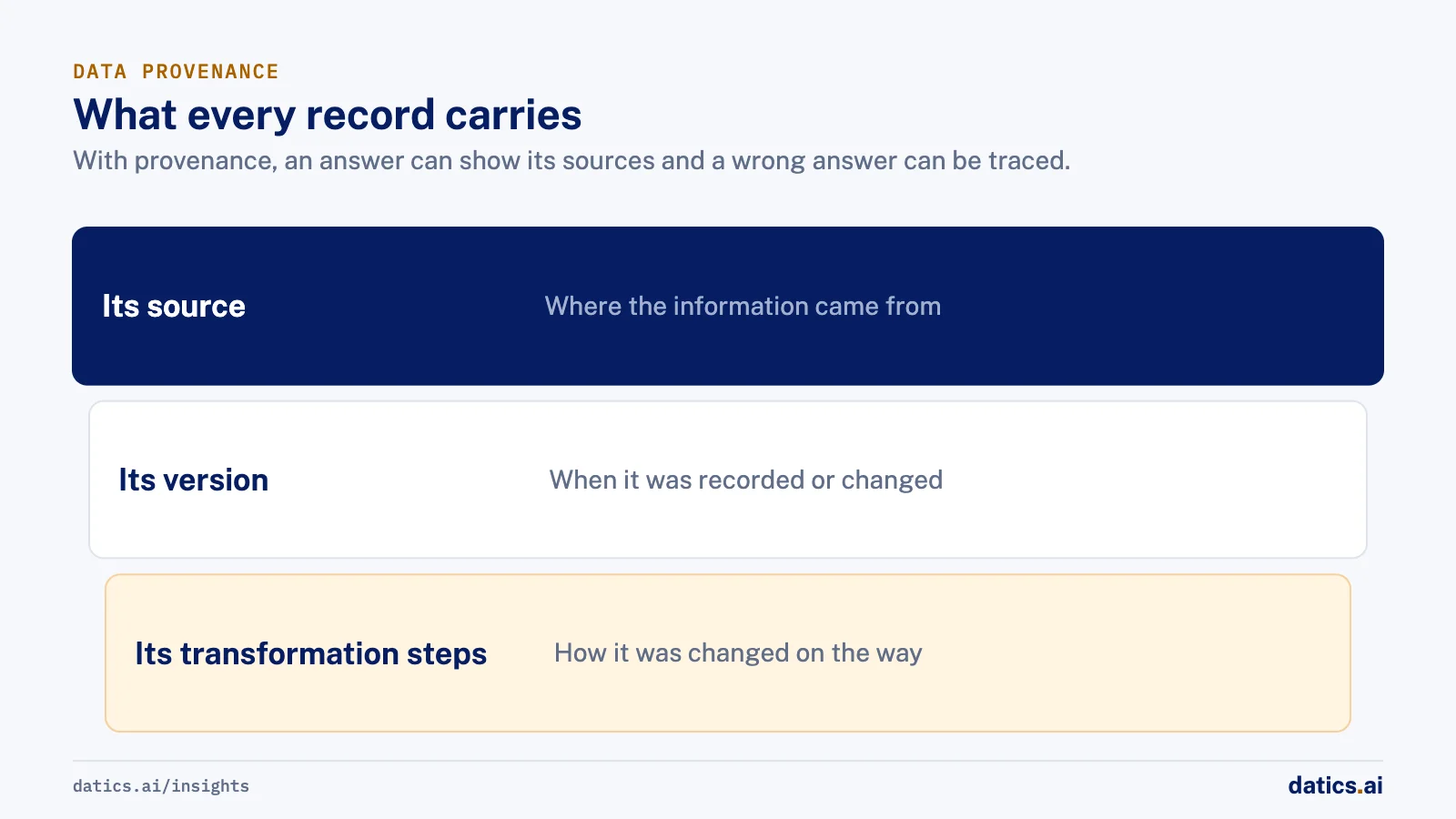
With provenance in place, an answer can show its sources. A wrong answer can be traced to the record that caused it. A source that turns out to be unreliable can be removed along with everything derived from it. Without provenance, none of that is possible, and every fix becomes a guess.
03Decide what enters the knowledge graph
A knowledge graph or retrieval index is only as trustworthy as its intake rules. These are the checks we put on intake:
- 01
Known source. Every record comes from a named source, public or licensed, with a reference back to it.
- 02
Normalized format. PDF forms, CSV exports, web portals and API responses are mapped into one schema before they enter the graph, so the same fact always looks the same.
- 03
Version and lineage. Each record keeps its version and the chain of steps from raw source to graph node.
- 04
Change detection. Sources are re-checked on a schedule, and changes update the graph instead of piling up beside old values.
- 05
Minimum personal data. If a capability does not need student data, it does not get student data. See AI for K-12 software without touching student data.
- 06
Retrieval relevance tested. Someone checks that the right records come back for real questions, not only that records exist.
04Guardrails belong in the backend
Restrictions that live only in the interface can be bypassed by anyone who calls the API directly, or by a prompt that talks around them. For an open-ended generator, such as a tool that builds websites or games, content rules must sit in the backend generation flow, where every request passes through them.
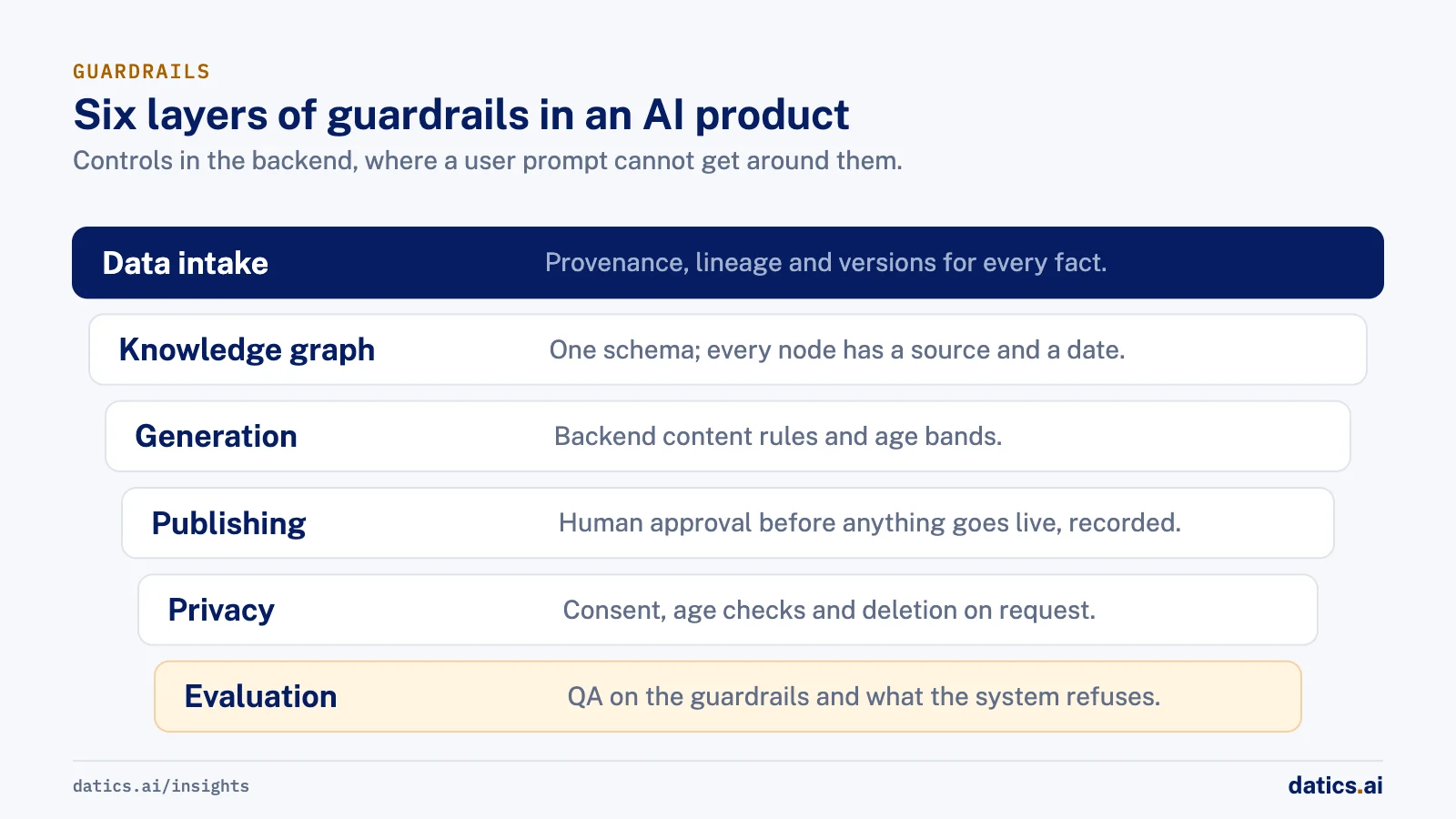
Guardrails also need to be specific to who is using the product. A tool for young children should generate differently by age group, use images from sources suitable for children, and avoid anything that requires reading skills the user does not have yet. Approval should sit with an adult: nothing goes online without a parent or supervising adult saying yes. Time limits and a lock that keeps a child inside the tool are part of safety too, not extras.
| Layer | Control | Question to ask |
|---|---|---|
| Data intake | Provenance, lineage and versions | Can we say where every fact came from? |
| Knowledge graph | One schema, normalized sources | Does every node have a source and a date? |
| Generation | Backend content rules and age bands | Can a user prompt their way around the rules? |
| Publishing | Human approval before anything goes live | Who approves, and is it recorded? |
| Privacy | Consent, age checks and deletion | Can we delete a child's data on request? |
| Evaluation | QA on guardrails and approval paths | Did we test what the system refuses? |
05Children's data raises the bar
In the United States, the FTC's Children's Online Privacy Protection Rule applies to operators of sites and online services directed to children under 13, and to operators that knowingly collect personal information from children. If your product may be used by young children, consent, age checks and deletion of a child's data have to be designed in from the start. They touch sign up, family setup, publishing and account management, and they are far harder to retrofit than to build. This is an area for your own legal counsel, and engineering should make whatever they decide easy to enforce.
06Test the guardrails, not only the features
A QA plan for an AI education product should spend as much effort on what the system refuses as on what it does. Try to generate content outside the age band. Try to publish without approval. Try to exceed the time limit. Try to reach another family's or another institution's data. Each of these is a test case with an expected result, run before every release.
07What we see in production
For a higher education technology leader's advisory firm building an AI-enabled B2B SaaS platform, a data engineer from our team works inside the client's own team, alongside its product manager and backend developer. In the first phase, the work was to collect public records from city-level sources in mixed formats, including web portals, CSV exports, APIs and PDF links. Those records were then normalized into JSON or SQL, with change detection added for periodic updates.
In the second phase, the work is to define the graph schema, normalize those sources into it, track versions and lineage, and work with the client's machine learning engineers on retrieval relevance. The client renewed into a second, larger contract. It is entirely data work, and it is where the trustworthiness of the client's AI platform is decided.
For a founder-led AI company, we built a child-safe website and game builder for kids, families and schools on the foundation of the company's consumer builder. Content rules sit in the backend generation flow, and generation is adjusted by age group, such as simple pop-up games for ages 4 to 6 and guessing games for ages 7 to 9. Pictures come from open, kid-friendly image libraries.
Nothing goes online without a supervising adult's approval, and daily time limits and a PIN lock keep parents in control. An age and consent check runs at sign up, and a child's data can be deleted on request. The product went live, and a full QA cycle passed through authentication, family setup, access controls, generation, editing and publishing.
Those content rules follow a written guardrails document and block unsuitable destinations and content categories in the backend, so no screen in the kids builder can get around them. Every change, including the production deployment pipeline, went through pull request review before it reached development or production.
For the same company's governed AI content platform, every claim in an answer carries a trust tier, a confidence score and a source reference. We wrote a provenance-first filtering approach so the record behind each claim stays attached as it moves through the system.
For K-12 platforms in particular, the same principle shapes how to add AI without touching student data.
Frequently asked questions
What does provenance mean for an AI education product?
Provenance means knowing where every piece of information came from, when, and how it was changed. Every record in your knowledge base or graph carries its source, its version and the steps that transformed it. With that in place, an answer can show its sources, and a wrong answer can be traced to the record that caused it.
Why should content rules sit in the backend?
Restrictions that live only in the interface can be bypassed by anyone who calls the API directly, or by a prompt that talks around them. In the backend generation flow, every request passes through the rules, so no screen in the product can get around them. This matters most for open-ended generators, such as website or game builders.
What changes when children use the product?
The bar rises. Generation should differ by age group, images should come from sources suitable for children, and nothing should go online without a parent or supervising adult saying yes. Consent, age checks and deletion of a child's data must be designed in from the start, with your own legal counsel deciding the rules that engineering enforces.
How do you test AI guardrails?
Spend as much QA effort on what the system refuses as on what it does. Try to generate content outside the age band, publish without approval, exceed the time limit and reach another family's or another institution's data. Each of these is a test case with an expected result, run before every release.
How Datics helps
Datics specializes in brownfield AI: bringing production AI into the product you already operate, without forcing a rebuild.
Related work
Case studies from our projects on the same subject.
Summers & Company
EdTech · Knowledge graph for an AI platform
An AI platform's knowledge graph, built on public data we structured first
The platform's AI needed public data scattered across many sources; we structured it first, then built the knowledge graph on top.
Builder Kin
EdTech · Child-safe AI website builder
Kids build websites with AI, and nothing goes online until a parent approves
Generative AI tools had no safeguards for children. Builder Kin restricts generation in the backend, and a parent approves every publish.
Insurance Sales Lab
EdTech · AI voice roleplay trainer
Insurance agents practice calls with an AI prospect, scored on the company's script
Practice used to wait for a human coach, and feedback varied. Now agents call an AI prospect any time and get the same checklist score.
More on EdTech
EdTech
EdTech AI for established platforms, without a rebuild
How established companies add EdTech AI inside the platform they already run: one buyer outcome, built on their own content, measured, then packaged.
Umair MajeedReadEdTech
AI in admissions: what enrollment platforms should build
AI in admissions works inside the enrollment platform: answers from each catalog, booked advisor calls, documents pre-filled for staff, and people deciding.
Umair MajeedReadEdTech
K12 AI: how vendors ship it without student data
K12 AI can start without student records: teacher, parent and admin features first, synthetic data for testing, your cloud, and a person before any student.
Umair MajeedReadEdTech
Student information system AI: let staff ask the data
Student information system AI lets staff ask plain-English questions inside their existing permissions, answered as tables with the query shown and local terms.
Umair MajeedReadEdTech
Skills based training: prove skills, not course completions
How corporate training platforms add AI for skills based training without a rebuild: course drafts, skills mapping, scored practice and admin approval.
Umair MajeedReadEdTech
Teachers already use AI. Bring it inside your learning platform without a rebuild.
You add AI to an established learning platform by building on what it already has: your content library, your classes and rosters, your gradebook and your integrations. The AI drafts lessons, quizzes and feedback from that material. Teachers approve the work before any student sees it. Nothing about the platform has to be rebuilt.
 Rana Umar MajeedRead
Your customers already expect AI from your product.
Let us make it real without rebuilding what already works.