
EdTech
Teachers already use AI. Bring it inside your learning platform without a rebuild.
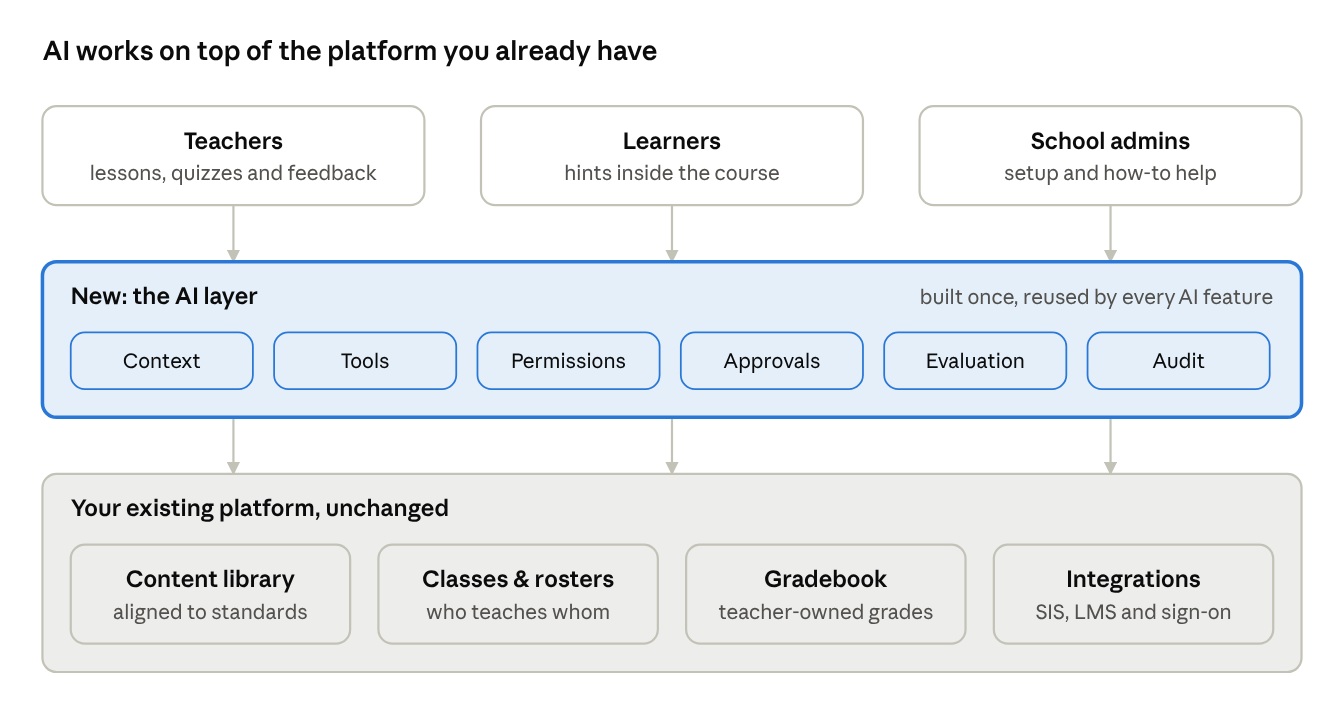
You add AI to an established learning platform by building on what it already has: your content library, your classes and rosters, your gradebook and your integrations. The AI drafts lessons, quizzes and feedback from that material. Teachers approve the work before any student sees it. Nothing about the platform has to be rebuilt.
Teachers decide. AI does the drafting.
Why learning platforms feel stuck on AI
If you run an LMS, a courseware product, or a maths, literacy or STEM platform, you have probably heard the same question at every renewal: what is your AI plan?
The question is fair. Teachers already use general AI tools to draft lessons and quizzes. They copy content out of your product, paste it into a chatbot, and paste the result back in. The work happens outside your platform, and so does the value.
The obvious answers both hurt. A chatbot added to the side of the product cannot see the course, the class or the standards it is meant to support. A rebuild puts years of aligned content, district integrations and student data agreements at risk for a feature that customers wanted this year.
A general AI tool has none of that. Your platform has all of it. The job is to let AI use it safely.
The advantage you already have is not a model. It is years of aligned content, real classes and the trust of districts.
The four places AI helps a learning platform first
The best first uses save teachers time on work they already do inside your product. Each one builds on content and data the platform already holds.
- 01
Lesson and quiz drafting from your own content
A teacher picks a unit or a standard. The AI drafts a lesson outline, a practice set or a quiz from your aligned content library, not from the open web. It can also draft versions at different reading levels for the same class. The teacher edits and publishes.
- 02
Feedback drafts against the rubric
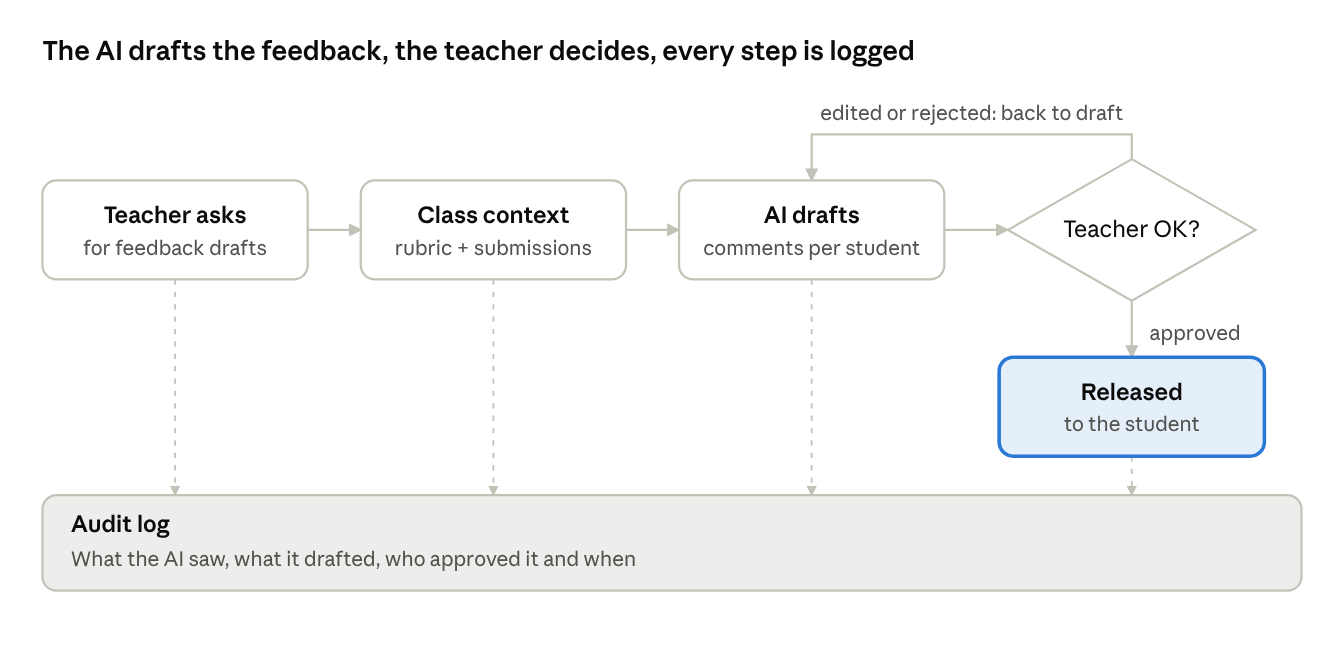
The AI reads a student's submission and drafts comments against the teacher's rubric. The teacher reviews, changes what they want and releases it. The grade stays the teacher's decision.
- 03
An in-product guide for teachers and admins
Teachers and school admins often use only part of what the product can do. A guide inside the product can answer "how do I set up this course?" or "where do I assign this to one group?" using your own help content. Better use of the product shows up at renewal time.
- 04
Learner hints grounded in the course
A student who is stuck gets a hint drawn from the lesson they are on, not the answer. The hints follow the course's own method, respect age rules, and hand the student back to the teacher when needed. This is the most visible use, so it should come after the teacher-side ones are proven.
Where to start: teacher first, records last
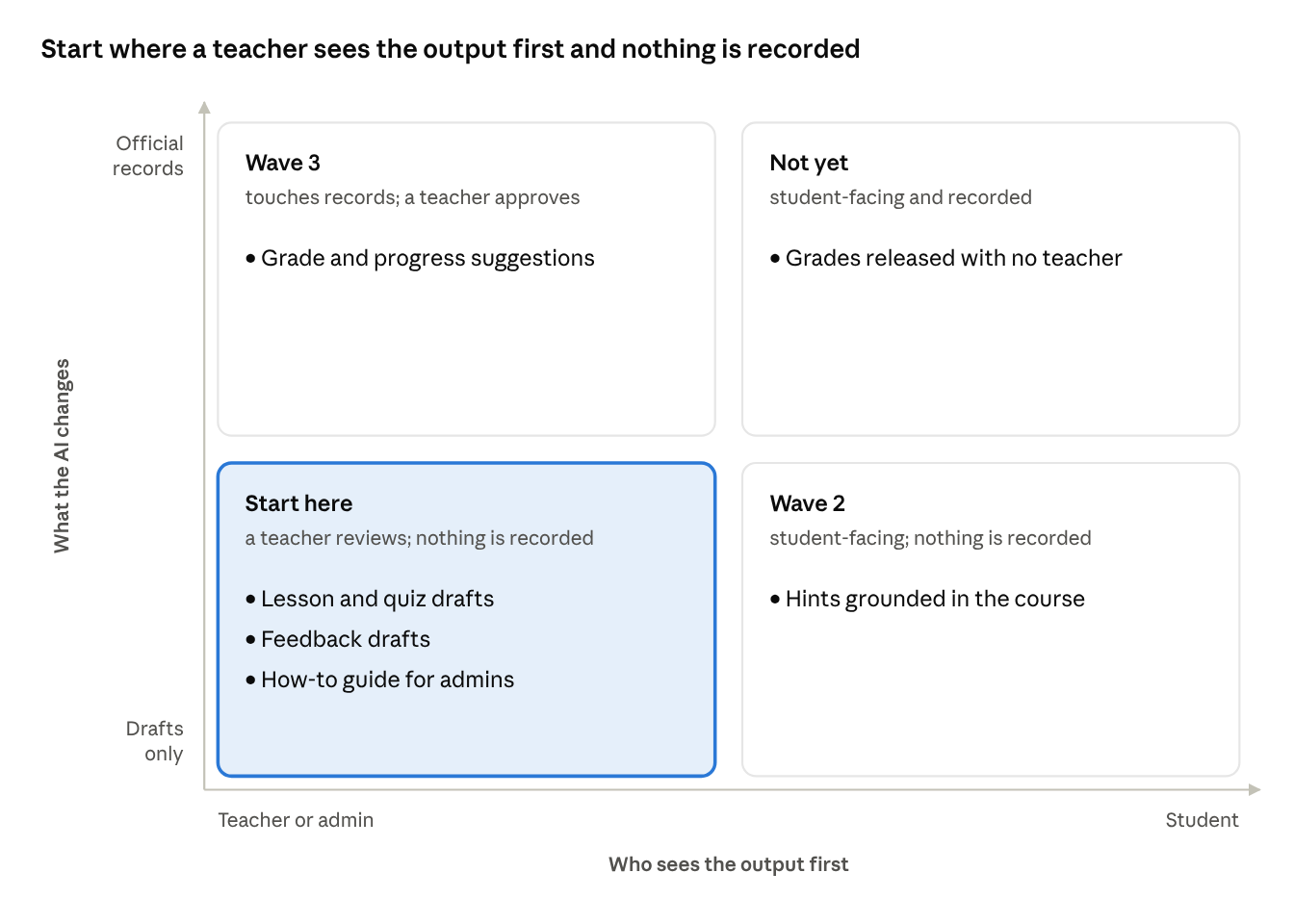
Two questions decide the order. Who sees the AI's output first: a teacher or a student? And does it only draft something, or does it change an official record such as a grade?
Start in the lower left, where a teacher checks every draft and nothing is recorded. Move right and up only when the first wave has earned the trust.
What the AI needs from the platform you already have
AI that works in a classroom is mostly the system around the model. In a learning platform, most of that system already exists:
The work is to connect the AI to these pieces, not to rebuild them. Here is how that looks for feedback drafts.
The AI never releases anything on its own. An edited or rejected draft goes back, and every step lands in the audit log.
- Context: the course, the unit, the standards and the class the teacher is working on.
- Tools: your own APIs to create a quiz, post a comment or update a lesson.
- Permissions: the roles you already enforce for teachers, students and admins.
- Approvals: a teacher step before anything reaches a student or the gradebook.
- Evaluation: checks on reading level, alignment and tone before a draft is shown.
- Audit: a record of every draft, approval and change.
Education controls belong in the first release
A district will ask how the AI handles student data before it asks what the AI can do. These controls belong in version one:
Good engineering makes compliance easy to enforce and easy to prove. It does not replace your legal and privacy review.
- Data stays inside the district. The AI reads only what the signed-in user can already see. One district's content and student work never reach another's.
- Your roles apply. A teacher's AI works on that teacher's classes. A student's AI sees that student's work.
- Teachers approve what students see. Drafts, feedback and anything that touches the gradebook wait for a teacher.
- Age rules shape the design. Rules such as COPPA for children under 13 and FERPA for student records decide what data the AI may use and where it may go.
- Accessibility holds. New AI screens meet the same accessibility standard as the rest of the product.
- Every action is traceable. The log shows what the AI saw, what it drafted, who approved it and when.
Ship it in three waves
A rebuild asks customers to trust a year of work at once. Waves ask them to trust one feature at a time.
Measure each wave on the teaching work, not on AI usage. Useful measures are the share of drafts teachers keep with light edits, the time a task takes, and how often teachers reject or rewrite the AI's work. If a measure does not improve, the wave stays small until it does.
- 01
Teacher-side drafts
Start with lesson, quiz or feedback drafts for a small group of schools, behind a feature flag. Teachers see everything first.
- 02
Learner support
Add course-grounded hints in one subject and grade band, using what wave one taught you about quality and tone.
- 03
Actions that touch records
Only then let the AI suggest grades or update progress, and still only after a teacher approves.
"Our AI drafts the quiz and the teacher decides" is a stronger answer for a district buyer than a broad promise.
How Datics helps
We run a 30-minute product review of your learning platform, then an AI-Native Sprint that names the first capabilities, the unlock work behind them and the first wave into production, inside the platform your schools already use.
Related answers
Workplace learning
Course completions won't renew your contracts. Proven skills will.
You add AI to an established corporate training platform by building on what it already holds: each customer's course library, their roles and skills framework, their completion records and their HR integrations. The AI drafts courses from the customer's own material, maps learning to skills and explains progress to managers. Admins approve what goes live. The platform does not need to be rebuilt.
Read the answerBrownfield AI
How to add AI agents to an existing SaaS product without rebuilding it
A practical route to shipping AI agents inside an established B2B SaaS product: use the existing permission model, integration layer and business logic instead of rebuilding around the model.
Read the answerProduction AI
Why AI Agents Fail in Production: It's Not an Intelligence Problem
As AI moves from answering questions to taking actions, production success depends less on model intelligence and more on deterministic control around identity, authority, state, recovery and audit.
Read the answerYour customers already expect AI from your product.
Let us make it real without rebuilding what already works.