
Healthcare practices
How much time does AI clinical documentation save?
The AI drafts the note. The clinician signs it.
 Umair MajeedCo-founder and CEO, Datics AI7 min read
Short answer
AI clinical documentation saves less time than many vendor claims suggest, and more for heavy users. In a 2026 JAMA study of 8,581 clinicians at five academic health systems, AI clinical documentation scribes were associated with 16 fewer minutes of documentation time per 8 hours of scheduled patient care. Clinicians who used them in at least half of visits saw three times that reduction. The Permanente Medical Group estimated 15,791 hours saved in its first year.
On this page
01How much time AI clinical documentation saves, by the evidence
The honest answer depends on which study you read and how much clinicians actually use the tool. Two sources are worth reading closely, and they measure different things.
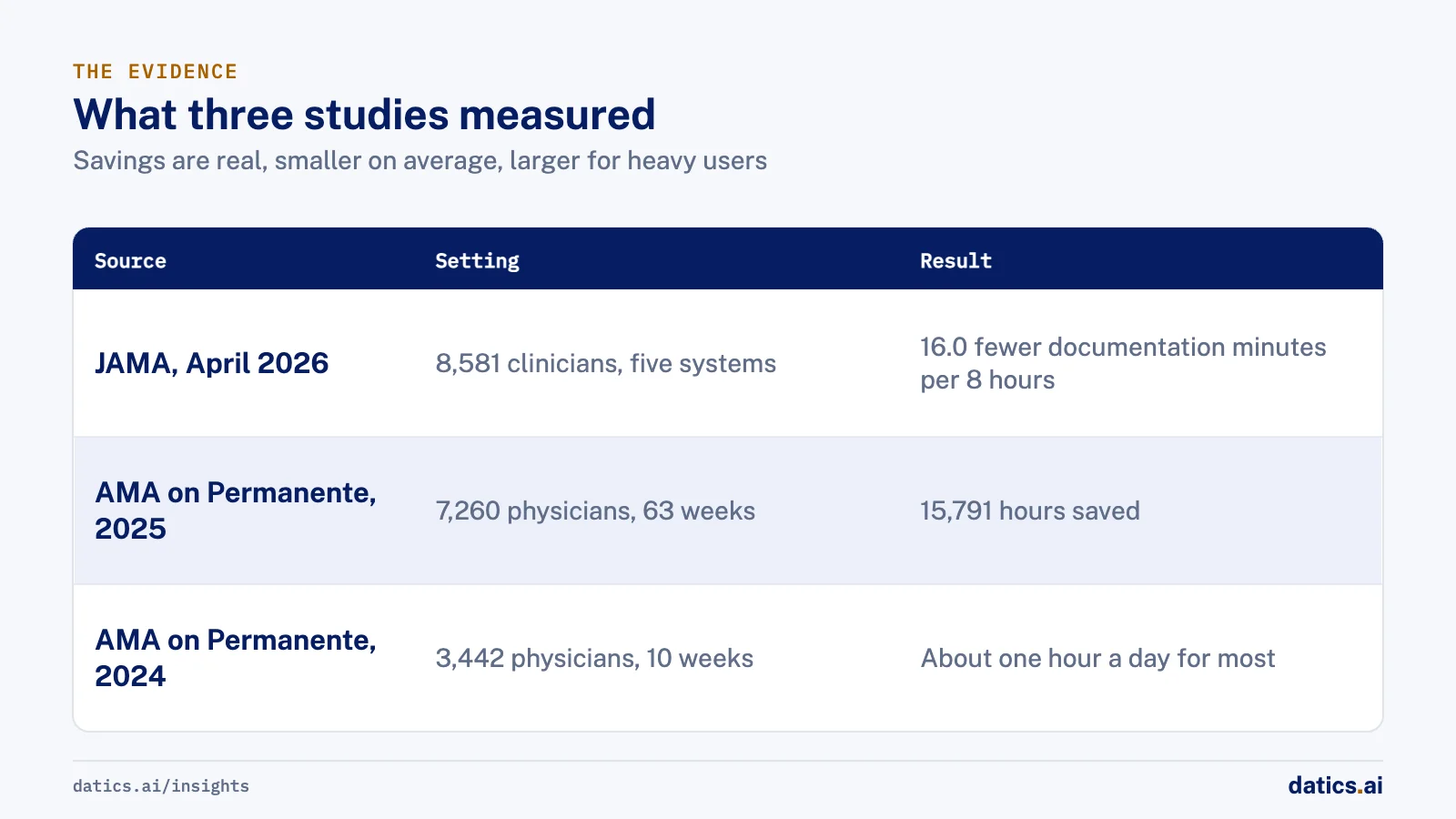
The largest multisite comparison we found was published in JAMA in April 2026 by Rotenstein and colleagues. It followed 8,581 ambulatory clinicians, including 1,809 who adopted AI scribes, at five U.S. academic health systems that introduced the tools between June 2023 and August 2025. Adoption was associated with 13.4 fewer minutes of total EHR time and 16.0 fewer minutes of documentation time, normalized to 8 scheduled patient hours, plus 0.49 additional visits per week.
EHR time outside work hours did not change significantly. The authors call these modest decreases. The gains were greatest for primary care, advanced practice clinicians, female clinicians and those who used the scribe in 50 percent or more of visits. Those clinicians saw twice the reduction in total EHR time and three times the reduction in documentation time.
The second source is The Permanente Medical Group. As reported by the AMA in June 2025, a follow-up analysis estimated that ambient AI scribes saved its physicians 15,791 hours of documentation time over 63 weeks, from October 2023 to December 2024. That is the equivalent of 1,794 eight-hour workdays. In that period, 7,260 physicians used the technology across 2,576,627 patient encounters. The top third of users accounted for 89 percent of activations and saw more than double the time savings per note. Pajama time, after-hours work, note time and order time fell, while in-basket time rose slightly. In surveys, 84 percent of physicians reported a positive effect on communication with patients and 82 percent said their work satisfaction improved.
An earlier AMA report, from March 2024, covered the first 10 weeks of that rollout. In that time, 3,442 physicians used the scribe in 303,266 encounters, and most of them saved an average of one hour a day at the keyboard. The article does not explain how that figure was measured, so we treat it as an early signal rather than a benchmark.
| Source | Setting | What was measured | Result |
|---|---|---|---|
| JAMA, April 2026 | 8,581 clinicians at five academic health systems | EHR and documentation time per 8 scheduled patient hours | 16.0 fewer documentation minutes; no significant change after hours |
| AMA on Permanente, June 2025 | 7,260 physicians, 63 weeks | Estimated documentation hours saved versus nonusers | 15,791 hours, or 1,794 eight-hour workdays |
| AMA on Permanente, March 2024 | 3,442 physicians, 10 weeks | Time at the keyboard | Most users saved about one hour a day |
The pattern across all three is consistent. Average savings are real but smaller than headlines suggest, and the clinicians who use the tool on most visits get most of the benefit.
02Where the time actually goes
A note is not one task. The time a scribe can save depends on which steps it touches, and on whether the steps it creates cost more than the ones it removes.
- 01
Capturing the visit.
The scribe listens, so the clinician types less during the encounter and looks at the patient more. Permanente patients noticed: 47 percent said their doctor spent less time looking at the computer.
- 02
Drafting the note.
The model turns the conversation into a structured draft. This is where most of the measured savings come from.
- 03
Reviewing and editing the draft.
This step is new work. In the Permanente rollout, infrequent users said that editing AI drafts took longer than typing their own notes, and that the drafts fit poorly with their note templates.
- 04
Orders, coding and follow-up.
Some tools help here, but these steps often stay manual.
- 05
The inbox.
Patient messages and results are untouched by a visit scribe, which may be why in-basket time did not fall at Permanente and after-hours EHR time did not change in the JAMA study.
For a practice software company, that list is the product brief. The minutes are won or lost in step 3, and step 3 is a product design problem, not a model problem.
03What practice software teams should build
If you sell software to dental, veterinary, therapy or medical practices, the question is not whether to offer AI clinical documentation. It is how to make the review step fast enough that clinicians use it on every visit, because the evidence says frequency is where the time savings come from.
Accuracy is the first design constraint. The AMA's 2024 report noted that most notes were accurate, but a tiny percentage contained hallucinations. Examples included a scheduled prostate exam recorded as performed, or a discussion of hand, foot and mouth issues summarized as a diagnosis of hand, foot and mouth disease. Errors like these are exactly why the clinician must review and approve every note before it enters the record.
Consent is the second. Permanente obtained patient consent before using the scribe in a visit, gave patients a one-page handout and put up posters in its facilities. Your product should make consent part of the workflow and record it with the encounter.
In practice, that means building:
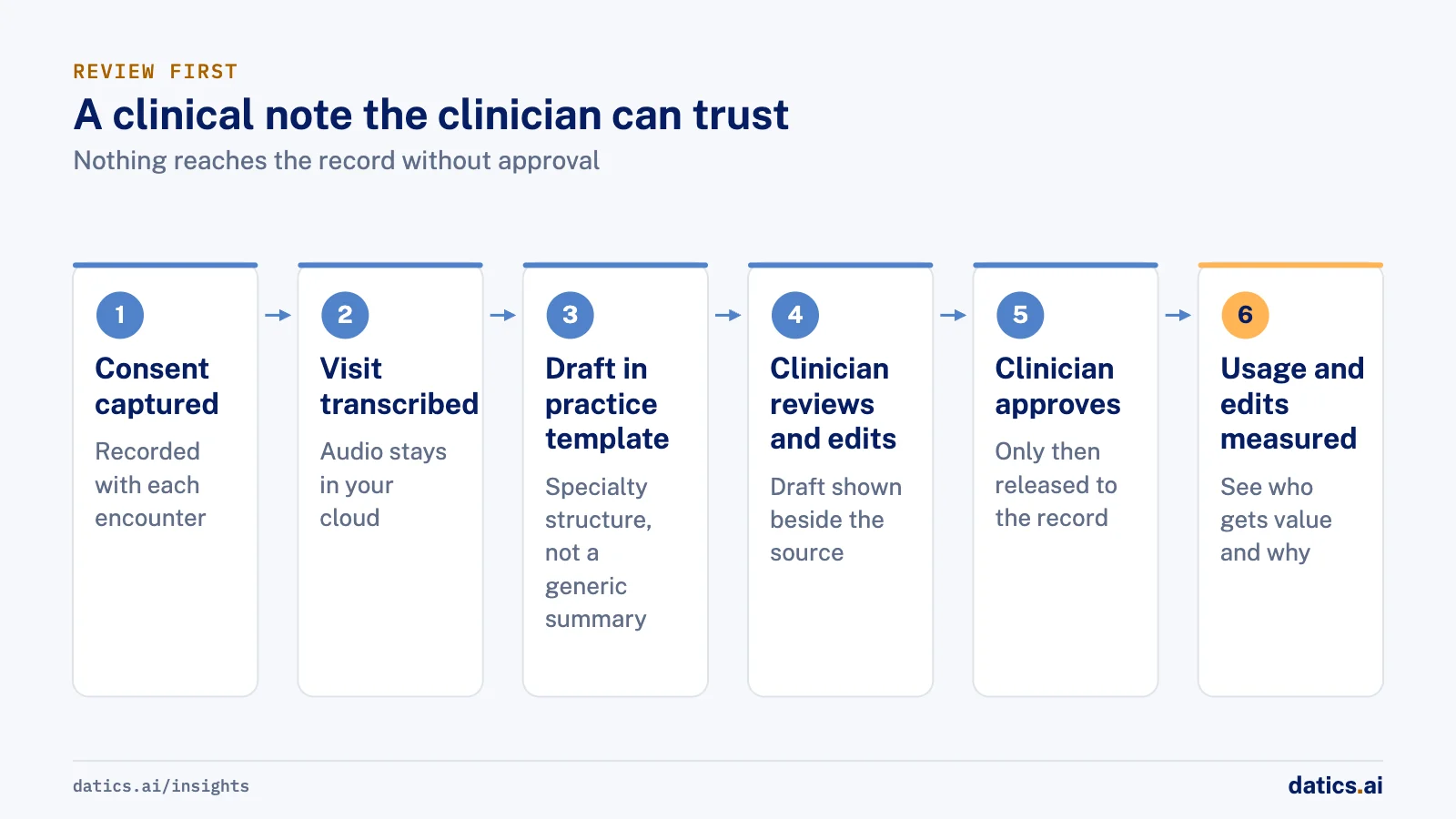
- Drafts in the practice's own note templates and specialty structure, not a generic summary.
- A review screen that shows the draft next to the source, highlights uncertain sections and makes editing faster than typing.
- An explicit approve step, with nothing released to the record until the clinician signs.
- Consent capture tied to each encounter.
- Measurement of edit rates and usage per clinician, so you can see who is getting value and why others stop.
04HIPAA and where the audio goes
Visit audio and draft notes are protected health information, so the data path matters as much as the model. Under the HIPAA definitions in 45 CFR 160.103, a business associate is a person or company that creates, receives, maintains or transmits protected health information on behalf of a covered entity for a regulated function. A subcontractor that does the same on behalf of a business associate is a business associate too.
For a practice software vendor, that usually means the chain looks like this. The practice is the covered entity and your company is its business associate. Any cloud or model provider that processes the audio or notes for you is a subcontractor in that chain. Each link needs a business associate agreement. AWS, for example, describes itself as a business associate under its Business Associate Addendum, and says protected health information should only be processed, stored and transmitted in services it lists as HIPAA eligible, under a shared responsibility model.
A business associate agreement is necessary but not sufficient. You still decide where audio is stored, how long it is kept, who can access it and whether it is used for anything beyond the note. Have your counsel confirm the specifics for your product; this is the architecture question, not legal advice.
05What we see in production
We have built this pattern for practice software. In a dental clinical documentation product, live transcription and the patient's history are used to draft clinical notes, and the dentist reviews, edits and approves each note before it is released. On a multi-clinic intake product, the AI work only became a real SaaS product once clinic isolation, role-based access, onboarding and provider configuration were in place. On a practice communications platform for dental and veterinary practices, the AI call intelligence connects to the practice-management systems the platform already supports and runs HIPAA-aligned inside the customer's cloud.
Three habits carry across this work. The AI runs in your cloud, on your model, by default, so protected health information stays inside the boundary your agreements already cover. Our engineers have no standing access to client production data. And the clinician, not the model, is the last step before anything reaches the record.
The same boundary held on a HIPAA project outside the exam room. We built a physician contract extraction pipeline under a signed business associate agreement, in the client's own GitHub and restricted AWS account, and it returns an empty field rather than a guess when a contract does not state a term.
We do not publish estimated outcome percentages, so we will not quote a minutes-saved figure for our own builds. What we measure in a project is whether clinicians keep using the feature, how much they edit the drafts and what each successful note costs to produce. The cost side is covered in how much production AI costs in SaaS, and adding this kind of capability to an existing product is covered in how to add AI agents to an existing SaaS product without rebuilding it.
Frequently asked questions
Do AI scribes reduce after-hours charting?
The evidence is mixed. The 2026 JAMA study found no significant change in EHR time outside work hours across five health systems, while The Permanente Medical Group reported reductions in pajama time and after-hours work among its users. Results depend on how often clinicians use the tool and what else fills their evenings, such as the inbox.
Does the clinician still need to review every note?
Yes. The tools produce drafts, and published reports include examples of notes that recorded things that did not happen. The product should make review fast and require an explicit approval before a note enters the record. Accuracy is the first design constraint, and the clinician, not the model, is the last step before anything reaches the record.
Is AI clinical documentation HIPAA compliant?
A tool is not compliant on its own. What matters is how it is deployed: business associate agreements across the chain, protected health information kept in eligible services, access controls, retention rules and audit logs. The vendor and the practice share that responsibility.
How Datics helps
Datics specializes in brownfield AI: bringing production AI into the product you already operate, without forcing a rebuild.
›References (5)
- JAMA: Changes in Clinician Time Expenditure and Visit Quantity With Adoption of AI-Powered Scribes (Rotenstein et al., 2026)
- AMA: AI scribes save 15,000 hours, and restore the human side of medicine
- AMA: AI scribe saves doctors an hour at the keyboard every day
- 45 CFR 160.103, HIPAA definitions (Legal Information Institute, Cornell Law School)
- AWS: HIPAA compliance
Related work
Case studies from our projects on the same subject.
Peerlogic Technologies
Healthcare & Wellness · Practice call intelligence SaaS
Our engineers inside Peerlogic's team turn raw phone events into trusted call records
Each phone system reported calls its own way. Now raw events become validated records that Peerlogic's dental and vet call AI relies on.
MIRA
Healthcare & Wellness · AI patient intake
Pain physicians start each visit with an AI summary of the patient's history
Pain histories used to be taken in the room. Now patients answer adaptive questions first, by tap or voice, and AI drafts the summary.
Datascape
Healthcare & Wellness · Contract data extraction pipeline
Compensation terms read from any physician contract, built inside the client's HIPAA cloud
Extraction code broke whenever a contract changed layout. One RAG pipeline now reads any contract, inside the client's own AWS account.
Your customers already expect AI from your product.
Let us make it real without rebuilding what already works.